Showing posts with label special effects. Show all posts

Thursday, February 26, 2015

Green Screen

For my blog this week I thought it would be a good idea to talk about green screening because we will be doing this for our film.

How a green screen works:
Firstly Green screening has many different names. Chromakeying and color keying are two different names. This is the process of singling out a particular color in an electronic image and then using computer software to make that color transparent. This allows another image, which can be just about anything you can imagine, to show through.


This sounds very simple and it is for the most part, but there are some things that can make in complicated.


Firstly is lighting the Screen. If the screen is not evenly lit this can cause issues because there will be different shades of green resulting in different variations of transparency. This can completely mess up a chromakey.

Make sure to light your screen properly!

A second issue is lighting you subject to match the image you are superimposing over the green screen. If the light, color, and shadows of the subject don't match, your audience will notice and t will effect your picture. 

Make sure to light your subject according to your setting!

Finally edging. When using a green screen the color of the green can reflect on the edges of objects causing them to also become slightly transparent. This is fairly unavoidable but can be fixed in post with some work. 

Friday, September 5, 2014

How Much Special Effects is Too Much?

We are in an odd time for film where many films are created with the use of so much green screen and special affects that it's become frieghtning to some filmmakers. Directors like Quentin Tarantino will one day leave the industry because of the increase in special affects and the decreasing use of film in the medium. Some say it is the death of cinema and to a degree I would agree. Cinema as we knew it is dead, but it is not gone.


With superheroes soaring over the box office it's no surprise why cgi and special affects are dominant in the industry today. But the question is can there be too much of it? Well lets look at a some examples. If you compare the Star Wars prequels to the original trilogy it is easy to see that the more recent films use a ton of cgi and special affects. And because of that so many fans of the series will immediatley credit that to why the prequels are abysmal compared to the original trilogy. The way I see it is the reason those films are not as great is because of a lot of other issues that could be discussed for hours on end. But in short that is not even close to why those films are not amazing. I'm not saying that there can be bad cgi and special effects. Oh no there can be really bad special affects that can ruin a whole movie (I'm looking at you The Mummy Returns) but as time progresses the use of cgi only helps the film industry.


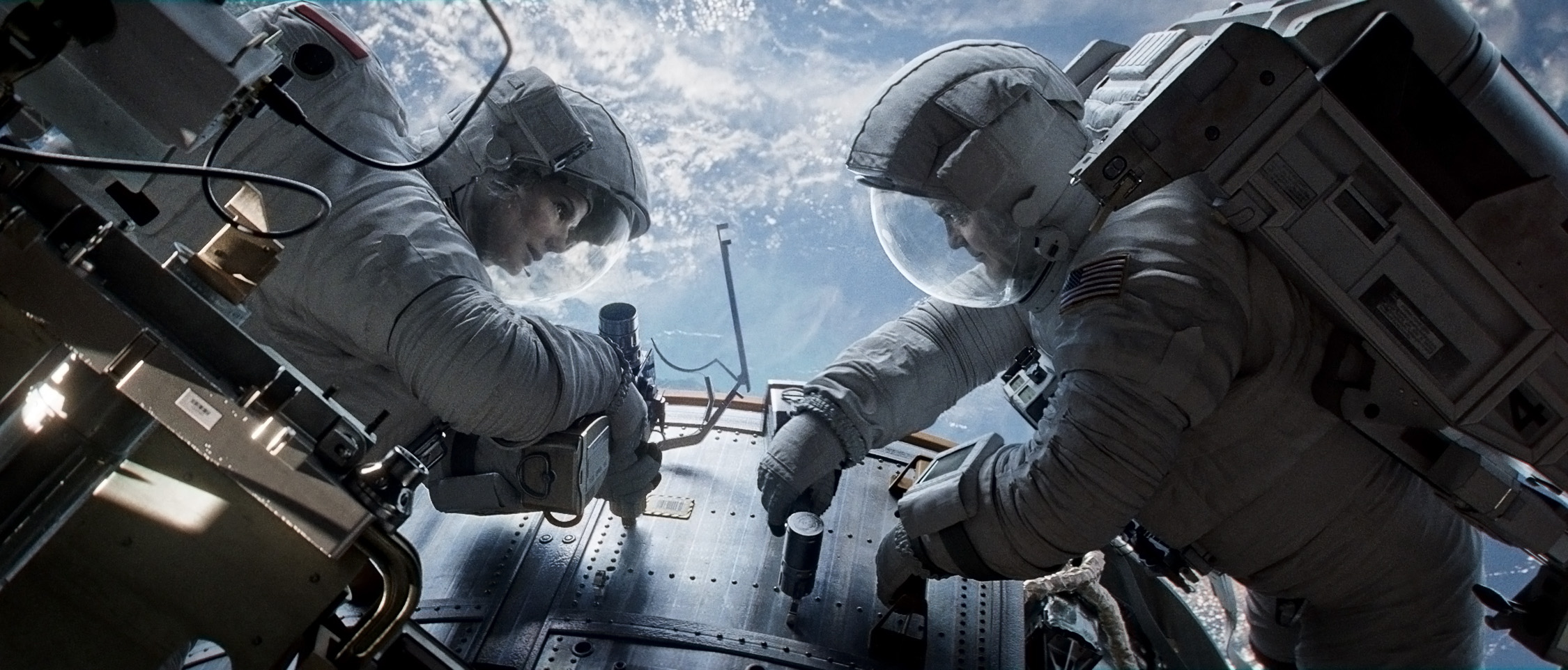
Stories, stories and more stories. I said it now and I will say it again, with more ways and deviations to creating a film the more different stories can be told. Look at Gravity and ask yourself if that movie could have been created ten years ago. Or Life of Pi? Both of these films used so much cgi and special effects that it becomes hard to know what's real and what isn't. Without special effects both of these films would not exist. It's all about how you go about using them really. Look at The Guardians of the Galaxy and Dawn of the Planet of the Apes and their use of special effects. It may sound dumb but both of these films made me cry. And the even worse part is that it wasn't the human actors that made me cry, it was a talking tree, a talking raccoon and a talking monkey (this is just as hard for me to type as it is for you to read). The use of motion capture has advanced so far that these creations have become believable and at times really something special. So at this moment in time it's not about how much special affects you want to use but how you go about using it. Write a good story, with great characters, make a film beautiful, and then you can add as much special affects as your little heart desires.


Friday, April 11, 2014

The Grand Guignol: Not for the Faint of Heart

Le Théâtre de Grand-Guignol, literally translated from French as "The Theatre of The Big Puppet Show", was a theatre that formed in a chapel inside Paris' red light district in the late 19th century. Renowned for it's displays of graphic horror and gore, the theatre gained a large cult following. It's actors (no, they weren't puppets) simulated astonishingly realistic acts of violence and sex such as hangings, stabbings, rape and all kinds of beatings.

The shows were so terrifying for it's audiences that it was common that at least two people fainted during the performances, many times up to fifteen people per night. Even the actors were injured and sometimes killed because of the shows. A doctor was kept on call every night in case of these events.

The Grand Guignol eventually closed in the sixties, unable to compete with the effects of cinema. But, the subgenre of horror movies known as splatter film was heavily influenced and based on the naturalistic effects invented at The Grand Guignol. Things such as inflatable animal bladders and pumps hidden under actor's clothes to spew out blood when cut were used at the theatre and adapted for the screen.
        

Many of today's splatter films such as the Saw franchise and movies like The Evil Dead were impacted by the shock factor that The Grand Guignol brought. The gore we know today started on the stage, and grew into a cinematic genre all of its own. The theatre pushed their actors and their audiences to the limits, exploring the horrific and bizarre, paving the way for horror cinema. Now, The Grand Guignol has reopened for special performances, allowing audiences to see what inspired the great gore films throughout history.

Friday, February 7, 2014

Visual Effects Breakdowns

The amazing part about TV shows and movies today is how visual and practical effects can expand the scope of a story. The abundance of this accessible technology allows TV shows to use what was, for a brief period of time, a costly technique that was usually reserved for movies. Like most things in cinema and film, the less obvious the CGI, the more power it gives to the scene. Good green screen use can make or break a scene and in a show like "Game of Thrones" the CG makes scenes more than the actors do. The show employs a company called Spin VFX for their visual effects needs. Spin VFX have created visual effects for a number of TV shows and films that include After Earth, Max Payne, and Titanic. The men behind the magic are VFX Supervisor Doug Campbell and Supervising Producer Luke Groves. Campbell has been nominated for 5 primetime Emmys and Groves has 3 nominations. The following video is a deconstruction of the visual effects that appear in the show during its third season.

Crazy right? They do such a good job that you don't even know where the effect ends and begins until they remove the key. In certain scenes it's easier to tell than others but for the most part it's pretty damn good. One thing I noticed that was interesting is that in scenes where the final shot needs to take place at night (such as the man walking up the stair case with the green screen behind him or in some of the wide shots of the castle and surrounding camps) the scene is well lit and then darkened by the VFX team in post. I can only assume this ensures that no matter how much the brightness is affected in post, the lighting off the actor's face and surroundings are well lit for the viewer. For further viewing and reading the link to Spin VFX website is right  HERE. What I find fascinating is the ability to peel back a layer of a tv show and have an entirely new appreciation for the work that goes into what we watch. For instance, the scene in the video where they are climbing the 700 foot ice wall was composed of 80 shots...whoever figured these techniques out is a gosh darn genius. 

Friday, October 25, 2013

The Golden Age of Special Effects.

We live in an age of CGI. Hollywood studios have been finding that it is a lot easier to CGI a bunch of enemies or explosions or anything in action and Sci-Fi films. Unfortunately I am one of those people that have not really enjoyed these transitions. Almost all of my favorite action and fantasy films took place in the mid-2000's. Lord of the Rings, Kingdom of Heaven, Mask of Zorro, The Bourne Trilogy. These films had a sense of realism to them that a lot of the more modern action films don't.

Although I thoroughly enjoyed The Hobbit, an Unexpected Journey, the excessive use of animation really took me out of some of the scenes. There were scenes that were exclusively CGI and since I knew it was all CGI, all suspense was immediately taken out of the scene. I think the reason why I enjoyed the big budget action films of the 2000's was because special effects were not good enough at that point to completely shoot a scene, but could only be used to enhance scene. Give them that extra something if you will. For an example I have added two scenes, both from director Peter Jackson, one from the Hobbit done completely in CGI and one from The Fellowship of the Ring, decide for yourself which one has more tension.


Hopefully, you agree with my opinion that the second clip is much better. Mainly because of the lack of frame cluttering. It's almost as if Peter Jackson told the animators to put as much stuff in the frame as possible. This excessive animation really makes it difficult for me at least to get personally involved in the scene. The sad part is, is that a scene shot in a forest with a bunch of guys in costume did so much more for me than and thousands of dollars of animation could.

I am going to bring up a point here that might cause some contention. As some of my classmates have already stated, they really did not like the film Pacific Rim, and while by no means did I think it was a great film. I found it to be very enjoyable and worth the money I spent in the theater (mainly cause I didn't watch it in 3D). Now obviously this film relies on CGI like it is nobody's business, but the thing I found interesting after looking a bit further into the making of the film was that director Benicio Del Toro made a conscious effort to make the cockpits of the Jaegers a real set and the enhance it with CGI. Here is a clip about building the set.


Now I thought that was pretty amazing. Especially because of the lack of necessity. They were already making an extremely CGI heavy set, Del Toro could have just as easily had the actors put in a green screen environment and done everything in post, but he said no. I want to add a sense of realism in an otherwise unrealistic film. This went as far as to make real functioning pilot suits and helmets

Well for those of you who have stuck through this whole post and watched all the videos and listened to all my wild comments I say thank you. I always appreciate a good debate, so if someone has a conflicting idea I'd love to hear their arguments. After all, we're here to learn.

Friday, October 11, 2013

Gravity: A Movie Out of this World

 
Cut to black. Credits roll. I usually stay through the credits when I see a movie. I mean, I want people to stay through the credits when my name is up there. But I didn't just stay through the credits. I stayed about ten minutes after the credits ended, until the man trying to clean up asked my friends and me to leave. The words spoken between us were few in that car ride home. We were actually speechless, completely shocked by what we just experienced. We needed to take it all in.

I knew Gravity would be incredible, but I did not expect to leave feeling the way I did. To be truthful, I've never left a movie theater feeling that way. I imagine it's how audiences, back in the start of cinema, felt when a train went by and they thought it was going to hit them. Or possibly how the audiences at the first Star Wars film felt. But this, this was unlike anything I have ever seen.

The story was nothing we haven't seen before. Astronauts up in space. Something disastrous happens. Stuck up there, trying to survive. Even down to the George Clooney character, Kowlaski, of the veteran astronaut in a state of nostalgia on his last mission to space. Nonetheless, I was sucked into this world. Completely captivated by the world Alfonso Cuarón created within minutes, I can only really describe the experience as an hour and a half long anxiety attack...in the best way possible, of course.

The movie is easily Sandra Bullock's best work. I so quickly felt connected to her character, Stone, despite barely being able to see her face through her spacesuit. Cuarón pushes her to new levels that we've never seen from her as an actress. She has my full support for the Oscar for Best Performance by an Actress in a Leading Role. But I could go on about how incredible Gravity is forever. So I'm sticking to the opening shot. The 17-minute take is an absolute masterpiece, shot by cinematographer Emmanuel Lubezki. Beware: spoilers of the first 17 minutes of the film lie ahead.

The film opens to a shot of earth from space, which is the most realistic earth I have ever seen. Slowly, signs of life begin to emerge, as we hear faint radio chatter and a distant space shuttle, satellite, and astronauts enter into frame. While Kowlaski jokes around with mission control, Stone clings onto the telescope, having minor health issues and struggling to fix a component. The camera weightlessly glides from each character, almost as if it drifts along in space with everything else.


The tranquil scene is disrupted when mission control tells them to abort the mission, explaining that debris from a broken satellite has created a domino effect. Before they get the chance to make it back to their shuttle, the debris arrives bringing a deadly hail of missiles towards them. The camera pans to the astronauts who try to evacuate, with debris flying past them, so realistic that I flinched.

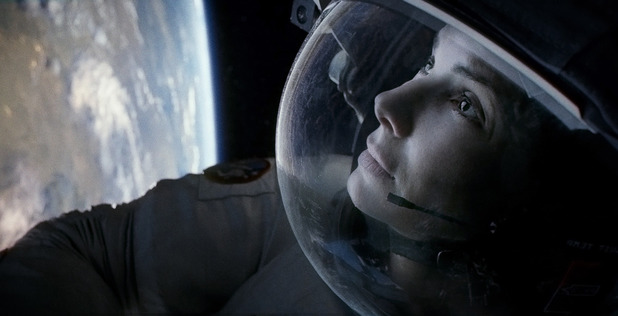
When something big crashed into the shuttle, it starts spinning, bringing Stone with it. The camera watches as she spins around and around with earth in the background. When something else crashes into the shuttle, the arm attaching Stone to the shuttle breaks off. The camera fluidly focuses in on Stone and begins to spin with her, close up on her terrified face. Then seamlessly, the camera turns, as if moving naturally in zero gravity, making its way behind Stone's glass. Now inside her space helmet, we see the background turn from space to earth to space to earth as we move with her. Over the radio, we hear Kowlaski tell her to detach herself before she gets too out of reach, so she does and the camera breaks away from her as she tumbles away from earth. She gets smaller and smaller until finally the camera cuts.


The genius of such a long, cinematically fascinating shot is that it brings the audience directly into the story. First, we are slowly introduced to the environment and then suddenly shifted right into the action. The cinematography of the long and thorough shot made you feel as though you were right there with these characters, experiencing this horror with them. Absolutely brilliant.

If you haven't already, you need to go see this movie. It is a revolutionary cinematic experience with groundbreaking special effects. Gravity might just be the most technologically impressive films ever made. It isn't often that you can walk out of a movie thinking, "How in the world did they do that?" You can place you bets on Gravity for all major awards in the categories of cinematography and visual effects. Go see it, and see it in 3D.

Lastly, the only negative reviews I have read of the film are about the scientific inaccuracy of some of the events. It almost angers me how stupid that is. If you're looking for a science lesson on space, go watch some informational documentary or rent a book or something. Nobody's going to this movie expecting to leave understanding outer space. This movie is made for entertainment. And truth be told, it is one of the greatest pieces of entertainment that society has ever seen. Gravity is out of this world. Pun intended.

Friday, September 27, 2013

Lucasfilm Predicts the Future

There have always been three stages to the filmmaking process: pre-production, production, and post-production. These three components rely on each other to create a polished final product. Regardless of being a documentary, a promotional video, or feature film, all film productions require these three steps. 

"Over the next decade video game engines will be used in film-making, with the two disciplines combining to eliminate the movie post-production process."


This is the ambitious claim made by Lucasfilm, the production company behind the Star Wars franchise. 


Speaking at the Technology Strategy Board event at BAFTA (British Academy of Film and Television Arts), the company’s chief technology strategy officer, Kim Libreri, introduced a new style of filming: 


As you can see, the company has figured out a way to implement special effects in real-time, moving a large amount of post-production work into the pre-production and production phase. Although Lucasfilm is able to show off this technology now, it is still more of a future concept and calling it a complete replacement to post-production is laughable. As you can see from the video, the graphics are not exactly feature-film quality. But this is, more then anything, is a sign of things to come. It could also be considered an advanced style of storyboarding, enabling special effects artists to see their work before actually implementing it.  


All of the effects in the video have been possible in the past, except before you had to process, tweak, and render the footage. Now they are able to do it incredibly faster to the point where it's instantaneous. In movie making time is money, so what this means is that films will be able to implement special effects on a much smaller budget. I know some people favor practical effects so this may not be an entirely good thing... but I'm very interested to see what happens when high-end graphics become assessable to a very wide audience.


Oh... and speaking of the future. Check out this cool film I found that interviews Steven Spielberg, George Lucas and Martin Scorsese. They ask them about the future of movies... but in year 1990. Quite the interesting perspective.


Friday, September 20, 2013

The Best After Effects Tutorials


Have you ever seen an amateur film with some great special effects, and asked yourself how they did it? Or how you can add the same kind of effects to your own pieces without hiring expensive professionals? It can be done with some patients and determination. My interest in After Effects first sparked when I was a junior in high school, I wanted to learn and become efficient with it. Learning special effects could bring a lot of new opportunities into my productions, so I decided to scour the internet for tutorials and any other help I could find. One of the greatest resources I discovered was videocopilot.net, and I encourage anyone interested in learning VFX to take a look at the tutorials on the site. Andrew Kramer, the tutorial master at videocopilot, makes After Effects easy to follow, and you will learn a lot. I am looking forward to taking Motion Graphics here at IC, and I hope to learn more about visual effects, and the power computers can bring to productions. Below is a tutorial showing you how you can extend a field location to match your originally desired location which just might not have been practical for you to actually get to. There are other great tutorials on videocopilot.net that are worth checking out if you have any interest in After Effects. 

Friday, April 5, 2013

Oz the Great and Powerful

A few weeks ago I went to see Oz the Great and Powerful. It is a prequel to the amazing Wizard of Oz and tells the story of how Oz came to the world of Oz and became the wizard. I thought the film was very imaginative and appealed to all types of people. It was a movie that anyone can appreciate at any age. One of the coolest things that I liked in the film was how they began with a 4:3 aspect ration and in black and white rather than widescreen and in color. I thought it was very clever how they did that like in the original Wizard of Oz, although it probably wasn't as shocking as seeing a film in color for the first time.


Another thing that I really enjoyed about Oz the Great and Powerful was the animation and special effects. The animators and special effects team did a fantastic job creating the world of Oz. The animated landscapes were incredibly beautiful and I also thought that the flying monkeys were very cool looking. Another place in the film where the special effects team excelled was turing Mila Kunis into the Witch. It was very interesting seeing someone like Mila Kunis play the ugly Wicked Witch of the West.


Overall I thought that Oz the Great and Powerful was a good film but did not live up to and certainly was not better than the original Wizard of Oz. 


Thursday, November 1, 2012

Tokusatsu

This week, I wanted to post about a guilty pleasure of mine, the Japanese film and television genre known as tokusatsu. Tokusatsu has a focus in science fiction or fantasy, and usually involves a good deal of special effects (hence the name literally meaning “special filming.”)

Godzilla, perhaps the most iconic Tokusatsu series

Shotaro Ishinomori has arguably had the most impact on the genre; he is the creator of the famous tokusatsu programs Space Ironmen, Akumaizer 3 and my personal favorite, Kamen Rider

Shotaro Ishinomori

Kamen Rider, which literally means Masked Rider, has a basic formula: a masked hero fights against evil monsters to keep the world safe. The original Kamen Rider television show set the standard for the series with its high action and well-developed characters. Additionally, the main hero of the original series, Kamen Rider 1 (known in Japan as Ichigo), set multiple trends for the franchise; Ichigo’s successors all own a motorcycle, transform by using a special belt and by saying the word “Henshin,” and use their own signature Rider Kick to finish off a monster.

Kamen Rider 1 on his motorcycle, the Cyclone

The franchise is divided between two distinct eras; the Showa era and the Heisei era. Showa Rider series were all produced during Ishinomori’s lifetime and are considered more traditional with poorer special effects, while Heisei Rider series are considered to be more modern and edgy with better special effects, and posthumously credit Ishinomori as the creator of each new entry to the series. 

Another difference between the two eras is that Heisei series have the intent to sell toys and other merchandise; in fact, Heisei Rider series first begin production by coming up with the toy designs and then follow by creating characters and writing the story. Furthermore, newer Riders follow a trend of having multiple forms they can assume. For example, Kamen Rider OOO, who receives his powers from ancient medals, can mix and match medals to assume one of an unprecedented 125 forms.

A scan showing Kamen Rider Beast's four known forms

The latest Rider series, is Kamen Rider Wizard, whose titular character fights villains known as Phantoms using magic rings. Wizard is a refreshing entry in the series, as the story is much darker, the fight choreography is greatly improved and the characters are some of the most developed ones in the entire franchise.

The logo for Kamen Rider Wizard

Most people see tokusatsu as a monster movie with bad acting, bad CGI and too many explosions. But to me, watching tokusatsu movies and TV shows is a fun way to unwind, get some laughs, and marvel at some unique costume designs and special effects.

Friday, October 19, 2012

My Favorite Movie


Over my break thus far, I have sat down and watched my favorite movie Inception directed by one of the most notable directors in the industry: Christopher Nolan. I mean not only was this movie well written, but the special effects and visual effects were tremendously well done. The first time I went to watch this movie I wasn't to intrigued to see it after watching the trailers. However, when I saw the movie, I left the theater totally mind blown. LITERALLY. I was so confused about what happened, but the story kept me on my seat and each minute that passed through the last scenes was a total nail biter more me. I watched the movie again and again and began to understand more of it and the hidden messages through out. I thought the characters were well picked for these roles. Leonardo DiCaprio played Cobb, the dream extractor and played an excellent leader of the group. Learning about his life through the plot made it even better and the story entertaining. Ellen Page showed true maturation through this film. After seeing her in Juno, I didn't expect her to do as well as she did, but she pulled off the part well. What can I say about Tom Hardy? An amazing actor with a lot of talent. I found his acting to be tremendously well-done and thought he did well playing the "bad-ass" of the group. Finally what movie isn't complete today without Joseph Gordon-Levitt? I remember watching him as a kid in one of my favorite child-hood movies "Angels in the Outfield." He has also grown up to become a really mature actor with the potential to do many different parts. I've enjoyed his roles and look forward to seeing more of his work in the future.

After a few awards at the Oscars in 2011 including best achievement in Cinematography, sound editing, sound mixing, and visual effects. I have to agree on all these awards because this movie produced excellent sound that followed the movie well. One of my favorite effects from the movie was the rotating corridor scene when Joseph Gordon-Levitt was fighting off an assassin. The scene consisted of a 120 foot long by 30 foot wide revolving corridor. The corridor was constructed of wood and was backed by steel tubing. I-beam rings with roller wheels were placed every 16 feet along the length of the corridor. The wheels were connected to two 55-hp electric motors, which were synchronized by a computer. The corridor would rotate every 10 seconds clockwise and counter-clockwise. The cameras were placed on tracks that were placed in the corridor to shoot the fighting scene. 


Rotoscoping: Frame by Frame is Heartless


For some reason I’ve been listening to a lot of rap music lately; Childish Gambino, Aesop Rock, etc. However, while watching the music video for Kanye West’s song “Heartless,” I was fascinated by the video’s unique style of animation. I quickly Googled the song and learned that the images were produced via rotoscoping.


Rotoscoping is a painstaking style of animation that involves tracing frame by frame over captured footage. Max Fleischer originated the technique, which he first performed by tracing a projected frame over a transparent canvas, and then tracing it. While rotoscoping obviously takes an incredible amount of time, detail and attention, the results can be very rewarding as the animations produced have an incredibly surreal lifelike quality to them.


After doing some more research, I learned that rotoscoping is also used to produce special effects like the glow of a lightsaber. If you’re feeling ambitious, you can practice rotoscoping a lightsaber in After Effects; just remember to animate each frame!


This video shows two hours of rotoscoping work... in nine seconds: http://www.youtube.com/watch?v=BiknjHjk0Os

Sunday, September 25, 2011

Fantastic Flesh

So I've always been a believer in real, live special effects in movies.  Unfortunetly there's a growing number of movie productions that only use CG to show special effects.  I don't have a dislike for CG, I just think there's a time and a place for it.  Horror movies are not usually that place.  I found a special on netflix about horror movie effects and how a lot of the directors feel about what to use and when. Fortunetely a lot of the major directors in hollywood agree with me that 'real' special effects have a better screen prescence than CG.
 
This behind the scenes special shows a lot of the props and devices used to create creatures in movies over the last century.  It has fantastic interviews from directors and make up artists from recent movies such as The Chronicles of Narnia and Grindhouse.
One of the best examples of combining real effects and CG is shown in the movie The Mist that was made a couple years ago. To get the desired tentacle effects they used real objects on green screen, then overlayed the textures in CG.
They didn't have a large budget, so the tentacles aren't amazing looking, but I think straight CG would have been much harder to make convincing.


Wednesday, April 20, 2011

Non CG Special Effects

So I was reading online and came across this article. The article explains that modern technology has effected the special effects in films and shows, but just because we have the technology to add in effects and such, sometimes adding effects in in post-production doesn't necessarily make things look better. This article shows a few examples of ways in which to create effects, while shooting a production. Its actually really interesting. The link is in the title if you want to take a look at it.

Wednesday, April 6, 2011

getting there

ok so our GBK has really picked up in the last couple shoots. got one or two more scenes and already started editing. not too worried we dont have anything crazy to do special effects etc..maybe some ADR and transitions really. got some good pics thanks to molly and thats about it

Monday, April 4, 2011

Brain feedback

In response to Travis post, I posted this 3 years ago here. Nobody paid any attention. Now that Cameron is pushing it perhaps someone will. I've been personally interested in this phenomena since the 80's and did some actual analog experiments to prove the point. Perhaps I will recreate them again.


"Workers Leaving the Lumière Factory", March 22 1895

Since this post deals with the subject of "virtual reality" or VR, I though it would be interesting to note certain antecedents and explain some technical aspects that might give you food for thought. Although one of the modern tenets of VR is the "interactivity" aspect (and that is another discussion topic) earlier attempts were more concerned with "immersion" and this is true still today, as total immersion is a primary focus of VR designers today.

Jean-Luc Godard, one of the most influential film critics and filmmakers of the New Wave, once defined film as "...24 frames per second".

Coming from one of the most intellectual directors in film history this definition seems simplistic. But Godard was in fact referring to the fact that film was an illusion created in our minds by a simple physical phenomena. For many years we were told that the reason film works the way it works is because of the "lag" produced by our vision system, which does not "refresh" the image fast enough, resulting in the images blending with the previous one and so forth, therefore creating the illusion of movement.


Everyone has probably at one point played with the illusion of the "bird in a cage".
The thaumatrope, as this is called was a very popular toy dating to the Victorian era, and is often considered an antecedent of cinematography and particularly of animation. As a curious note some claim that Charles Babbage, who originated the concept of the programmable computer, was its inventor, although no definite proof of this exists.

Many still believe that "persistence of vision" is the phenomena behind the perception of movement in cinema, a "lucky defect of the retina" which permitted this illusion.

Movement, however, is a phenomena perceived directly by the brain, through different sensors with which it interacts. In this respect, the eye acts as a gate which transmits to the brain a frequency. And here we come around Godard's 24 fps or frames per second. Although early cinematographers arrived at this particular frequency empirically, they did not exactly know why the perception of movement was so "realistic" at this frame rate.

The brain produces different types of waves, like Alpha and Beta, associated with different "states of mind". This electromagnetic oscillations convey different sensations based on the information acquired by the senses. These wave frequencies range from 8 to 12 hz to 12 to 15hz respectively of which 24 and 30, the most common film and video rates are multiples.

I believe, based on my own experiments as an special effects (SFX) cinematographer that this results in a "feedback" loop, amplifying the electrical activity of the thalamic cells, responsible for the communication between the senses and the thalamus, which plays a major role in regulating arousal, level of awareness or consciousness and activity.

In 1983, Douglas Trumbull, the special effects supervisor for such films as 2001: A Space Odyssey, Close Encounters of the Third Kind, Star Trek: The Motion Picture and Blade Runner, directed his first major film, "Brainstorm" which predicted the fascination with virtual reality and developed a system for this film named Showscan, which was shot and projected at 60 frames per second. The effect for the viewers was an incredibly enhanced high definition and movement experience, described by some as a "psychedelic drug trip".


I describe the experience of viewing a film (at 24 and particularly at 60 fps) as a mild epileptic seizure since the frequency of projection greatly enhances the synchronous electrical activity of the brain. This is what is mainly responsible for the high degree of "immersion" that both film and TV effect in the viewer, regardless of content. And it is in this respect that Marshall McLuhan's phrase "the medium is the message" makes total sense.

I think I will leave it at that for now as a trigger point (pun intended) for a future conversation about the subject.