The Hollywood debate over whether to use real birds or CGI birds is a heated one.
Some people say they can tell the difference between real and CGI birds and some say they can't. Can you tell which of these pictures of birds is real and which is CGI?
Exhibit A:
Exhibit B:
Which one is real? Exhibit A, or Exhibit B?
I asked my two roommates to see what they thought. One of my roommates guessed that the second picture was the real one and my other roommate said that he thought it was a trick question and that both pictures were real.
You might be as surprised as my roommates to find out that it was in fact a trick question, but the trick was that they were both CGI!
CGI birds are very convincing in Hollywood these days, but filmmakers have a history of staying away from CGI, especially CGI birds. One of the most famous examples of movies that used non-CGI birds was Hitchcock's The Birds (1963)
Hitchcock didn't know what he was getting into when he wrote the script for this movie, but with the help of his animal-trainer/friend Ray Berwick, he was able to pull it off. Hitchcock had planned to use machines in place of birds for shots but quickly realized that if he wanted his movie to look realistic he would need to use real birds.
One tactic he used to train his cast was to put them in giant cages the week leading up to filming and literally throw birds at them to get them used to it, meanwhile training the birds to do certain moves to get ready for filming.
Nowadays, we have the ability to use real birds but often use CGI because it looks so good and it's so hard to train a bird. Animated movies have still decided to abstain from using real life, practical birds in their movies. It makes sense from an aesthetic point of view but I can't help but imagine how much money they could save by using real birds at least some of the time.
Look, Spotlight is a great movie. With fantastic performances from a stellar cast and a compelling story, it's almost certain to win Best Picture at the Oscars this year. However, there was another film released in 2015 that has stuck with me more than any other movie in a long time. If you read the title of this blog post you'll know that that movie is Mad Max: Fury Road.
Fury Road summarized in one image.
Mad Max: Fury Road is the fourth film in director George Miller's post apocalyptic saga. It was released 30 years after the previous film in the series Beyond Thunderdome, came into theatres. To briefly summarize the movie for those who haven't seen it, Fury Road follows the titular Max (Tom Hardy replacing Mel Gibson) who joins a woman named Furiosa (played by Charlize Theron), in transporting the slave wives of a warlord to safety all while being pursued by the Warlord. To someone who hasn't seen the movie, the plot can sound like a somewhat generic action movie. However, Mad Max: Fury Road is anything but. The movie excels in countless ways and becomes in this writer's opinion, a perfect action movie that should, even though it will lose to Spotlight, win best picture. Let's examine a few reasons why.
1. Editing.
One of the biggest faults the modern action movie suffers from is the editing. The movies are so concerned with action that the become nearly impossible to watch or even understand what is going on.
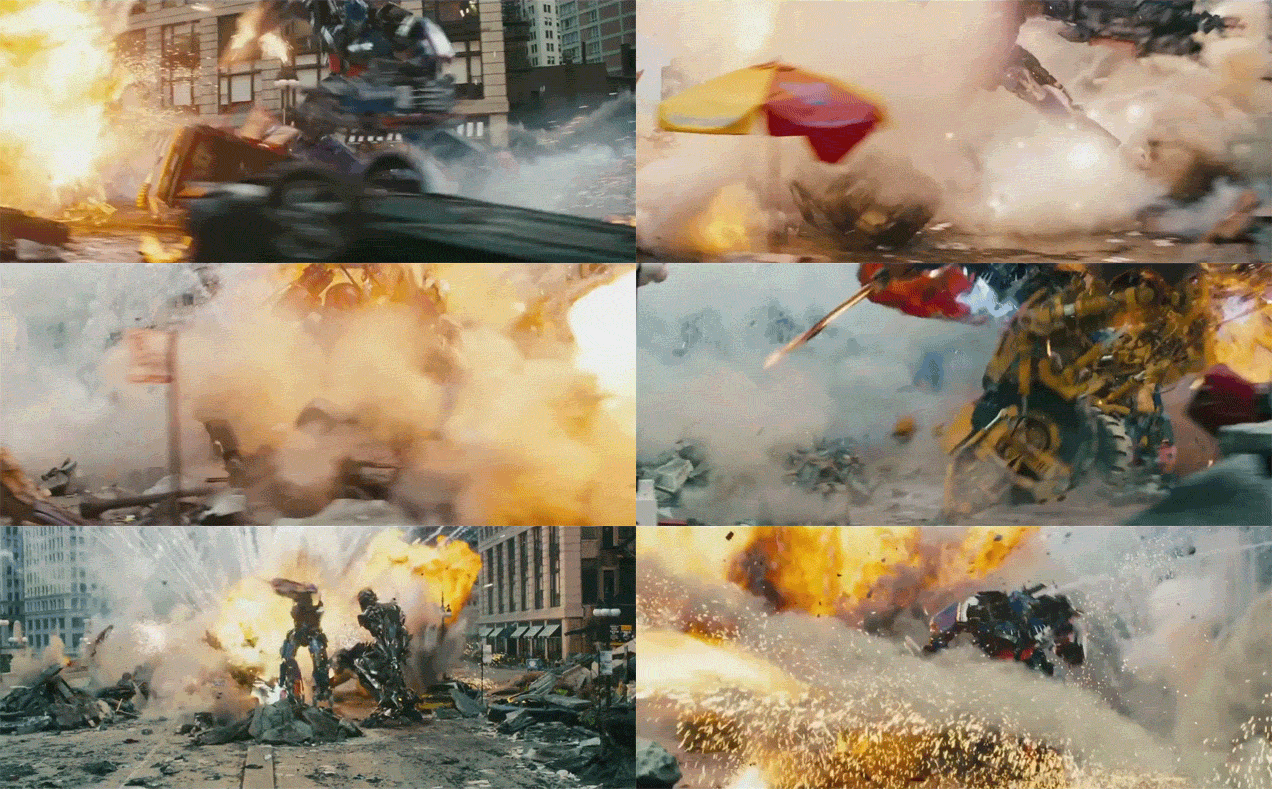
Looking at you Michael Bay.
Just take a look at the gif above, or at this 20 minute video of all the fight scenes in Transformers. The action is all over the place and quickly becomes very hard to follow. The shaky camerawork and near constant explosions make taking in the action an overwhelming and difficult task that quickly becomes an eyesore. I'm just picking on Bay for this post but it happens with a lot of actions movies. However this is where Miller excels. Actually, I should say this is where Margaret Sixel excels, as she is the one who edited this movie. What makes the editing of Fury Road so interesting is that it isn't edited like an action movie. In fact, Sixel, who is Miller's wife, had never edited an action film before Mad Max: Fury Road. Miller, when asked why he selected Sixel to edit the film said that had it been edited by "the usual kind of guys, it would look like every other action movie we see" The result of Margaret Sixel's editing is high octane action scenes that are easy to follow.
Look at this gif to the left. Important points are kept in the center so the audience doesn't have to search for them. Shot shots, while short, are long enough that we are able to see what is occurring in each one before the next shot comes along. Also notice how while there is slight directional movement with the camera, it is still steady enough for us to be enthralled by the action but not made motion sick by the blair witch level shakiness.
While this edited works great for these action sequences, it also improves the films watching as a whole. Film being a visual medium, and actions films doubly so, it is important that you can tell your film well with minimal use of dialogue to expose what is occurring on screen. Check out this video of several action films 12 times their normal speed. As many of the other films becomes a hard to follow muddled mess, more or less you can still tell what's going on in Mad Max: Fury Road. You could easily take all the sound out of Fury Road and besides missing an awesome score by Junkie XL you would still be able to understand the story and could pretty easily explain the major plot points of the film.
2. Practical Effects
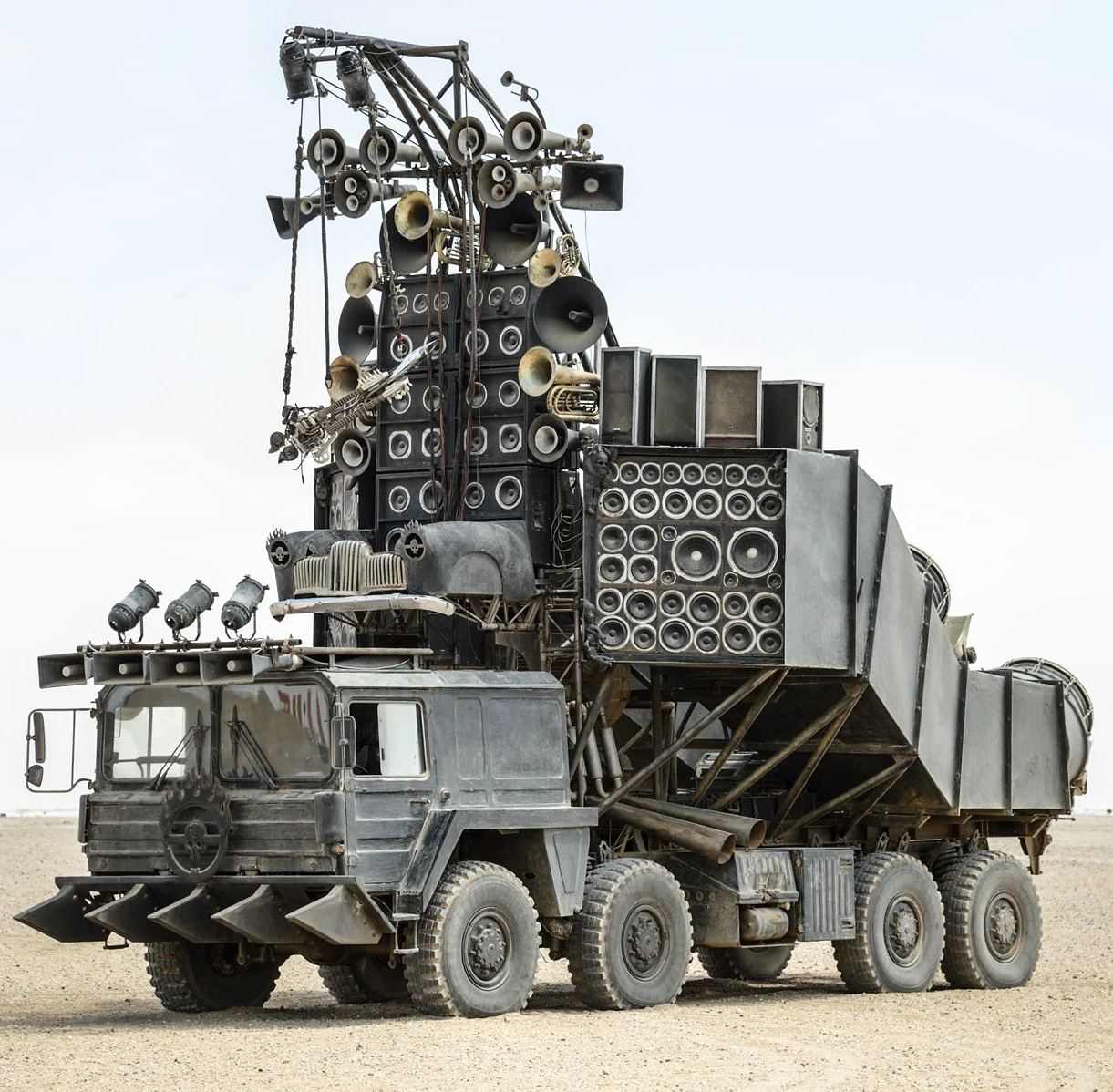
With CGI, almost anything is possible and for considerably less than it would cost to actually do it. think about it; If you were making a movie like Mad Max: Fury Road, you wouldn't spend all that time to actually build all those cars and then actually go out in the desert and film all those dangerous stunts full speed and end up destroying those cars, when you could do almost all of that with CGI right? Well George Miller did. Almost every single car in the film is a real, fully functioning vehicle.
That includes this one.
This one
This one, which you may remember having a man playing a flame-throwing guitar which was also real, on top of it.
And countless other ridiculously awesome post-apocalyptic vehicles. All of these were actually built, functioned, and for most of them, destroyed in one of the final car chase climaxes ever. Miller did use CGI, but only to enhance. This is how CGI should be used, to enhance scenes, not to completely replace what could be made practically.
Check out this great video which shows many of the CGI shots in the film before and after it was added. Notice how for the most part, things are done practically, when important. Scenes where shooting inside a moving vehicle would not have worked are done on green screen, but almost anything else is done with good old practical destruction.
Here are a few other pre and post CGI/VFX shots from Fury Road.
3. Story/Feminist Action
Perhaps one of the most interesting parts of Mad Max is that Max is not the protagonist of the film, in fact, the story of Fury Road is not Max's. That honor goes to Furiosa.
Hands down biggest badass of 2015.
Furiosa's journey is what drives (see what I did there) the plot. Max is simply along for the ride. (see that I did there) The entire film has a strong feminist message. Furiosa is never a damsel in distress and is never seen as inferior to Max. In fact, she saves Max's ass a few times. Her character is given depth and important backstory which the plot gives proper attention to. She is not oversexualised or just made to be an object of male gaze. She is smart, independent, and very resourceful. What works well with the film is the mutual respect she and Max have for eachother. Max never assumes she is unable to perform a task, he is simply weary of her at first. Furiosa however is not the only female character in the film. Joining her are Immortan Joe's fives wives, also referred to as breeders, used to bring Immortan healthy sons. Each of the wives in the film stands out in their own way and is unique from the others. Again giving character development to them. They too are able to hold their own in a fight. the film easily passes both the Bechdel_test and the Mako Mori test. The film does such a good job with its female characters that a group of Men's Rights Activists, which is sadly a real thing, protested the film calling in feminist propaganda. I'm not going to give the link to the article, but if you can find it pretty easily. The story as a whole improves the film. Despite these many complex characters, the overall plot is simple. This benefits the film and allows the visual aspect and action to do the rest of the storytelling. There is no need for any subplots or things that go nowhere, the film simply tells one story and focuses entirely on that.
In Conclusion
Mad Max: Fury Road excels in almost every aspect. It's beautiful to look at, has great characters who you wanna root for, and is fun as hell. The film is clearly made by someone who dearly loves film. One can even see multiple subtle references to the older Mad Max films, but we won't go into that now. Filmmaking is a craft, and the craft that went to making Mad Max is truly remarkable. Each aspect is equally important to the film working out. If it failed, the whole film would have too. From the editing to the script, to the practical effects, the utmost care was put into every detail of the movie. This is not to say that the other nominees are not deserving they are, and in Spotlight's case, they will succeed. None of the films however, accomplish what Mad Max: Fury Road did. For that Fury Road shall ride enteral, shiny and chrome.
The first time watching Children of Men, I was so struck by the visual language that you can get from the camera movements in this film. Unaware at the time, what really goes into filmmaking, I found the action happening onscreen extremely unique. Taking a look at the process of how some of the imagery was created in this science fiction adventure, can surely inspire. Emmanuel Lubezki, the cinematographer of the film, collaborated with Alfonso Cuaron, the director, in order to accomplish some of the many choreographed, long takes in this film. There are more than three different long takes which are more than three minutes a piece, the longest of which is six whole minutes. During production, what has caused many problems, eventually paid out into a creative landmark. During an ambush sequence there was a special car rig for the camera, so that the camera could turn 360 degrees, and by allowing seats and actors to move, there was a floating-documentary style of capturing the story. Of coarse there are some instances with CGI aided effects to make seamless transition for the effect, but nevertheless Lubezki help create some really beautiful sequences.
We are in an odd time for film where many films are created with the use of so much green screen and special affects that it's become frieghtning to some filmmakers. Directors like Quentin Tarantino will one day leave the industry because of the increase in special affects and the decreasing use of film in the medium. Some say it is the death of cinema and to a degree I would agree. Cinema as we knew it is dead, but it is not gone.
With superheroes soaring over the box office it's no surprise why cgi and special affects are dominant in the industry today. But the question is can there be too much of it? Well lets look at a some examples. If you compare the Star Wars prequels to the original trilogy it is easy to see that the more recent films use a ton of cgi and special affects. And because of that so many fans of the series will immediatley credit that to why the prequels are abysmal compared to the original trilogy. The way I see it is the reason those films are not as great is because of a lot of other issues that could be discussed for hours on end. But in short that is not even close to why those films are not amazing. I'm not saying that there can be bad cgi and special effects. Oh no there can be really bad special affects that can ruin a whole movie (I'm looking at you The Mummy Returns) but as time progresses the use of cgi only helps the film industry.
Stories, stories and more stories. I said it now and I will say it again, with more ways and deviations to creating a film the more different stories can be told. Look at Gravity and ask yourself if that movie could have been created ten years ago. Or Life of Pi? Both of these films used so much cgi and special effects that it becomes hard to know what's real and what isn't. Without special effects both of these films would not exist. It's all about how you go about using them really. Look at The Guardians of the Galaxy and Dawn of the Planet of the Apes and their use of special effects. It may sound dumb but both of these films made me cry. And the even worse part is that it wasn't the human actors that made me cry, it was a talking tree, a talking raccoon and a talking monkey (this is just as hard for me to type as it is for you to read). The use of motion capture has advanced so far that these creations have become believable and at times really something special. So at this moment in time it's not about how much special affects you want to use but how you go about using it. Write a good story, with great characters, make a film beautiful, and then you can add as much special affects as your little heart desires.
We live in an age of CGI. Hollywood studios have been finding that it is a lot easier to CGI a bunch of enemies or explosions or anything in action and Sci-Fi films. Unfortunately I am one of those people that have not really enjoyed these transitions. Almost all of my favorite action and fantasy films took place in the mid-2000's. Lord of the Rings, Kingdom of Heaven, Mask of Zorro, The Bourne Trilogy. These films had a sense of realism to them that a lot of the more modern action films don't.
Although I thoroughly enjoyed The Hobbit, an Unexpected Journey, the excessive use of animation really took me out of some of the scenes. There were scenes that were exclusively CGI and since I knew it was all CGI, all suspense was immediately taken out of the scene. I think the reason why I enjoyed the big budget action films of the 2000's was because special effects were not good enough at that point to completely shoot a scene, but could only be used to enhance scene. Give them that extra something if you will. For an example I have added two scenes, both from director Peter Jackson, one from the Hobbit done completely in CGI and one from The Fellowship of the Ring, decide for yourself which one has more tension.
Hopefully, you agree with my opinion that the second clip is much better. Mainly because of the lack of frame cluttering. It's almost as if Peter Jackson told the animators to put as much stuff in the frame as possible. This excessive animation really makes it difficult for me at least to get personally involved in the scene. The sad part is, is that a scene shot in a forest with a bunch of guys in costume did so much more for me than and thousands of dollars of animation could.
I am going to bring up a point here that might cause some contention. As some of my classmates have already stated, they really did not like the film Pacific Rim, and while by no means did I think it was a great film. I found it to be very enjoyable and worth the money I spent in the theater (mainly cause I didn't watch it in 3D). Now obviously this film relies on CGI like it is nobody's business, but the thing I found interesting after looking a bit further into the making of the film was that director Benicio Del Toro made a conscious effort to make the cockpits of the Jaegers a real set and the enhance it with CGI. Here is a clip about building the set.
Now I thought that was pretty amazing. Especially because of the lack of necessity. They were already making an extremely CGI heavy set, Del Toro could have just as easily had the actors put in a green screen environment and done everything in post, but he said no. I want to add a sense of realism in an otherwise unrealistic film. This went as far as to make real functioning pilot suits and helmets.
Well for those of you who have stuck through this whole post and watched all the videos and listened to all my wild comments I say thank you. I always appreciate a good debate, so if someone has a conflicting idea I'd love to hear their arguments. After all, we're here to learn.
Judging just by this blog alone, there has been quite a lot of hype around the upcoming film adaptation of The Hobbit. As someone mentioned in an earlier post, the producers have been releasing short clips of how the film has been coming along. Released on youtube just a couple of weeks ago was a featurette that offered some insight into the post production process of the film. As many of us have begun to work on the footage we have shot for our final project, I thought that it would be of interest.
It was really interesting to see all of the different jobs that are part of the post production team and what they do for the film. Considering the Peter Jackson's film adaptation of the Lord of the Rings Trilogy was widely known for its graphics, it is safe to say that The Hobbit has potential to be even better considering that technology has advanced since then. This clip shows the origins of what the animators receive (a title card just describing the scene) and all of the necessary steps they go through to get a finished product, including sound design and visuals.
Over the last week, we have spoken a lot about acting in class. This art has a special place in my heart, and my pursuit of this career has already taken six years of my life. Through workshops with casting directors, like Paul Weber from Weber Casting, and working with an acting coach out in L.A., I have learned much in those six years. Yet, I have found there is always some new tip or rule to the art. It is a constant learning process that is mostly acquired through experience, especially since theatre acting truly is a completely different concept than film acting.
So what happens when technology changes and the way films can be made reaches a new climax? Do actor's have to reshape how they perform their craft? Answer: Not at all.
When motion capture was first starting to be used, I remember hearing how worried professional actors had become. Would this new technology replace "the actor" in film, losing the face as well as the performance? Would this technology make acting even harder than it can already be? Again, I think everyone was amazed with the answer, especially when it went beyond motion capture and into performance capture. This new, amazing technology has been seen in so many recent films including The Lord of the Rings, King Kong,Avatar, Rise of the Planet of the Apes.
It started out very new in The Lord of the Rings through Andy Serkis' performance of Gollum. This was an amazing development in film: allowing actors to even become the most different of creatures without all of the make-up and prosthetics that can sometimes come across as very fake. What a freeing experience!
The technology itself is astounding as well. Through the use of a body suit, dots and many, many cameras, an actor's performance can be converted over into a completed CGI character. This character then embodies the soul of the actor that performs the role, even down to facial characteristics.
At the time of Lord of the Rings, I was so entranced with this concept of motion capture/performance capture that I didn't think it could get any better. I was really wrong. Andy Serkis then appeared in both King Kong and Rise of the Planet of the Apes, using this similar technology. His performances were stunning, and the characters truly took on a life of their own. Something about motion capture/performance capture brings a real life to these characters that creates an emotional draw as an audience member. I truly believe it has to do with the fact that there is a real person behind the CGI, a mind that can understand and convey the depth of the character it portrays.
I can't imagine the amount of time Andy Serkis had to spend studying ape behavior to get the facial and body movements to the point where they are so believable. This is another aspect of performance capture that is so exciting. It takes a lot of work to learn the behaviors and movements of other creatures. Sometimes actors even have to take months of "classes" just learning how to perform their characters for performance capture. Take it from the cast of Avatar directed by James Cameron.
I absolutely love this movie. I still remember sitting in the theatre, completely drawn into the film in awestruck wonder at how "real" the Na'vi of Pandora seemed. I know Avatar creates a mix of emotions regarding plot, but one thing no one can argue about is how revolutionizing this film truly is in just how a movie can be filmed. Not only did they use performance capture for the acting, but they literally created the world of Pandora as they went along. This extended even to the point where they made a special camera for James Cameron to use that allowed him to see a rough outline of the CGI world even though it was just an actor in a motion capture suit and a set of boxes around him. When I watched the behind the scenes sections for avatar, I couldn't help but be both amazed and excited about all the possibilities that performance capture offers. After seeing all of Andy Serkis' performances, and now all of the actors on Avatar, this technology have the ability to allow a greater opportunity to both actors and filmmakers in the future. Having minimal, but acting experience nonetheless, I can have nothing but a great admiration and excitement for actors who have been able to be a part of this new style of filming.
~Amber Capogrossi
Most of you have probably heard of HBO's hit television show Boardwalk Empire. Last week I posted the call sheets for the show. I was watching it tonight and I remembered thinking how amazing the actual boardwalk set is. The set built nearby NYC is a miniature version of the Atlantic City boardwalk in 1920. Where the ocean would be is a huge blue screen. By being able to use this huge blue screen the show is able to spend more money elsewhere and pull of shots that were improbable before (like a shot of the ocean behind a fake boardwalk). It reminded me how far technology has come, even in the last few years, and I think that more filmmakers need to consider it an option. Although there are many examples of its abuse, I think CGI can be a great thing.
Last class we mentioned the example of Benoit Mandelbrot, the father of Fractal Geometry. His work is so important and has influenced so many fields, from mathematics to medicine to entertainment and economics that I am not even attempting to go into more details.
I leave it up to you to find out by utilizing available resources in the net or in the literature, like Mandelbrot's own book The Fractal Geometry of Nature, which made possible to non-specialists to understand or simply enjoy how the visualization of a simple recursive formula can reveal the underlying structure of the world around us, I would even say of the Universe itself.
After people in the film industry for example, were able to "see" with their own eyes the generative power of this recursive formulas, computer graphics programs were developed to take advantage of this procedure to generate highly realistic natural phenomena, from landscapes to water, explosions, fire and such. Things would never be the same.
On a similar note (pun intended), Stephen Wolfram, has contributed to the visualization field, as well as many others too numerous:-) to mention here. Among other things he is the creator of Mathematica, a computational software used primarily for scientific and engineering visualizations. Thanks to that program many applications have been developed that relate to the arts as well. The case in point is Wolfram Tones, which allows you to generate music, soundtracks etc. where you can modify parameters (such as type of sound, rhythm etc) to suit your taste or your application, try it out. You could call it Audiolizations!