Showing posts with label avatar. Show all posts

Sunday, October 26, 2014

MacGuffin

“The main thing I’ve learned over the years is that the MacGuffin is nothing. I’m convinced of this, but I find it very difficult to prove it to others.” –Alfred Hitchcock

Other wise known as McGuffin or maguffin, a MacGuffin is a plot device that is usually given little or no narrative explanation. It can be in the form of a goal, desired object, or other kind of motivator, and can be either a person, object or place. Sometimes, you might not even notice what the MacGuffin is in a film, but it's always there, and it's the driving force behind the main character's actions in a film.
Alfred Hitchcock is famous for using this term throughout his films.

MacGuffin use in Hitchcock films

Vertigo: Carlotta Valdes' character never appears in the film, and her death isn't important at all to the audience. However, because she is apparently possessing Madeleie Elster, it starts the case for Scottie to investigate and drives the entire film's plot. Some also have noted that the necklace or Scottie's vertigo is also a MacGuffin.
The 39 Steps: Mr. Memory's memorization of plans for an airplane engine. 
Rear Window: the "murder" committed by Lars Thorwald.
Notorious: the uranium ore that is in all the vintage wine bottles.
The Birds: the reason why the birds are attacking everyone.
Psycho: the $40,000 in the envelope. 

His famous method has also inspired other films to use this method in their films. Some examples are:
Pulp Fiction: the briefcase
Avatar: the mineral unobtainium
Mission: Impossible III: the rabbit's foot
Casablanca: the letters of transit
Citizen Kane: the rosebud


Wednesday, August 28, 2013

Legend of Korra, Book 2: Big Philosophical Shoes to Fill


Growing up, I was an avid watcher of cartoons, a word perhaps too often and unfortunately correlated to brainless childhood animation and crude adult comedy. All though the percentage of time I spend watching animated shows has greatly weened in relation to my aggregate TV watching, I still like to revisit some of my "old favorites". Toward the end of my senior year, I re-watched a show called "Avatar: The Last Airbender", which ran from 2005 to 2008.The show was one of the few that withstood the test of my aging. It was undeniably a great show, and perhaps, at times, more than that. I hybrid of action, drama, and comedy, "The Last Airbender" seemed to have more heart than any other "children's cartoon" of the time. That is the reason why I was so excited to hear that a sequel series, "The Legend of Korra"  was to be released in 2012.

"The Legend of Korra" seemed to transcend any and all expectations but, before we delve into that, a little background information. The series takes place one hundred years after its predecessor, in a fictional world where people are spiritual connected to one of four elements, and can manipulate or "bend" it. Only the Avatar, the protagonist of the show, Korra, can bend all four elements: water, fire, earth and air. It is Korra's duty to maintain peace and balance in the world. The main action takes place in Republic City, the hub of this fictional world, a world that clearly favors benders and, in some ways, mirrors our own.

Although the "Legend of Korra" is,  at least on the surface, an action show, the backbone of the plot lies in the disparity between benders and non-benders. The very lowest common denominator that separates the two groups is the fact that some non-benders are oppressed by a bending mafia. Beyond that however, lie social, economic and political implications that separate them. Due to their "predisposition", benders certainly get a leg up in the aforementioned categories. Talented fire-benders, who can harness the power of lightning, power the city with electricity. Pro- bending competitions provide a lucrative and entertaining sport for the folks of Republic City. Earth-benders, who can bend metal, make up the city's police force. No non-benders are included in the political system, as the city is ruled by a council of benders. Essentially, social mobility only exists in Republic City for benders. While all of these issues are occurring, a group called the Equalists, led by a masked man named Amon, calls for outright egalitarianism, a principle that favors equal opportunity.

Although egalitarianism is not an inherently bad principle, and the show addresses that the current state of affairs in Republic City is wrong, Amon is most certainly the villain in the show. He essentially becomes a terrorist, bombing the city and eventually taking it over. Gifted with the power to remove people's bending ability, Amon wants to "rid the world of benders", a sentiment eerily mass genocidal. Blinded by his zeal, he becomes a hypocrite in his own cry for equality. The show presents a very clear message: violence is the wrong answer.

This message, befitting the likes of Gandhi and MLK, is beautifully woven into the plot, even in the face of disproportionate economic, political and social advantages. Now, I'd like to reiterate that this show is largely marketed toward children. Very few adult shows are able to craft a message of peace and equality so beautifully and so poignantly. Whether you subscribe to any sort of movement or not, "The Legend of Korra" masterfully preaches to always strive toward equality and balance but warns against the dangers of extremism.

The show is slated for a second book, or season, coming out September 13th. The first season was so perfectly crafted that I'm afraid that it's second season cannot reach the same heights of storytelling. However, with undeniably brilliant writers, I will most definitely, and suggest you do too, watch when it comes out.


Sunday, November 25, 2012

Two Plots Are Better Than One : Dexter and Series Television

I've noticed there are two types of shows on television, the first is shows that have concrete main characters but a new, unrelated plot every time .  These types of shows can be watched out of order with no actually progression of an overall plot.  This type of television show can usually be seen in children's programs for example "Spongebob" or "The Rugrats."  However as I have gotten older I have noticed another type of television programing as I started to become more interested in series television.
    The first television series that has gotten my attention enough to buy the first season DVD and start from the beginning, in order of the series, is "Dexter".  As I came to the completion of the first season I have started to notice a pattern in how the show is formatted.  For every episode there is an individual sub-plot (in this case a bad person Dexter must kill) and also an overarching plot pulling on pervious episodes and the episodes of the future (for example  Dexter's love life and the mystery of Ice Truck Serial Killer).  Once I noticed this pattern I began to think of other popular television shows (everything from Nickelodeon's Avatar to Glee to Spartacus)  and they all seem to follow this same format to one extent or another.
      I had to then ask myself why?  Well as a scriptwriter I looked at this from a storyline standpoint the sub-plot keeps every episode interesting and engaging for an audience that may not be familiar with the show but also heightens the engagement of dedicated followers.  The overarching plot however is what creates the "show followers" and drive to wait and watch the next episodes.  I believe this equates to the marketing of the show in a way.  The fact that a television show can be enjoyed by someone new to it is equally as important as to entertain someone who has watched it from the start.  Seeing a random episode of Dexter is what got me to start over from the beginning in order to understand what exactly was going on.  The usage of two story-lines to in a way to attract new watchers while furthering the entertainment of followers of the series seems to be extremely effective.
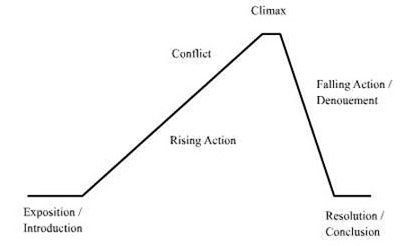
     Another interesting point I would like to add is about the story structure of each episode.  The basic outline of a conventional story is supposed to have an introduction, rising action, conflict, climax, falling action, and a conclusion…however as I have looked further into series television (or at least in the case of Dexter) this does not seem to be the case.  I feel as though every sub-plot follows this basic outline curve however the overarching plot provides it's most heightened sense of emotion at the end of every singular episode.  This climax at the conclusion if you will is what keeps audiences coming back and insights feeling of personal investment and connection within a series television program, turning first-timers into followers.
     It would seem from my experience and my research into series television programs this story-line format is at the core for creating a successful televisions series.  I have found that although some shows such as certain sitcoms and children's shows work on a per-episode basis, the shows that acquire the most "hype" and engage the audience most fully are those that utilize this idea that two plots are better than one.  After taking time to verbalize all of my thoughts and as someone who is interested in series television and the television business I have found that taking time to evaluate my own personal reactions as an audience may help to understand how audiences I may one day market to work as well.


Friday, September 28, 2012

Capturing the Actor in Film: Motion Capture/ Performance Capture

Over the last week, we have spoken a lot about acting in class. This art has a special place in my heart, and my pursuit of this career has already taken six years of my life. Through workshops with casting directors, like Paul Weber from Weber Casting, and working with an acting coach out in L.A., I have learned much in those six years. Yet, I have found there is always some new tip or rule to the art. It is a constant learning process that is mostly acquired through experience, especially since theatre acting truly is a completely different concept than film acting.

So what happens when technology changes and the way films can be made reaches a new climax? Do actor's have to reshape how they perform their craft? Answer: Not at all. 

When motion capture was first starting to be used, I remember hearing how worried professional actors had become. Would this new technology replace "the actor" in film, losing the face as well as the performance? Would this technology make acting even harder than it can already be? Again, I think everyone was amazed with the answer, especially when it went beyond motion capture and into performance capture. This new, amazing technology has been seen in so many recent films including The Lord of the Rings, King Kong, Avatar, Rise of the Planet of the Apes. 

It started out very new in The Lord of the Rings through Andy Serkis' performance of Gollum. This was an amazing development in film: allowing actors to even become the most different of creatures without all of the make-up and prosthetics that can sometimes come across as very fake. What a freeing experience!


The technology itself is astounding as well. Through the use of a body suit, dots and many, many cameras, an actor's performance can be converted over into a completed CGI character. This character then embodies the soul of the actor that performs the role, even down to facial characteristics. 

At the time of Lord of the Rings, I was so entranced with this concept of motion capture/performance capture that I didn't think it could get any better. I was really wrong. Andy Serkis then appeared in both King Kong and Rise of the Planet of the Apes, using this similar technology. His performances were stunning, and the characters truly took on a life of their own. Something about motion capture/performance capture brings a real life to these characters that creates an emotional draw as an audience member. I truly believe it has to do with the fact that there is a real person behind the CGI, a mind that can understand and convey the depth of the character it portrays. 

I can't imagine the amount of time Andy Serkis had to spend studying ape behavior to get the facial and body movements to the point where they are so believable. This is another aspect of performance capture that is so exciting. It takes a lot of work to learn the behaviors and movements of other creatures. Sometimes actors even have to take months of "classes" just learning how to perform their characters for performance capture. Take it from the cast of Avatar directed by James Cameron. 


I absolutely love this movie. I still remember sitting in the theatre, completely drawn into the film in awestruck wonder at how "real" the Na'vi of Pandora seemed. I know Avatar creates a mix of emotions regarding plot, but one thing no one can argue about is how revolutionizing this film truly is in just how a movie can be filmed. Not only did they use performance capture for the acting, but they literally created the world of Pandora as they went along. This extended even to the point where they made a special camera for James Cameron to use that allowed him to see a rough outline of the CGI world even though it was just an actor in a motion capture suit and a set of boxes around him. When I watched the behind the scenes sections for avatar, I couldn't help but be both amazed and excited about all the possibilities that performance capture offers. After seeing all of Andy Serkis' performances, and now all of the actors on Avatar, this technology have the ability to allow a greater opportunity to both actors and filmmakers in the future. Having minimal, but acting experience nonetheless, I can have nothing but a great admiration and excitement for actors who have been able to be a part of this new style of filming.
~Amber Capogrossi

Friday, September 21, 2012

The Hidden Magic: Music


Over the last week, my health has gotten worse. I hate to say it, but I think I am one of the lucky ones who caught the viral infection that is sneaking its way across campus. The wonderful thing about being sick though, is that my time for watching movies and TV shows has almost doubled. Inevitably, during my many viewings I would start to dose off. I may have been half conscious, but I could always tell what was going on in the films and shows, not based on what I could see, but on what I could hear.
I don't only mean the dialogue or the recorded sound effects, although those are obviously very important. No, I'm talking about the power of music. Think about your favorite movie, or your favorite scene. Now try to imagine that scene without the background music. Isn't that a strange thought? It is something that is almost always overlooked, yet without it, the context of the movie doesn't seem quite complete. 

Now, I danced for about nine years and I played piano for about five years. I love music. I think everyone does, but what I loved about music was how, when I was dancing or even playing piano, I was able to feel the music inside me and move me in a way that let me express the heart of the song. Something about music hits us in our core and allows us to feel emotions. Who would have thought that combining sounds, raising or lowering the levels, and tempo would allow us to feel so much? With music, we are giving almost a sixth sense, or a 4D quality to our visual or movie experience. I believe it is because we can relate to what is happening through the notes. We all have some kind of device that we use to listen to music. When do you listen to music? In the car? In the morning as you are getting ready? Walking to class? When you are doing homework? Music has become such a part of our lives that it is easily overlooked. Sometimes we even hear soundtracks to our own lives. So, if music is such a huge part of our everyday life, it only makes sense that it should also be present in the movies and shows we watch. 
Last week I wrote about Lord of the Rings, and I will use it as an example again. The music in that film is astounding. It was written in such a way that it literally brings you into Middle Earth and traps you there with its interweaving melodies and harmonies. Other movies like AvatarNarniaHarry Potter, and The Hunger Games have similar qualities. Movies and shows that take place in our world and our times have more modern music performed by modern artists that fits the film genre. This extends even to books. I have read several commentaries from modern authors about the music that inspired their stories. When I sit down to write my own story I'm always playing some kind of celtic or other instrumental music that helps me to see or create the story that I am writing. 

Music is a part of the world, from the birds in the trees to the notes playing through your headphones. The next time you watch a movie or show, listen for the underlying music or film score. Sometimes that music can tell a story all on its own. 


~ Amber Capogrossi

Friday, September 7, 2012

A Surprised Movie Addict


On my trip to Virginia Beach this summer, I was squished into the backseat of my mom's Buick with my two nieces. With their iPods an inch away from their faces and their headphones softly leaking music and dialogue, I watched as their eyes filled with wonder and disappeared into whatever world their movies were taking them. I can not even begin to tell you how many times I caught them watching  The Lorax or Puss In Boots. That is the funny thing about children. They can sit through an hour to an hour and a half long movie, turn around to their parents and say, "Can I watch it again?" At one point during our twelve hour car ride I whispered to my mom and my brother, "I can't believe they are watching that movie again!" My brother, who is twelve years older than me, just laughed. He continued to recount how when I was their age I did the same exact thing with my movies at home. Well. That put me in my place for certain. I recalled going through my old picture books and seeing some pictures of my four or five year old self, laying on the floor staring up at the moving pictures on the TV. 

I loved watching movies when I was young, and as the years flew by, that love never vanished. I eventually developed a passion for reading novels (I read fifteen or sixteen different ones this summer!), but I never get tired of movies. Even television shows, although I'm a little picky when it comes to this kind of entertainment. When I was little, and today as well, I was quite an oddity I think. Instead of waking up in the morning and putting on cartoons, I would put the channel to TVLand. I loved Get Smart, I Dream of Genie, I Love Lucy, The Andy Griffith Show, Bonanza, MacGyver, and the list goes on and on. 

By the time I was a senior in High School, I thought that I had a pretty good movie and TV show library in my head. I had even watched the Behind the Scenes footage from Lord of the Rings (my favorite movie) directed by Peter Jackson, and I think by then, even Behind the Scenes from Avatar directed by James Cameron, and many others. Then my world was completely changed by one thing. Netflix. Not only did Netflix have a billion movies and shows I hadn't seen (or heard of) that you could rent, it also allowed you to stream some of those movies right online! It was thanks to this discovery that by my freshman year in college I was a pro at browsing through Netflix in search of my new favorite movie. This is still my addiction today. Recently, I have gotten hooked on movies set in 19th century England, such as North and South directed by Brian Percival, Pride and Prejudice (the 1980 TV miniseries), Mansfield Park (1999) directed by Patricia Rozema, and again, the list could go on and on. I have also watched different TV shows on Netflix including Downton Abbey, Lost, and Robin Hood (2006 TV series). 

By this point in my life, I was again content with my new expanded range of movies and shows. I had even enjoyed Charlie Chaplin when I went with my friend to France. We stayed with her grandparents in Antibes, and her grandfather loved Charlie Chaplin. My friend translated later of course, but her grandfather said that Charlie Chaplin was the best because it didn't matter what language you speak, everyone can understand and laugh along. He was right. I also took a course called Bollywood while I was in college, and we watched films ranging from Jab We Met (which I recommend because it is amazing!) directed by Imtiaz Ali to I've Loved You So Long (another great movie!) directed by Philippe Claudel. 

Yet, I am continually shocked by how small my knowledge of movies is still. Even though I watch movies on Netflix all the time, (Seriously, sometimes I watch three movies in a row. Don't worry I still have a life.) somehow I am still in the dark when it comes to the classics. In class this week we were asked if we had seen several different films for examples. I don't think I raised my hand once. This was such an eye opener for me. 

So, since I am heading into a career where it is important to know and see other people's work, I have decided to watch as many movies on the list that Professor Sinclair provided for us on the blog page. Through all this I have learned that it doesn't matter how many movies or TV series you have watched, you will never have seen enough. The learning process never stops throughout life. Just like my nieces, I have to be prepared to watch, watch and watch some more. Not only for entertainment, but in order to learn and become more knowledgeable. 

~Amber Capogrossi

Monday, October 26, 2009

AR, VR, MAR, MVR, ISMAR and other acronyms


ISMAR 2009 was a mixed bag, some awesome talks and demonstrations and on the other hand very few vendor kiosks with disappointing demos that looked more like 2001. Yes, some AR headgear was almost tolerable but with poor image quality (basically little low-res tv's hung in front of your eyes). Although there are already working prototypes of retinal projection none was available, and this is the technology which I believe will be both less intrusive (almost ubiquitous) and at the same time totally invasive with a direct path to your brain.

I think that all head worn displays suffer from an extreme case of risk-aversion, incrementing oh so slowly, sensors and devices that are already mainstream, like accelerometers, magnetic compasses etc. They need a serious garage-shock! anybody there?

The conferences, on the other hand, were fabulous. It was hard to choose which one to attend, but we stayed with the Arts&Humanities chapter most of the time, except when some very well known presenters gave their demos, like Pattie Maes from MIT wearable computing lab which demonstrated the "SixthSense""a device developed by Pranav Mistry that we had already seen in a TED video, or the HitLab guys from New Zealand with which we had very interesting conversations about their various tools and projects. We also found out that they are already working very closely with UF's department of Engineering.

Augmented Reality (AR) Joiner series, Waterfall - Outdoors from Augmented Stories on Vimeo.


And talking about projects, I was really impressed by Helen Papagiannis from York University in Toronto. She presented work utilizing marker tracking with a custom library created at their Augmented Reality Lab in the Department of Film. This was the first time that I have seen a truly creative an original work which has gone beyond technology and in the process of becoming a new language, a new form that she might not even be aware of. I am sure we will hear more from her in the future. The video above is only a small taste. But in a shorter term she agreed to make a virtual presentation to our class, just need to coordinate times! Very exciting.


The other high point for me was the presence of Natasha Tsakos, whose work we have also seen in class. She too agreed to visit us online. It was nice to see her after almost seven years, from a theater student to a full fledged international performer and media star. We had a chance to talk about the ethics of technology and our responsibility as technoartists in this world and time that will be crucial to our survival as a species, not to mention other life forms that we are decimating as we boldly go where no one has been before.

Our presentation of the virtual alien controlled real-time from Digital Worlds was a smashing success. Eyes and mouths open, plenty of smiles and excitement. To be honest I myself was surprised of the enthusiastic response, being a very techie and sophisticated audience. That made me realize that we are on the right place at the right time...! Using an Open Source game engine running code by Anton Yudi and my 3D character and environment we were able to advance a few steps towards physical-virtual avatar control. Still a long way to go to be completely untethered.

Jarrel Pair, the organizer who introduced us, said we had taken a great risk by presenting something live, in real-time and involving so many variables. In reality it was nerve wrecking! Internet connectivity via ethernet, which we needed because wireless was so spotty, was non existent until about 4 minutes before our group began (we were 3 presenters in a panel). But once we started everything went absolutely smooth, even beyond our expectations.

Pictures coming soon...

Wednesday, October 7, 2009

BCI System- Second Life


"A research team led by professor Jun'ichi Ushiba of the Keio University Biomedical Engineering Laboratory has developed a BCI system - which stands for brain-computer interface - that lets the user walk an avatar through the virtual world that is Second Life without using mouse, keyboard or any other controller but the power of thought."

I had no idea anyone was doing this. I think I'd need a choice though. I wouldn't mind moving my avatar with my brain signals for awhile so long as I could switch to some sort of body motion detection system. I'd enjoy walking in real life in front of a camera and having my avatar do the same.

Monday, September 21, 2009

Virtual Worlds: A First-Hand Account of Market and Society on the Cyberian Frontier

This article talked about some of the various virtual worlds that exist or have existed over the years such as Norrath, Ultima Online, The Sims Online and Project Entropia. I was surprised to learn that some 20% of Norrath's citizens considered their online virtual life in this world to be thier real life! Though that does not appeal to me, I must admit that I spend so much time in front of a computer that it does in fact take up a very large portion of my life. I might as well be in a virtual world! But, I'd never consider it more real than my everyday life.

Castronova also pointed out that gaming companies are making profits in the hundreds of millions just from the money customers spend on creating thier avatars. Wow, as if we didn't already have enough to spend money on! Now, we've got to go around paying for virtual reality representations of ourselves. Will there be a social stigma against those with low-quality avatars as happens in Neal Stephenson's novel, Snow Crash?

Castronova ends by talking about how virtual worlds will become highly commercialized. I hope these virtual worlds don't become 3D Myspaces with advertisements lining the walls everywhere I turn!

Sunday, September 13, 2009

Avatars for Social Responsibility

Image Source:http://graphico.free.fr/hfr/pollution.jpg


As Yann Arthus-Bertrand (a famous aerial photographer, author of Earth from Above) says in his TED talk "...we don't want to believe what we know". He starts by mentioning that even though he came to talk about ecology, he flew from France to California, thereby producing 9 tons of CO2, the equivalent, he says, of two elephants!

For those of us who work with digital technologies and virtual worlds, it is easy to disregard such concerns, as if they only applied to the "real world". But what about the carbon footprint of our avatars?. An article published in the Near Future Laboratory blog mentions some interesting numbers that gave me pause:

According to professor Julian Bleecker Ph.D of USC and cofounder of design think tank the Near Future Laboratory, "a Second Life avatar produces 1,685 pounds of CO2 and an acre of real estate in Second Life produces 99 tons of CO2.

Power Consumption Per Avatar Per Year (Second Life Servers): 153 kWH
Power Consumption Per Avatar Per Year (Home User’s PC): 1,095 kWH
Total Power Consumption Per Avatar Per Year: 1,248 kWH CO2 Emissions Per Avatar Per Year (Second Life Servers): 207 lbs (94 kilos)
CO2 Emissions Per Avatar Per Year (Home User’s PC): 1,478 lbs (670 kilos)
Total CO2 Emissions Per Avatar Per Year: 1,685 lbs (764 kilos)

...Some equivalence for perspective:In 2003, the per-capita power consumption in the United States: 13,242 kWH
In 2001, the per-capita power consumption in Iceland: 26,947 kWH
In 2001, the per-capita power consumption in Keyna: 118 kWH
(World Resource Institute, EarthTrends — )

...Every year, every Avatar in Second Life produces CO2 emissions equivalent to a typical, honking, bloated, arrogant SUV driving 1,293 miles, based on the assumption that this kind of SUV generates 1 lbs of CO2 per mile".


We all know that we will have to make substantial changes to our lifestyle if we want to do our part in saving this "spaceship earth" like Bucky called it. If we don't we will leave the planet to our avatars instead of our grandchildren...

Tuesday, May 20, 2008

Avatar's carbon footprint

We did not really go into this discussion in our class, except by bringing up the fact that Google's use of a white screen contributes substantially to global warming. Google itself acknowledged it by turning their screen black for a day to save energy.

But on to avatars. An article published in the Near Future Laboratory blog mentions some interesting numbers that gave me pause:

According to professor Julian Bleecker Ph.D of USC and cofounder of design think tank the Near Future Laboratory, "a Second Life avatar produces 1,685 pounds of CO2 and an acre of real estate in Second Life produces 99 tons of CO2.

Power Consumption Per Avatar Per Year (Second Life Servers): 153 kWH
Power Consumption Per Avatar Per Year (Home User’s PC): 1,095 kWH
Total Power Consumption Per Avatar Per Year: 1,248 kWH CO2 Emissions Per Avatar Per Year (Second Life Servers): 207 lbs (94 kilos)
CO2 Emissions Per Avatar Per Year (Home User’s PC): 1,478 lbs (670 kilos)
Total CO2 Emissions Per Avatar Per Year: 1,685 lbs (764 kilos)

...Some equivalence for perspective:In 2003, the per-capita power consumption in the United States: 13,242 kWH
In 2001, the per-capita power consumption in Iceland: 26,947 kWH
In 2001, the per-capita power consumption in Keyna: 118 kWH
(World Resource Institute, EarthTrends — )

...Every year, every Avatar in Second Life produces CO2 emissions equivalent to a typical, honking, bloated, arrogant SUV driving 1,293 miles, based on the assumption that this kind of SUV generates 1 lbs of CO2 per mile".


We all know that we will have to make substantial changes to our lifestyle if we want to do our part in saving this "spaceship earth" like Bucky called it. If we don't we will leave the planet to our avatars instead of our grandchildren...

Monday, April 21, 2008

Tired of Reality?


Stanford University is announcing a 2 week intensive training institute on immersive virtual reality. From September 8 to September 19 they will train you in the design and programming of virtual reality worlds.

The faculty is composed, among others by researcher Jeremy Bailenson, currently the director of Stanford's Virtual Human Interaction Lab, whose work in the field of cognitive psychology, telepresence and virtual environments, (funded by the National Science Foundation) is highly recognized.

In the The Avatar's Influence, The Chronicle of Higher Education
- What people do in virtual reality doesn't always stay in virtual reality he argues, and makes an excellent and compelling case that virtual representations of professors can be more effective than the real thing.

In Transformed Social Interaction in Immersive Virtual Reality Jeremy Bailenson discusses VHIL research projects in an extraordinary and fast paced Metaverse U presentation . I will try to show this in class because I think it will open (or close, there is always that possibility) a few eyes and raise awareness of what we have already discussed earlier in the class, that being as we are in the midst of a paradigm shift, it is difficult, sometimes impossible to perceive what is right in front of our eyes. Sometimes because it is very skilfully disguised.

Bailenson's main area of interest is the phenomenon of digital human representation, especially in the context of immersive virtual reality. He explores the manner in which people are able to represent themselves when the physical constraints of body and veridically-rendered behaviors are removed. Furthermore, he designs and studies collaborative virtual reality systems that allow physically remote individuals to meet in virtual space, and explores the manner in which these systems change the nature of verbal and nonverbal interaction.

You can apply at http://vhil.stanford.edu

Sunday, January 13, 2008

The primitives I am working with

I've enjoyed reading everyone's posts, so after a week of diving in (and flying around) SL here are a few things that I've found interesting, academically and otherwise. I have enjoyed chatting with a few class members already in-world - this should be fun. (Or, Deckard Jameson has chatted and enjoyed it? Argh.)

I took the class because it was interdisciplinary and interesting - I really had no idea how it would relate to my research, if at all. That's good because in the last week of using SL I've found a whole bunch of things about it that I love that have very little to do with my research, like:
  • "travel writing" -- I collected a few lists of "places to visit" and spent way too much time visiting different sights and writing notes on them. I would think doing some travel writing on different SL sights would be a blast.
  • "the book experience" -- I'm kind of a book nerd, in the sense that I like the 'experience' of a book (that can't be found on the Web) so I was interested to see if/how the good ol' book would adapt to the SL world. I went to visit the SL Library and several book publishers. And, I visited a bunch of "bookstores" to see if anyone had managed to create that great "third place" feel of a good coffee house or old bookstore. (Or, err ... would that be "fourth place"? I get confused easily.)
  • "snapshot aesthetics" -- I started taking snapshots early on and they were so bad I had to spend time learning the camera controls. Then I started wondering what qualifies as a good snapshot in SL.
  • avatar creation -- To do some posed snapshots I started creating different avatar "roles/skins/???" to use as "models." Fooling with the sliders in different ways brought back lots of lessons on anatomy from art classes that I thought were lost forever. If I were a (professional) actor I think I would be thrilled at my ability to throw off physical constraints in the creation of a role.
So ... I'm not sure exactly how SL relates to my current research directions, though it certainly does. Thus far in my research I have been looking closely at the rise of online social networks (ie MySpace or Facebook) and how people use them to connect and relate to each other. (Example: when I say you are my "friend" online, what are the obligations/expectations I have about our relationship?) So, like Narasi and others I'm interested in the "quality" of SL relationships.

Beyond the metaphysical questions I'm interested in SL as a technology of social connection, too. There are pieces of the "social network toolbox" built in to SL (ie profiles) - but how will this aspect of SL evolve, if at all? Could a future version of SL provide residents with the same sort of "uses and gratifications" that, say, MySpace does today for those who use it? If not, what about the experience of both is different?

So many questions, not enough avatars to find out the answers ...