Showing posts with label spartacus. Show all posts

Friday, April 19, 2013

Since we do have a test...

Since we will be having a final exam, and it is on Stanley Kubrik, I figured using the blog to post some information about him would be a good idea. I do not know much about him as a person or a filmmaker, since I have only seen 2001: A Space Odyssey in my physics class back in high school, so this is helpful for me as well.

I know we mainly need to know about his films, but I figured it could be useful to know a little bit about him as well, so...

BIO:
Stanley Kubrik born on July 26, 1928 in the Bronx, New York. While first working as a photographer in New York City, he taught himself all of the skills needed in order to produce and direct films. He did most of his work in the United Kingdom, where he took on the roles as a film director, screenwriter, producer, cinematographer, and editor. He very often participated in more than one of these positions for each film he worked on. 

In these positions, he is best noted for his attention to detail and his unique style. He covered a variety of topics including, romantic and black comedies, epic and science fiction, war, crime, and horror movies. Kubrik died in March of 1999 of a heart attack. He is still remembered as one of the greatest, if not the greatest, filmmaker of all time.


MOVIES: 
Kubrik is responsible for some of the most important films of all time. These include:
  1. A Clockwork Orange- A futuristic film based in Britain that follows Alex DeLarge. DeLarge is the leader of the "droogs," one of many gangs in the area. After committing multiple heinous acts, including multiple beatings and fighting a rival gang, he is betrayed by the droogs, arrested, and sentenced to 14 years of incarceration. DeLarge then volunteers to undergo therapy treatment to help stop crime, but it does not go as well as they planned. 
  2. Full Metal Jacket- Based in 1967, a group of Marines travels to Parris Island for training during the Vietnam War. After their training, they are set out into Vietnam to fight with the other Marines. There, they begin to see the horrible and unbelievable acts of war taking the lives of both the Vietnamese and the United States soldiers. 
  3. The Shining- This film centers around Jack, Wendy, and Danny Torrance travels to an isolated Overlook Hotel that is controlled by an evil spirit. The spirit takes over the father, Jack, making him violent and out of control. The son, Danny, who is psychic, also begins to see horrifying visions of the past and future, and the entire family enters into a period of chaos. 
Other notable films include 2001: The Space Odyssey, Dr. Strangelove, Eyes Wide Shut, and Spartacus. 

Sunday, November 25, 2012

Two Plots Are Better Than One : Dexter and Series Television

I've noticed there are two types of shows on television, the first is shows that have concrete main characters but a new, unrelated plot every time .  These types of shows can be watched out of order with no actually progression of an overall plot.  This type of television show can usually be seen in children's programs for example "Spongebob" or "The Rugrats."  However as I have gotten older I have noticed another type of television programing as I started to become more interested in series television.
    The first television series that has gotten my attention enough to buy the first season DVD and start from the beginning, in order of the series, is "Dexter".  As I came to the completion of the first season I have started to notice a pattern in how the show is formatted.  For every episode there is an individual sub-plot (in this case a bad person Dexter must kill) and also an overarching plot pulling on pervious episodes and the episodes of the future (for example  Dexter's love life and the mystery of Ice Truck Serial Killer).  Once I noticed this pattern I began to think of other popular television shows (everything from Nickelodeon's Avatar to Glee to Spartacus)  and they all seem to follow this same format to one extent or another.
      I had to then ask myself why?  Well as a scriptwriter I looked at this from a storyline standpoint the sub-plot keeps every episode interesting and engaging for an audience that may not be familiar with the show but also heightens the engagement of dedicated followers.  The overarching plot however is what creates the "show followers" and drive to wait and watch the next episodes.  I believe this equates to the marketing of the show in a way.  The fact that a television show can be enjoyed by someone new to it is equally as important as to entertain someone who has watched it from the start.  Seeing a random episode of Dexter is what got me to start over from the beginning in order to understand what exactly was going on.  The usage of two story-lines to in a way to attract new watchers while furthering the entertainment of followers of the series seems to be extremely effective.
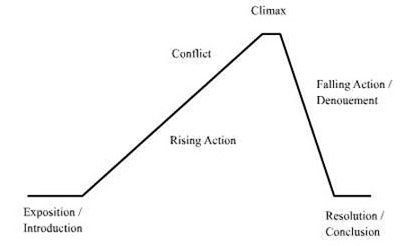
     Another interesting point I would like to add is about the story structure of each episode.  The basic outline of a conventional story is supposed to have an introduction, rising action, conflict, climax, falling action, and a conclusion…however as I have looked further into series television (or at least in the case of Dexter) this does not seem to be the case.  I feel as though every sub-plot follows this basic outline curve however the overarching plot provides it's most heightened sense of emotion at the end of every singular episode.  This climax at the conclusion if you will is what keeps audiences coming back and insights feeling of personal investment and connection within a series television program, turning first-timers into followers.
     It would seem from my experience and my research into series television programs this story-line format is at the core for creating a successful televisions series.  I have found that although some shows such as certain sitcoms and children's shows work on a per-episode basis, the shows that acquire the most "hype" and engage the audience most fully are those that utilize this idea that two plots are better than one.  After taking time to verbalize all of my thoughts and as someone who is interested in series television and the television business I have found that taking time to evaluate my own personal reactions as an audience may help to understand how audiences I may one day market to work as well.