Craig, Mike and myself are working together as the team "The Purple Cobras" for this assignment to develop a short film around a story about a teen who was struck with kindness of strangers when a man offered him a well paying job. This man had heard about the teen's struggles to support his brothers and sisters after their mother passed away and how the teen had trouble getting a job. This sounds like a good ol' heart warming story that can be turned into a film? But can it really? Does it have a 3 act arch and does it have character development? We had to find some ways to creatively tell our story and still make it appealing as a film.
We have decided that the story it's self will remain the same, but will be the middle chuck of our film. We still need a solid beginning and end. Without these our project might as well be useless. Without the beginning we wouldn't be able to get into the characters situation and learn about his life and the hardships he goes through. We need a reason to root for this character and learn a little back story about him and his family before we can develop the plot. On the opposite spectrum we also need to wrap up the ending with closure. We can't just leave the audience wondering what happened because we ended our film in the middle of the story. We have to show the effect and reactions to what happens in the plot and how everything turns out.
I love writing but this should be an exciting challenge for me as I write the script. My writing excels in scriptwriting for television. I love how the characters have room to grow and develop over a broader sense of time and how intimate you can make certain situations that would be cut from a film. I'm very lucky to have such hard working and brilliant team members to help me develop the story and change/add things to the script. I look forward to writing it this weekend. But it will not come as easy to me as if I were writing an episode of TV. We have to tell an entire story in a very short amount of time and still develop strong connections to the characters and produce a heartwarming story. It will be a good challenge for me and I hope I can do this story justice.
Showing posts with label audience. Show all posts
Friday, March 8, 2013
A Simple Story
Labels:
audience,
characters,
film,
plot,
Project,
screenwriting,
television,
writing
Monday, December 10, 2012
Got Gump?
I don't think I've written about Forrest Gump, directed by Robert Zemeckis, yet so here it goes.
I'm going to focus on an aspect to it that I noticed it last time I watched it. This movie is highly adaptive to its audience. By this I mean that the same person, depending on their mood can get different meanings out of it every time they watch it.
Last night I watched it in a slightly darker mood than I normally watch it. And scenes meanings changed for me. For example in the scene where he says his last words to Bubba. Forrest Gump narrates "If I'd have known this was going to be the last time me and Bubba was gonna talk, I'd of thought of something better to say." Bubba asks Forrest why did that happen. And Forrest replies "you got shot." And then Bubba dies in Forrest's arms. In the past I had laughed because it was a funny line since he states the obvious, like always. But last night it had weight behind it, it wasn't funny. It was actually a very sad scene. He tried to save his best friends life, willing to lose his own, and he failed.
There are many other aspects that were different too. Story changing too. Normally when watching this, pardon the french, but Jenny is a bitch and Forrest is the helpless victim to her acidic lifestyle. Last night though I was sympathetic towards Jenny and Forrest was more of her savior. It was more of Jenny's story and Forrest was just a tool used to explain it. I was drawn a lot more to her and her problems. Almost all of the references to birds, being free, and running came through.
It wasn't so much the story of Gump anymore, not the American Dream, but probably the human dream. The contrast between Forrest and jenny really showed this. Jenny, trapped by her past, drug addiction, not satisfied with her life and always trying to escape it. Forrest while "constrained" by his intelligence, "broke out" of it as a kid in the scene where he breaks his leg braces. He never lets anything hold him back and just lives life freely. He went with the flow, without too much thought as to what the consequences could be. He is completely free. Which is where Jenny wants to be, she even says she wishes she was like a bird. And birds typically and in this case as well are symbols of freedom. By the end she gets there right before her death.
There were many other examples of these new meanings depending on the mood. But I'll let you figure out the meanings for yourself.
I'm going to focus on an aspect to it that I noticed it last time I watched it. This movie is highly adaptive to its audience. By this I mean that the same person, depending on their mood can get different meanings out of it every time they watch it.
Last night I watched it in a slightly darker mood than I normally watch it. And scenes meanings changed for me. For example in the scene where he says his last words to Bubba. Forrest Gump narrates "If I'd have known this was going to be the last time me and Bubba was gonna talk, I'd of thought of something better to say." Bubba asks Forrest why did that happen. And Forrest replies "you got shot." And then Bubba dies in Forrest's arms. In the past I had laughed because it was a funny line since he states the obvious, like always. But last night it had weight behind it, it wasn't funny. It was actually a very sad scene. He tried to save his best friends life, willing to lose his own, and he failed.
There are many other aspects that were different too. Story changing too. Normally when watching this, pardon the french, but Jenny is a bitch and Forrest is the helpless victim to her acidic lifestyle. Last night though I was sympathetic towards Jenny and Forrest was more of her savior. It was more of Jenny's story and Forrest was just a tool used to explain it. I was drawn a lot more to her and her problems. Almost all of the references to birds, being free, and running came through.
It wasn't so much the story of Gump anymore, not the American Dream, but probably the human dream. The contrast between Forrest and jenny really showed this. Jenny, trapped by her past, drug addiction, not satisfied with her life and always trying to escape it. Forrest while "constrained" by his intelligence, "broke out" of it as a kid in the scene where he breaks his leg braces. He never lets anything hold him back and just lives life freely. He went with the flow, without too much thought as to what the consequences could be. He is completely free. Which is where Jenny wants to be, she even says she wishes she was like a bird. And birds typically and in this case as well are symbols of freedom. By the end she gets there right before her death.
There were many other examples of these new meanings depending on the mood. But I'll let you figure out the meanings for yourself.
Labels:
audience,
bubba,
change,
emotion,
forrest gump,
freedom,
greatest movie ever,
jenny,
life,
Robert Zemeckis
Sunday, November 25, 2012
Two Plots Are Better Than One : Dexter and Series Television
I've noticed there are two types of shows on television, the first is shows that have concrete main characters but a new, unrelated plot every time . These types of shows can be watched out of order with no actually progression of an overall plot. This type of television show can usually be seen in children's programs for example "Spongebob" or "The Rugrats." However as I have gotten older I have noticed another type of television programing as I started to become more interested in series television.
The first television series that has gotten my attention enough to buy the first season DVD and start from the beginning, in order of the series, is "Dexter". As I came to the completion of the first season I have started to notice a pattern in how the show is formatted. For every episode there is an individual sub-plot (in this case a bad person Dexter must kill) and also an overarching plot pulling on pervious episodes and the episodes of the future (for example Dexter's love life and the mystery of Ice Truck Serial Killer). Once I noticed this pattern I began to think of other popular television shows (everything from Nickelodeon's Avatar to Glee to Spartacus) and they all seem to follow this same format to one extent or another.
I had to then ask myself why? Well as a scriptwriter I looked at this from a storyline standpoint the sub-plot keeps every episode interesting and engaging for an audience that may not be familiar with the show but also heightens the engagement of dedicated followers. The overarching plot however is what creates the "show followers" and drive to wait and watch the next episodes. I believe this equates to the marketing of the show in a way. The fact that a television show can be enjoyed by someone new to it is equally as important as to entertain someone who has watched it from the start. Seeing a random episode of Dexter is what got me to start over from the beginning in order to understand what exactly was going on. The usage of two story-lines to in a way to attract new watchers while furthering the entertainment of followers of the series seems to be extremely effective.
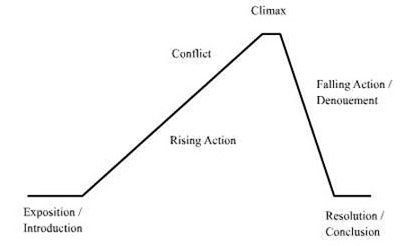
Another interesting point I would like to add is about the story structure of each episode. The basic outline of a conventional story is supposed to have an introduction, rising action, conflict, climax, falling action, and a conclusion…however as I have looked further into series television (or at least in the case of Dexter) this does not seem to be the case. I feel as though every sub-plot follows this basic outline curve however the overarching plot provides it's most heightened sense of emotion at the end of every singular episode. This climax at the conclusion if you will is what keeps audiences coming back and insights feeling of personal investment and connection within a series television program, turning first-timers into followers.
It would seem from my experience and my research into series television programs this story-line format is at the core for creating a successful televisions series. I have found that although some shows such as certain sitcoms and children's shows work on a per-episode basis, the shows that acquire the most "hype" and engage the audience most fully are those that utilize this idea that two plots are better than one. After taking time to verbalize all of my thoughts and as someone who is interested in series television and the television business I have found that taking time to evaluate my own personal reactions as an audience may help to understand how audiences I may one day market to work as well.
The first television series that has gotten my attention enough to buy the first season DVD and start from the beginning, in order of the series, is "Dexter". As I came to the completion of the first season I have started to notice a pattern in how the show is formatted. For every episode there is an individual sub-plot (in this case a bad person Dexter must kill) and also an overarching plot pulling on pervious episodes and the episodes of the future (for example Dexter's love life and the mystery of Ice Truck Serial Killer). Once I noticed this pattern I began to think of other popular television shows (everything from Nickelodeon's Avatar to Glee to Spartacus) and they all seem to follow this same format to one extent or another.
I had to then ask myself why? Well as a scriptwriter I looked at this from a storyline standpoint the sub-plot keeps every episode interesting and engaging for an audience that may not be familiar with the show but also heightens the engagement of dedicated followers. The overarching plot however is what creates the "show followers" and drive to wait and watch the next episodes. I believe this equates to the marketing of the show in a way. The fact that a television show can be enjoyed by someone new to it is equally as important as to entertain someone who has watched it from the start. Seeing a random episode of Dexter is what got me to start over from the beginning in order to understand what exactly was going on. The usage of two story-lines to in a way to attract new watchers while furthering the entertainment of followers of the series seems to be extremely effective.
Another interesting point I would like to add is about the story structure of each episode. The basic outline of a conventional story is supposed to have an introduction, rising action, conflict, climax, falling action, and a conclusion…however as I have looked further into series television (or at least in the case of Dexter) this does not seem to be the case. I feel as though every sub-plot follows this basic outline curve however the overarching plot provides it's most heightened sense of emotion at the end of every singular episode. This climax at the conclusion if you will is what keeps audiences coming back and insights feeling of personal investment and connection within a series television program, turning first-timers into followers.
It would seem from my experience and my research into series television programs this story-line format is at the core for creating a successful televisions series. I have found that although some shows such as certain sitcoms and children's shows work on a per-episode basis, the shows that acquire the most "hype" and engage the audience most fully are those that utilize this idea that two plots are better than one. After taking time to verbalize all of my thoughts and as someone who is interested in series television and the television business I have found that taking time to evaluate my own personal reactions as an audience may help to understand how audiences I may one day market to work as well.

Labels:
audience,
avatar,
dexter,
episodic television,
glee,
rugrats,
screenwriting,
script,
scriptwriting,
series,
spartacus,
spongebob,
story line,
storytelling,
television,
television series,
theme
Subscribe to:
Comments (Atom)