This past weekend was the first production day for the
documentary that Shai and I are working on, and I am already starting to see
how documentary filmmaking is different than fiction. In the past, I have only
worked on scripted videos, translating stories on the screen that have been
thoroughly planned out on the page. With this project, I’m learning how
documentary stories can evolve to make themselves become more clear throughout
the process. What began as a short documentary about a person doing good became
a call to action for a movement of doing good, and this weekend, I could start
to see the direction by which we are going to tell the story.
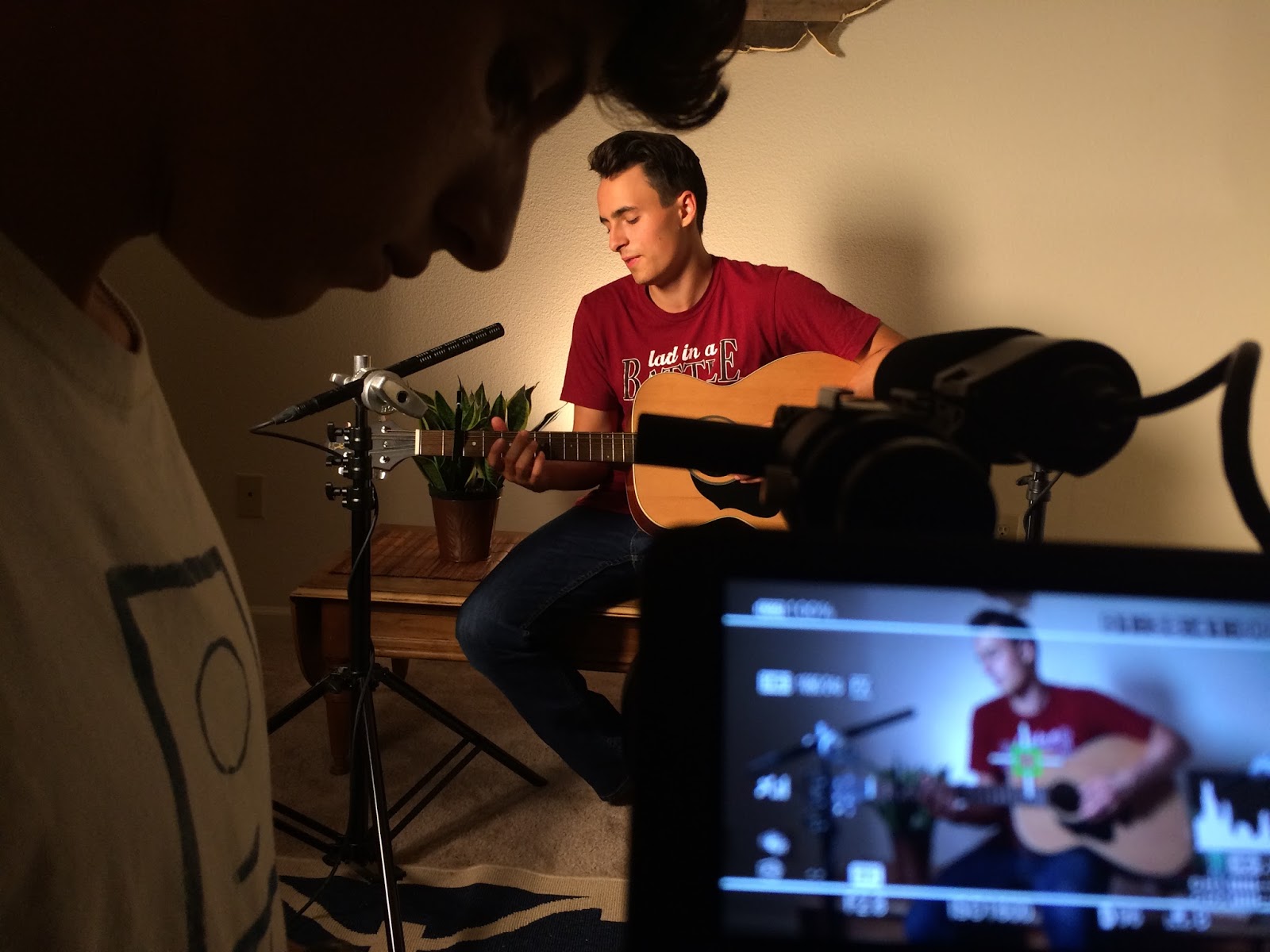
Friday afternoon, Shai and I hit the road to Virginia to
shoot our main interview with James Orrigo, the founder of Lad In A Battle and
the subject of our film. Just before we left, he called us about another person
we could interview for the film, his college guidance counselor, Christine, who
had seen him and his movement grow.She
was only an hour’s drive from his home in Virgina, and had a house on Lake
Anna, a potentially great interview location. Yet as much as Shai and I were
tantalized by the idea of the waterfront backdrop, we knew that it wouldn’t
serve our story enough to justify the sound problems it came with.
During her interview, Christine talked about the problem of
living one’s life in fear. Fear for the future, for grades, for school, for
money. The problem with fear is that it prevents us being happy and from fully
embracing the world with love. As I listened through my headphones, watched the
microphones levels, and thought about her words, I started to realize how this
video was going to take shape. James made a choice back when he got a
concussion in high school from lacrosse that nearly killed him; he could either
live the rest of his life in fear of the world, or embrace it with love. Immediately after the interview, Christine invited us all out on her boat in Lake Anna, and we Shai and i made the conscious choice to live by the new words of our film. In fact, this
could be the angle by which we tackle the rest of the film.
What does it mean to embrace the world with love? It means
reaching out to people, it means doing what makes you happy, doing what makes
others happy, and finding a way to balance those out everyday. What James does
with music for children and the music he played for his mother during her
cancer, is his way of bridging what makes those around him happy and what makes
him happy. What became even more clear during James’ interview is that
something about him and the Lad In A Battle movement is infectious. Early on
when he just started Lad In A Battle, he had an idea to get from VA to ME
without a car by relying on people along the coast who liked his message and
sell t-shirts along the way. James had a choice: to live his life in fear, or
in love. The success of this trip and the effects it had on propelling his
movement demonstrated the power of this idea that Christine had talked about.
Especially at a time when our lives are moving so fast. There is so much
pressure for the future, to get good grades to go to a good school to get a
good job to have money. Yet James choice to follow his heart and live his life
in love for others and now he and his wife are gearing up to build a tiny house
on the back of trailer to tour hospitals across the country, all in hopes to
kick start his Out Of The Music Box program for children with cancer.Despite the battles underneath, he’s living
his life in love, not in fear, and this is something that we can all do. This
is not the way I had thought to tell his story, but now I am realizing that
with documentary’s, they like to tell their own stories and we have to guide
them.
"What is important to the education of a filmmaker is not a matter learning a set of skills and techniques, but having a vital, passionate need to express something unique and personal. Above all, the student has to understand why he wants to become a filmmaker rather than work in some other art form and he has to ponder what he wants to say in film's unique form of expression.
"In recent years I have met more and more young people who go to film school to prepare themselves to do "what they have to do" (as they say in Russia) or "to make a living" (as they say in Europe and America). This is tragic. Learning to use the equipment and edit a movie is child's play; anyone can learn that without half-trying. But learning how to think independently, learning how to be an individual, is entirely different from learning "how to do" something. Learning how to say something unique and different is a skill that no one can force you to master. And to go down that path is to shoulder a burden that is not merely difficult, but at times impossible to bear. But there is no other way to become an artist. You have to go for broke. You must risk everything in your quest to express a personal truth. It must be all or nothing.
"The man who has stolen in order never to thieve again is forever a thief. Nobody who has once betrayed his principles can have a pure relationship with life ever again. When a filmmaker says he will try to please people - relatives, friends, teachers, or reviewers -- this time in order to get a degree or earn the money to make the film of his dreams the next time, he is lying to you, or even worse, lying to himself. Once he heads down the path of deceit he will never be capable of making a real film."
--Andrei Tarkovsky, Sculpting in Time, p. 124 (adapted and updated by Ray Carney)
Werner Herzog on Film School
"I personally don't believe in the kind of film schools you find all over the world today. I never worked as another filmmaker's assistant and I never had any formal training. My early films come from my very deepest commitment to what I was doing, what I felt I had no choice but to do, and as such they are totally unconnected to what was going on at the film schools - and cinemas - of the time. It's my strong autodidactic streak and my faith in my own work that have kept me going for more than forty years.
"A pianist is made in childhood, a filmmaker at any age. I say this only because physically, in order to play the piano well, the body needs to be conditioned from a very early age. Real musicians have an innate feel for all music and all instruments, something that can be instilled only at an early age. Of course it's possible to learn to play the piano as an adult, but the intuitive qualities needed just won't be there.
As a young filmmaker I just read in an encyclopedia the fifteen or so pages on filmmaking. Everything I needed to get myself started came from this book. It has always seemed to me that almost everything you are forced to learn at school you forget in a couple of years. But the things you set out to learn yourself in order to quench a thirst, these are things you never forget. It was a vital early lesson for me, realizing that the knowledge gleaned from a book will suffice for the first week on the set, which is all the time needed to learn everything you need to know as a filmmaker. To this very day the technical knowledge I have is relatively rudimentary. But if there are things that seem too complicated, experiment; if you still can't master them, hire a technician.
"Filmmaking is a more vulnerable journey than most other creative ventures. When you are a sculptor you have only one obstacle - a lump of rock - which you chisel away on. But filmmaking involves organization and money and technology, things like that. You might get the best shot of your life but if the lab mixes the developing solution wrongly then your shot is gone forever. You can build a ship, cast 5000 extras and plan a scene with your leading actors, and in the morning one of them has a stomach ache and can't go on set. These things happen, everything is interwoven and interlinked, and if one element doesn't function properly then the whole venture is prone to collapse. Filmmakers should be taught about how things will go wrong, about how to deal with these problems, how to handle a crew that is getting out of hand, how to handle a producing partner who won't pay up or a distributor who won't advertise properly, things like this. People who keep moaning about these kinds of problems aren't really suited for this line of business.
"And, vitally, aspiring filmmakers have to be taught that sometimes the only way of overcoming problems involves real physicality. Many great filmmakers have been astonishingly physical, athletic people. A much higher percentage than writers or musicians. Actually, for some time now I have given some thought to opening a film school. But if I did start one up you would only be allowed to fill out an application form after you have walked alone on foot, let's say from Madrid to Kiev, a distance of about five thousand kilometres. While walking, write. Write about your experiences and give me your notebooks. I would be able to tell who had really walked the distance and who had not. While you are walking you would learn much more about filmmaking and what it truly involves than you ever would sitting in a classroom. During your voyage you will learn more about what your future holds than in five years at film school. Your experiences would be the very opposite of academic knowledge, for academia is the death of cinema. It is the very opposite of passion."
Honestly, everyone should just be amazed it took me this long to cave and make a post about this TV show. Avatar: The Last Airbender is by far one of my favorite, possibly my most favorite, television series. There are a lot of things that make this show incredible, but I believe that by far it's strongest quality is it's impeccable storytelling.
If you have never seen this show (which oh my god I know I always tell people to watch things in these posts, but I have never been more serious when I say you need to watch this show) I could waste my time trying to summarize the basic plot, but why do that when you can just watch the show's intro which will explain everything for you in 45 seconds.
So now that everyone has a least some idea of what I'm about to discuss we shall forge on!
This show is incredibly complex and nuanced for a children's show. It explores themes that most children's programing wouldn't dare touch including but not limited to: sexism, racism, genocide, war, death, murder, religion, environmental awareness, family disfunction, domestic abuse, disability and many other "adult" themes.
It is because of the extreme care the shows creators took with the storytelling that they were able to address these themes in a show that is targeted for such a young audience.
Firstly the show's characters are in no way one demential. Most children's shows, and let's face it, many adult shows, have archetypical characters with cliched problems who never develop throughout the show's run. The characters in Avatar, have complex problems and personalities that do not feel contrived or cliched. They grow and evolve through each episode and learn from past failures and events.
Even the shows villains are fleshed out. We understand and learn as much about the villains of the story as we do the heroes. We sometimes find ourselves sympathizing with the villains even more than the heroes. This is something particularly unusual for a children's show, as usually characters are defined as either good or evil, and good always triumphs over evil. In this show the heroes frequently are defeated by villains. It is in these defeats that we are most able to feel for our heroes and connect with their struggle.
As in most television shows there are some episodes that can be considered "filler", or an episode in which not much is done to advance the plot but instead to simply fill up time because they creators of said show signed a contract with the TV station to make a certain number of episodes. However, unlike most shows the "filler" episodes in Avatar never feel like a waste of time. While not much is being done to advance the plot, these episodes serve to explore and deepen our understanding of the characters and their struggles.
Another unfortunate reality of many TV shows is that they go on for too long. There are too many seasons of the show, because it is popular and making the station money, and they story eventually gets lost as it continues to droll on and on and the writers must continually come up with new problems for the characters to face. This is a problem that Avatar does not have. When the creators of the show pitched their idea to Nickelodeon they already had the entire story planned beginning, middle, and end. Even when they were offered more seasons, the creators refused because they did not want to jeopardize the telling of the story. In result, the story is exactly as long as it needs to be. It does not drag to a point where you lose interest in the characters. I have massive respect for the writers for turning down a potential to make more money in favor of telling the best story possible. It really paid off.
In conclusion, Avatar: The Last Airbender is really a masterpiece of storytelling and everyone should take the time to watch the show at least once. Don't let the fact that it is a children's show stop you, because as I mentioned earlier it deals with adult themes and in no way talks down to it's audience. It is something that people of all ages can enjoy.
I would like to end by linking to a really interesting documentary about the making of Avatar: The Last Airbender. If you are a fan of the show you will definitely find it interesting!
I will begin this post by saying that if you have not yet experienced the awesomeness that is BBC's modern adaptation of Sir Arthur Conan Doyle's Sherlock Holmes books, then stop what you are doing and go watch it. I will wait. No, I'm serious go check it out, it's on Netflix.
Now, I could sit here all day and talk to you about how amazing this mini-series is. I could tell you how incredible the acting is, or how I could even tell you that the last installment just won seven Emmys. But I think the quality of this series speaks for itself. One of the most impressive things about this series is the way the cinematography and editing is utilized.
If you don't know anything about Sherlock Holmes (which would be weird, because he's the most famous fictional character of all time), then you know that he is a genius detective who solves cases by picking up on things that no one else can. In past portrayals Sherlock would look around a crime scene before suddenly declaring what it was that everyone else was missing. In BBC's adaptation they actually show you Sherlock's thoughts as he is solving the case in his head, and they do it through clever editing and cinematography
As Sherlock thinks or makes deductions, we as viewers can see his thoughts through carefully placed text. This way the audience can feel as though they are solving the case along with him, instead of just watching him do it. This is also more interesting visually then just having the actor do a voice over. Not only that, but it makes Sherlock's genius more believable. The audience is more willing to believe that Sherlock can come to these conclusions if they can physically see him work them out.
It was also even used for comic relief when Sherlock tried to solve a case while drunk. This made for some pretty amusing deductions.
They also use a similar technique to show Sherlock's "Mind Palace".
This is a memory technique where one visualizes a location (in Sherlock's case a palace), with different rooms and stores different information in those rooms. Then when they need to remember something, they simply have to visualize the place where it was stored. Sherlock uses his Mind Palace to store all sorts of important information he might need to solve crimes.
The creators of the show used the cinematography and editing to show the way Sherlock interacts with his Mind Palace, much they way they did to show how he thinks.
There are even entire sequences that take place inside Sherlock's Mind Palace. In these scenes, lighting is used dramatically to show Sherlock's state of mind. One particular scene, when Sherlock was injured and unconscious, the lighting is bright and blindingly white as his body goes into shock. In the same is sequence clever camera angles were used, the camera pointed downward at the top of a long spiraling staircase as Sherlock struggles to climb up them and back to consciousness.
Basically, everything about the way this show is constructed is extremely clever, much like it's hero. I would highly recommend it to anyone.
Music videos have a unique way of telling stories. I have found that not all music videos are of women dressed in skimpy outfits and dancing or of singers showing off what they have. There are some videos that actually have artistic merit to them. I was lucky to come across a music video that not only reflects the mood of the songs, but also tells a story of it's own. The video that I found just came out today and it is for the song "Instant Crush" by Daft Punk featuring the voice of Julien Casablancas, the lead singer of The Strokes. Here's the video directed by Warren Fu:
This music video involves Julien Casablancas singing on a small stage and two wax figures in a museum. One wax figure is dressed up as an 18th century soldier and he has a strong resemblance to Casablancas. The other figure is a beautiful milk maid who catches the attention of the soldier. The video tells the story of the two inanimate objects growing affection for each other. They do not speak throughout the video but they still have a strong connection. They are eventually separated, but in the end they are reunited during a fire in a warehouse. The fire subsequently melts their wax bodies, but they are together.
This video is very touching even though the story is about a love between two inanimate objects. The way the shots are frames gives the appearance of longing between the characters. There are many close-up shots of their faces and you can tell that they have the same feelings for each other, even though their faces don't actually move. Overall I really thought this video was well done.
In late 2011, a former story artist for Pixar tweeted 22 tips for storytelling that she learned while working for the company. Her name is Emma Coats (follow her on Twitter - @lawnrocket - for her thoughts on film and storyboarding) and after working for Pixar on both Brave and Monsters University, she plans on moving on to directing feature films. She's only 26 years old.
While her 22 tips are by no means representative of some kind of "Pixar story bible," they certainly give a good idea of how most people in the company go about trying to tell a story. Having worked with masterminds like Lee Unkrich and Pete Docter (director of Toy Story 3 and Up, respectively), she's picked up the overall tone that Pixar uses in their films, as she explains in detail in this article from the Washington Post. Since I'm so fascinated by the writing process, I went through all of her tips and picked out a few that I thought were especially useful or interesting.
As a writer, you want your main character(s) to succeed - in one way or another - by the end of your film. Unless you're some masochistic person who finds joy in torturing the people you've created, this is almost always the case. However, an audience is not going to appreciate a character who has everything handed to them; that's no fun for anybody. We want to see our characters fail. It makes them infinitely more human and relatable. If my best friend brags about not studying for a test and still gets an A on it, I'd be like "hey man, good for you" while secretly loathing him behind his back. If that same friend studied his ass off for the test, got a D, studied some more for the next test and still failed, I would admire him way more than if he didn't study and did well. Like your grandma always says: nothing else matters as long as you give your best effort.
Endings suck. Every writer will tell you that it's a blast to create characters and toss them into ridiculous situations, but you always have to be careful about writing yourself into a corner. Vince Gilligan and the writers of Breaking Bad are actually kind of notorious for this; to every writer's jealousy, however, he always seems to find an ingenious way to get his characters out of high octane, high stakes situations. Something that every writer needs to be aware of (myself included) is that we are not Vince Gilligan. We need to know how our stories end. Not only will it help to flesh out your story and let you do things like foreshadow and plant items for later payoff, but it also just makes your life a hell of a lot easier.
This rule really struck a chord with me, probably because I'd never thought about surprising myself with my writing. It makes a lot of sense though. I want to write something that I would personally enjoy, which means that if I want to surprise my audience, then I have to surprise myself as well. Part of me hates the idea that I have to get rid of so many ideas, but that's what writing is; revising and revising until you find something that is truly great.
My personal favorite rule: #19. It sums up everything that a great film or piece of writing should be. While it's great when coincidences get you out of trouble in real life, it's a terrible, terrible thing to do when writing. For example, say I have two characters with the same gray Volvo and neither of the driver's side doors can be locked. One car is fairly average, but the other car has 10 million dollars of drug money hidden inside. The characters park next to each other and end up accidentally swapping cars. Great plot. A little unrealistic, but hey, let's go with it. That's a coincidence. If, however, the same exact thing happens at the end of the film and each man ends up getting out with no repurcussions, that's not fair. Your audience has been waiting 2 hours to see some kind of payoff; not only will they be disappointed by a clear lack of character development, they'll feel cheated and will probably hate everything about you. Yeah. Everything.
While nobody is perfect (no Pixar, not even you) I think all 22 of these rules/suggestions can be helpful to anyone who aspires to be any kind of writer. They're definitely something that I'll keep in the back of my head and on the favorites bar of my laptop for a long time.
Art comes in a lot of different forms. Film and television are some of those forms. They are the art of storytelling. I strongly believe in the preservation of art. I'm not talking about old films from 1910, although I do wish more films from that time survived. I'm talking about respect for the art of storytelling. Marketing, and really the industry, seems to to lack that respect. They see money as more important than conserving this art. Storytelling has been jeopardized by trailers and sneak peeks that are used to advertise and up their ratings. The currently system used to advertise is an insult to the work it is advertising.
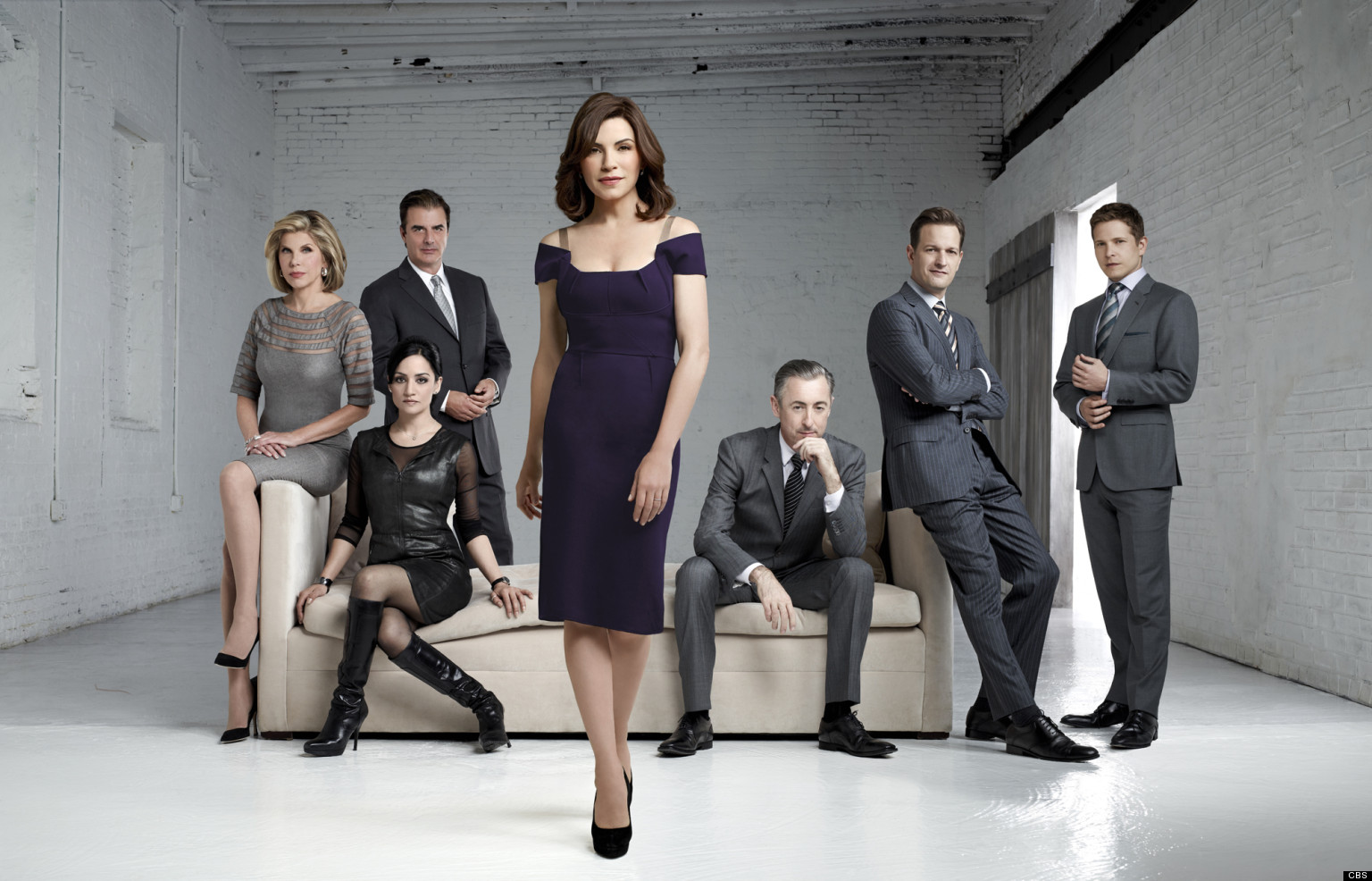
I'm only writing about it now, because of recent advertising that upsets me. CBS's The Good Wife is currently my favorite show (tied with Showtime's Shameless). It is easily the most well rounded show I know of. It's a political drama, a lawyer drama, and a family drama all at once. The amount that happens in one episode is equivalent to probably an entire season of Breaking Bad...or more. And still, while juggling so much, they never drop the ball. There is not a dull moment and nothing is ever predictable. For example, the season four finale was unbelievably incredible. In the fifty-ish minutes, there were over a dozen unexpected twists and turns. You thought you were following the story until the last shot of the episode, where you learned you were completely wrong and misinterpreted everything and were left with wide eyes and jaw dropped as you realized that nothing on this show will ever be the same.
I can talk about how phenomenal The Good Wife is forever, but that's not why I'm writing this. Back to my point. Here we are. Four episodes into the fifth season, with episode five coming out on Sunday, and it already feels like this next episode should be a season finale...or season premiere. No other show can tell a story as well as Robert and Michelle King. Their art speaks for itself. Example, as soon as last week's episode ended, I yelled to my roommate, "And that is what it looks like when shit hits the fan." I found out the day after that the next episode is actually called "Hitting the Fan." So why am I talking about this? Because CBS and The Good Wife have been really trying to create buzz about this Sunday's episode. I don't blame them, the entire world needs to see how great they are at their art. However, it's their methods that I'm honestly so appalled by.
At first, I came across a Buzzfeed article: http://www.buzzfeed.com/jacelacob/the-good-wife-hitting-the-fan-review. This came out the day after last week's episode, but it is a review on next week's episode. I thought maybe he got the title wrong, so I read it. He didn't get it wrong. CBS screened the episode for critics ahead of time to create buzz. I quote and agree with Jace Lacob, "I’m not one of those Good Wife adherents who qualifies their
passionate engagement with the Robert and Michelle King-created drama by
adding “on broadcast television,” as the show shouldn’t be forced to
carry such a backhanded compliment." The Good Wife is without a doubt one of the best television shows, period. Despite this, the ratings are not doing very well. My age group is extremely important when it comes to ratings, and nobody my age watches this show. The only people I know that watch The Good Wife are my roommate and my best friend, and that's only because I made them. I fear this is the last season of the show, as a result of their ratings. For that reason, I gave them some slack and didn't get upset about early reviews.
Then, the show released four sneak peeks on YouTube. They have been posting the videos like crazy on Facebook, Twitter, CBS's website, and whatever other social media networks. I do understand the need to keep their ratings up. However, those four sneak peeks add up to 7 minutes and 24 seconds of footage, from let's assume a 52-minute program. Now that pisses me off. Why is the solution to give things away, spoil parts of the next chapter, and insult your art? There has to be another way. The last scene of the latest episode contained a pivotal moment of the story. To keep this spoiler-free, let's just say it left us with one of the characters finding out that he is being betrayed by the last person he ever expected. Clearly, the entire next episode will be able how he reacts and how everything plays out. Now that's something I could spend an entire week thinking about, freaking out about, and waiting to learn about. However, there's no need to wonder how he will react. Just check out the sneak peek. No. Absolutely not. That is rude and offensive to character development, and I personally, as a fan, find it irritating that my experience of the story has been compromised.
Another example of this was the season eight trailer for Showtime's Dexter. My brother somehow convinced me that it didn't spoil anything, and I stupidly trusted him. SPOILER ALERT - The previously season ended with Dexter's sister Deb about to shoot him, then instead shooting a co-worker to save Dexter. If you watched the show, you'd know this is extremely unexpected of Deb, just completely out of character. There couldn't be a cleaner, more hard-working cop. She would never kill an innocent person. With an ending like that, the viewer is left wondering what happens next. Does Deb join Dexter as a serial killer? Does she turn herself in? Is she unable to live with herself? Here's the trailer to season 8:
How my brother thought that didn't give anything away is beyond me. Things I learned in that trailer that I shouldn't have: Deb turns to drugs, lots and lots of drugs, Dexter is safe, nobody knows that Deb killed LaGuerta, Deb blames and hates Dexter for what she has become, Deb wishes she shot Dexter instead of LaGuerta, there's some new character named Evelyn Vogel who is an expert at psychopaths and is a potential threat to Dexter, Deb is getting DUIs and getting into car crashes. Now my brother argues that all those things happen in the first episode of two anyways so it doesn't matter. I very much disagree. Every episode is important when telling a good story. Every scene is significant to the world that has been created. Deb's character change, like Will's in the next episode of The Good Wife, is a definitive moment and a game changer. Sneak peeks and trailers do not display critical moments properly. They ruin them.
Similar to my feelings towards trailers and sneak peeks, I despise the "Next week on (insert television show that I'm about to spoil)" that comes at the end of every episode. My only exception to this is "On the next... Arrested Development." At the end of every Arrested Development episode, there is an epilogue segment in which lingering stories are wrapped up or extended humorously. The scenes in this segment rarely appear in the next episode, but instead further ongoing jokes.
Most shows use a "on the next" or "next week on" to show mini clips of what will happen in the next episode. It is a pathetic attempt to get the viewer to tune in next week. If do you do your job correctly, engage the viewer, and end at a place where they would like to see the next part of your story, then they will tune in next week. I now know what direction they are taking the next step when I shouldn't. I want to know when I am supposed to know, which is when I would find out in the story. I used to have to run out of the room and down the hall when an episode of Walking Dead ended to make sure I heard nothing. Then I would come back, wanting to talk to my friends about what think Rick is going to do. Only all of them knew already that he would meet with the Governor. I find it aggravating that it's an option for people to hinder their viewing experience like this.
All my examples have been on television, but movies are even worse. Trailers give away every good part of a movie. Let's start with comedies. Go watch the trailer of a comedy that you have seen a dozen times. Try to tell me that the funniest lines, the ones you quote weekly, aren't in that trailer. Lies. They are. Moving onto action films, go watch the trailer of your favorite action movie. It probably showed every explosion, car chase, fight or battle scene in the movie. It isn't as cool to see that slow-motion bullet-dodging badass move in The Matrix (you know what I'm talking about) when you already knew it was coming.
The amount that is spoiled in a trailer is a major flaw of this industry. Why are we showing all of our cards? It isn't just that trailers spoil the funny lines or the big explosions. They're guilty of bringing you way too far into the story. It would be one thing if they set the stage, showed you life pre-initial plot point. It would be one thing if they revealed the first plot point that changes daily life. Either of those would be understandable. Trailers do more than that, though. They show key points in rising action and often show clips from the climax of the story. It is absolutely ridiculous.
My favorite trailer of all time is that of Hitchcock's Psycho. I'm warning you, it's long. Six and a half minutes long. I think it's wonderful though. Alfred Hitchcock gives you a tour of the set of the film. He brings you to different rooms where important scenes in the film take place. He almost talks about the action that takes place in each place, but repeatedly brushes it aside. By never revealing the action, he teases the viewer and draws their curiosity. I am not saying it's perfect, but I prefer this style of trailer to the ones that ruin key parts of the story.
Another great trailer is the one for Orson Welles' Citizen Kane. Welles himself narrates this trailer, similar to Psycho and Hitchcock. He introduces each key actor, then asks the characters (not actors) of the film what they think of the protagonist, Kane. Without a single second of footage of the actual film itself, Welles reveals what a complex character Charles Foster Kane is and invites the viewer to see the film and form their own opinion of the man. Again, I would love to see trailers more like this. Citizen Kane and Psycho both have trailers that honor the story being told. Hitchcock and Welles showed their respect and confidence in their art by advertising in this fashion.
I realize that it is my choice to watch a trailer or sneak peek or "next week on," and as you can assume, I choose not to watch those things. However, I believe it shouldn't be my choice. I respect the art of film and television and storytelling, because this art is my life. Not everybody thinks this way though. They don't care if things get spoiled and I have a problem with that. It's our responsibility as artists to preserve the art of storytelling and give our viewers the experience intended for them. It's time we find other methods to advertise movies and television shows, one that doesn't compromise the art.
Like many of us. I attended the workshop with Carl Potts on Tuesday and found some parts of it to be very interesting. I also never realized how similar comic books and films can be. At a basic point comics are just really detailed storyboards that could be used for a movie. It really was very interesting how many of the same visuals are used in comics, film, and television.
I think the most interesting part of the lecture for me was when Mr. Potts talked about different types of shots and angles. Although I have a little experience in filming things, and have a decently natural understanding about why some shots work and others don't. Mr. Potts was really able to break it down to a fundamental level. The idea that the long shot is the establishing shot, the medium shot is the action shot, and close up is the reaction shot was very interesting and I found it to be very true when I think about films in general. Another interesting discussion point that I found to be very interesting was the idea of map orientation as well as the 180 degree rule.
I have never been a big comic book guy and I would say after the lecture with Mr. Potts I really appreciate them a lot more. There is a lot I can learn from comics because what is film except a bunch of pictures played really really fast.
Last year, Youtube tried an experiment. They launched their own film festival, online, open to anyone. It was called "Your Film Festival", and judging by the results, I'd say it was a success. They had over 15,000 submissions, of which 50 were chosen as finalists for the world to vote on. The top ten were then shown at the Venice Film Festival, and voted on by a panel. The winner was a short film entitled "La Culpa" ("The Guilt"), by director David Victori. I would suggest watching it fullscreen in HD.
This is a stunning piece of work. It has an intriguing story that draws the viewer in, told with a minimum of dialogue. All the technical aspects, the camerawork, the lighting, the sound, art direction, and visual effects, enrich the story and contribute to the emotional depth. However, they do so in such a way that they never distract from the story, in fact, the technical aspects are almost invisible on the first viewing.
On closer inspection, it is all these small technical details that create such good visual storytelling. The camerawork, in particular, is used to display the characters' emotions without any dialogue. As the intensity builds, the camera motion becomes more and more erratic, which echoes the emotional turmoil and confusion that the characters are feeling. There are also some great shots where a character snaps into focus right when they have a realization or change of heart.
Overall, this short film is extremely well done, with great writing, acting and production. You can check out David Victori's other films on his Youtube channel, and the other finalists at Your Film Festival. No word on whether Youtube will be hosting this festival again in 2013, but here's hoping!
I've noticed there are two types of shows on television, the first is shows that have concrete main characters but a new, unrelated plot every time . These types of shows can be watched out of order with no actually progression of an overall plot. This type of television show can usually be seen in children's programs for example "Spongebob" or "The Rugrats." However as I have gotten older I have noticed another type of television programing as I started to become more interested in series television.
The first television series that has gotten my attention enough to buy the first season DVD and start from the beginning, in order of the series, is "Dexter". As I came to the completion of the first season I have started to notice a pattern in how the show is formatted. For every episode there is an individual sub-plot (in this case a bad person Dexter must kill) and also an overarching plot pulling on pervious episodes and the episodes of the future (for example Dexter's love life and the mystery of Ice Truck Serial Killer). Once I noticed this pattern I began to think of other popular television shows (everything from Nickelodeon's Avatar to Glee to Spartacus) and they all seem to follow this same format to one extent or another.
I had to then ask myself why? Well as a scriptwriter I looked at this from a storyline standpoint the sub-plot keeps every episode interesting and engaging for an audience that may not be familiar with the show but also heightens the engagement of dedicated followers. The overarching plot however is what creates the "show followers" and drive to wait and watch the next episodes. I believe this equates to the marketing of the show in a way. The fact that a television show can be enjoyed by someone new to it is equally as important as to entertain someone who has watched it from the start. Seeing a random episode of Dexter is what got me to start over from the beginning in order to understand what exactly was going on. The usage of two story-lines to in a way to attract new watchers while furthering the entertainment of followers of the series seems to be extremely effective.
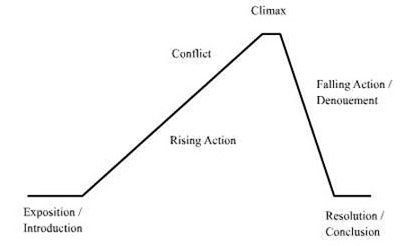
Another interesting point I would like to add is about the story structure of each episode. The basic outline of a conventional story is supposed to have an introduction, rising action, conflict, climax, falling action, and a conclusion…however as I have looked further into series television (or at least in the case of Dexter) this does not seem to be the case. I feel as though every sub-plot follows this basic outline curve however the overarching plot provides it's most heightened sense of emotion at the end of every singular episode. This climax at the conclusion if you will is what keeps audiences coming back and insights feeling of personal investment and connection within a series television program, turning first-timers into followers.
It would seem from my experience and my research into series television programs this story-line format is at the core for creating a successful televisions series. I have found that although some shows such as certain sitcoms and children's shows work on a per-episode basis, the shows that acquire the most "hype" and engage the audience most fully are those that utilize this idea that two plots are better than one. After taking time to verbalize all of my thoughts and as someone who is interested in series television and the television business I have found that taking time to evaluate my own personal reactions as an audience may help to understand how audiences I may one day market to work as well.
I saw this video a while ago. Maybe it will help groups with coming up with ideas for their films. It is definitely contains a wealth of knowledge.
This video basically walks you through Ken Burns's thought process when coming up with ideas.
Yes this is the same Ken Burns as the "Ken Burns Effect".
So hearing from such and influential person is always great, but at the same time it is humbling because he is human, not eccentric and his thought process seems normal when he explains it and most people can do the same.
One of the main things I got out of it is his math. Everyone is used to 1+1=2, but he is saying make 1+1=3, add that extra element that will make the audience feel. Manipulate them with things that they hold close to their hearts and you will come up with something truly great.
It's also cool hearing about how he can see stories so easily, like things that happen in history make such interesting stories. Like Jefferson writing that all men are created equal, but had slaves of his own and never freed them in his life.
So without further adieu here's the link to the video:
Video games have been a huge part of my childhood and teenage years. Now, as a college student, I find myself playing them less and less (it's more of a time thing rather than an interest thing). Regardless, I still appreciate the value video games have when it comes to creativity and storytelling. One unique things video games can be used for is to create machinima.
We talked briefly about machinima in class. It is essentially using real-world filmmaking techniques and applying them to interactive virtual spaces, which in most cases is a video game engine. One could think of it as a hybrid between animation and traditional cinema.
The types of videos created using machinima vary from features to music videos. Yes, there is even an academy for machinima arts and an international machinima exposition. I personally don't know of any long-form machinima, but it most certainly is a legitimate form of art/filmmaking.
Some of the only machinima that I have watched is not even true machinima. There is a fantastic YouTuber, Captain Sparklez, who produces video game content as well as music videos about games such as Minecraft.
While some of his earlier work is done mostly through the actual game, some of his stuff (like the video above) does not use the physical video game engine at all to produce machinima content. The style and look is almost exactly like Minecraft, but is actually animation. I personally like it better.
The ability to tell stories through non-traditional ways is really interesting, and machinima is a great outlet. There are many popular series, such as Red v Blue (done using the Halo games). I am excited to see where this form of art can go.
Welcome everyone!. The following project structure is intended to provide you with a methodology to be both specific and help you track the progress and meet your milestones. Since individual projects vary widely some points might not apply. However, you can use it as a roadmap to define/clarify your goals and go back to it frequently and methodically.
It has four distinct phases:
DISCOVERY
This phase helps you understand the big picture and the opportunity to achieve the main goals of your project; to take an idea from conception to completion in the most effective manner.
Brainstorming, sketch scenarios, analysis and feasibility assessments.
Define the requirements, scope, timeline, budget (your time and resources) and benchmarks for the project.
Synthesis:
Produce a final script with the discovery result.
Develop a production plan and a storyboard.
Present a timeline and a budget estimate.
Don't be afraid to make mistakes! invent associations, structures, forms, silences, sounds.
DESIGN
During this phase, create the look and feel of the story. Develop the story requirements, the creative components, the technical design and the infrastructure that supports the project.
Creative Design:
Storyline and character creation
Script
Storyboard
Art Direction
Audio Design
Production Design
Technical Design:
Equipment requirements
Set/backgrounds/location/plates
Lighting diagrams
Special efx design
Models, costumes and makeup
PRE-PRODUCTION
Develop and integrate all the creative, technical and information components.
Research, research, research!
Location Scouting
Set design
Casting
Graphics, 3D video/audio production needs
Technical integration
PRODUCTION
Lighting
Rehearsals
Systems testing
Problem resolution
Cinematography
Sound
POST-PRODUCTION
Media Management
Editing
Sound Mixing
Color Correction
VFX
Title Design
DEPLOYMENT
Live environment:
Projection
Audience Test performance and feedback
Implement promotion/communication strategies
Showtime!
That's all folks!
1-Quality: the true nature of things, the peculiar and essential character
Welcome everyone!. The following project structure is intended to provide you with a methodology to be both specific and help you track the progress and meet your milestones. Since individual projects vary widely some points might not apply. However, you can use it as a roadmap to define/clarify your deliverables and go back to it frequently and methodically.
It has four distinct phases:
DISCOVERY
This phase helps you understand the big picture and the opportunity to achieve the main goals of your project; to take an idea from conception to completion in the most effective manner.
Brainstorming, sketch models, scenarios, analysis and feasibility assessments.
Define the requirements, scope, timeline, budget (your time and resources) and benchmarks for the project.
Requirements of Analysis:
Prioritize and validate requirements based on quality(1) and strategic factors
Determine success criteria and metrics
Define a preliminary list of production requirements.
Synthesis:
Produce a final script with the discovery result.
Develop a high-level implementation plan. (storyboard)
Present a timeline and a budget estimate.
DESIGN
During this phase, create the look and feel of the solution (style). Develop the story requirements, the creative components, the technical design and infrastructure that supports the project.
Creative Design:
Storyline and character creation
Script
Storyboard
Art Direction
Audio Design
Production Design
Technical Design:
Equipment requirements
Set/backgrounds/location/plates
Lighting diagrams
Special efx design
Models, costumes and makeup
PRE-PRODUCTION
Develop and integrate all the creative, technical and information components.
Creative Production:
Location Scouting
Casting
Rehearsals
Graphics, 3D video/audio production needs
Technical integration
Technical Production:
Set design
Lighting
Cinematography
Sound
System testing
Problem resolution
DEPLOYMENT
Demonstrate the solution after all final specifications and testing results.
Live environment:
Projection
Audience Test performance and feedback
Implement promotion/communication strategies
Showtime!
That's all folks!
1-Quality: the true nature of things, the peculiar and essential character