Showing posts with label character. Show all posts

Thursday, February 11, 2016

A Clown's History of the United States

When writing the script for my thesis, I have to admit I went in blind. I had no real prior knowledge of clowns other than what was depicted in various forms of media. This was definitely a problem. I didn't want my clown to fall victim to these clichés. So I decided to give myself a little history lesson.

Clowns originated all the way back to Roman times. They performed as secondary figures in farces and mime, parodying the actions of more serious characters. Then, during the middle ages, Court jesters and fools emerged, entertaining figures of power and authority. And if they failed, they would be decapitated. But obviously, times have changed.

There are three types of clowns.

WHITE-FACE CLOWN


The White-face clown is the ‘classic’ clown, the oldest and most well-known of the clowns, and is typically the straight clown in skits. This is the oldest style of clown, dating back to Greek theatre. Whiteface is the court jester of the Middle Ages. The White-face is the most intelligent type of clown with the highest status - typically the ringleader.

AUGUSTE CLOWN


In the 1860s, or so the story goes, a low-comedy comic appeared under the name of Auguste, who had a big nose, baggy clothes, and large shoes. He worked with a White-face clown and always spoiled the tricks by appearing at the wrong time to mess things up. This then became a type of act – called the Auguste clown. The Auguste clown is the least intelligent, and zaniest of the clowns. The Auguste clown tends to be the silly clown in skits. 

CHARACTER CLOWN


The Hobo or Tramp clown is the most popular character clown, although character clowns can be police officers, women, babies or government officials. The Hobo usually has tattered clothes, a tattered hat, make-up which suggests he is unshaven, exaggerated features and a red nose. The generic Tramp character is 'down-on-his-luck'. The Tramp clown is an American creation. Charlie Chaplin as the silent 'Little Tramp' clown, brought laughter to millions worldwide through film.


Now, that I knew a little bit more about clowns, writing the script became easier. I knew exactly what type of clown I wanted to make my clown and how I wanted to depict him. It’s crazy what a little research can do!


Thursday, January 28, 2016

The Graduate

     I've been watching a lot of dramatic comedies lately to get into the mindset of what I want my movie to 'feel' like. The Graduate might be the most famous dramatic comedy, or dark comedy, of all time. So I rewatched it to try to get a quick master class of funny/sad that Mike Nichols seemed to do so well


     The Graduate is a movie that seems to defy explanation. Even Roger Ebert was greatly divided on the film. When he first saw it he called the movie "the funniest American comedy of the year". When he reviewed it again for the 30th anniversary special he called it "a movie about a tiresome bore and his well meaning parents."


     What I think divides the younger and older Roger Ebert, and people in general, is that Dustin Hoffman's character, Ben Braddock, doesn't really change. The beginning of the film tells a lot thematically. Ben is on a moving walkway in an airport and while he is "moving forward" he is not walking or moving himself anywhere. People pass him and he watches them go by. Ben is also facing towards the left, which in traditional American film means going backwards or against the grain.


    Throughout the course of the movie Ben doesn't do much. He sits in his pool and ignores his family friends. The main conflict of the film, Ben's affair with Mrs. Robinson, is started not by Ben but by Mrs. Robinson. The argument can be made that Ben changes when he falls in love with Elaine and follows her to Berkley and then again follows her to her wedding. 


     But Ben's reasons are still completely selfish. He is in love with Elaine because she is in the same "not moving" position he is. There are several moments where this is implied in the cinematography, most famously the runnning scene.


   This begs the question that is asked every god damn semester in every film class. In film, does the main character have to change? I'd argue no. Ben doesn't change much in The Graduate. But what does have to happen is that audience has to see that the character has the ability to change but, for whatever reason, does not. Nichols shows this inability to change as a tragedy as Ben and Elaine pull away. What we thought was a happy tale of romance is just the characters realizing they haven't changed.


     My goal for this semester is to make a movie where a character is given multiple opportunities to change but ultimately fails to do so. I think it's a powerful form of story telling that encourages introspection. While it is easy to say this, and showcase a movie in which this happens, it will be difficult to pull off. It will require constant rewriting and meticulous shot planning. I never thought I would say this but I disagree with Roger Ebert. The Graduate is a film that stands the test of time. Not as a comedy, but as a complex movie about depression and the selfishness in passiveness. 


Thursday, September 24, 2015

Location is a Character

This may well come off as one of my more obvious blog posts, but I think it's something that's really important for everyone to remember as we all start gearing up to make our films; location should always act as a character. A silent, unflinching, omnipresent character, but a character nonetheless.

Surprisingly enough - as I'm just now finding out - you don't get a whole lot of interesting results when you Google "film locations as characters." But pick any great movie or cinematic TV show and boom: there it is. Let's take, for instance, Mad Max Fury Road. The barren, deserted landscape practically breathes. It not only presents itself as an obstacle to the characters, it comes to life. The movie was filmed in Namibia (unlike the first three which were shot in Australia) and the desert sands and dunes are literally blown out of proportion in order to bring the movie to life. It gives the movie a distinct tone more so than any other element of the film; while the (sparse) dialogue and set design are unique, it would be nothing without the location itself.

Let's take another example: True Detective. The only thing that the first and second season even remotely have in common is how they treat their locations. In the first season, director Cary Fukunaga both played with expectations and met them in his use of the creepy bayous and run-down areas of Louisiana (fun side note, here's a link to a tour you can take that has 13 locations from the show). It also had this boat that looks like it's floating on land, but that's more of a cool shot than anything else. They used the locations to really bump up the level of creepiness that oozes throughout the season, and at a certain point, you start to feel like it's its own entity.

Same goes for season 2. No matter what your opinion of it may be (it sucked) they still use location as a major indicator of what's happening and what matters. I'm pretty sure that the aerial shots of freeways and various roads take up more screentime than Rachel McAdam's character. It, too, sets the tone: instead of the slow burn, Southern feel of season one, we now know that we're in a world where everything is constantly moving forward, with little hope of ever coming to a halt. It's a bit more inconsistent than the previous season, but the point still comes across.

No Country for Old Men, Lost in Translation, Cool Hand Luke, Drive, any movie that prominently features the city of New York: all of these treat their locations as a character (to see where I got all of those ideas from, here's a list on letterboxd I found that more or less sums up what I've been talking about). Locations can add tone, texture, and feeling to a film, and if you use them right, you'll be that much better for having done it.

Thursday, April 30, 2015

Ex Machina

     I was told to watch Ex Machina with the person I'd seen Her with. The movies are similar, both feature AI women portrayed beautifully. However tonally the movies could not be farther apart.  Ex Machina is a powerful film that plays with audience expectation and creates a setting that is striking and unique. 


     Alex Garland, of 28 Days Later and Dredd, wrote and directed the psychological sci-fi thriller. The film is a blend of thought provoking cultural importance and visual storytelling. The main characters are Caleb, a sympathetic hard worker, who has won the lottery to meet his boss Nathan, who Caleb describes as a Mozart of programming. The last of the major players is Ava, an AI created by Nathan that Caleb is to give a Turing test. A test to see if Ava truly has consciousness. 


     The cast does a phenomenal job. Domnhall Gleeson, who actually played an AI himself in Black Mirror, is believably tepid and Oscar Isaac is brutally intimidating, both physically and mentally, as Nathan. This is the first major role for Alicia Vikander, who plays Ava, who creates a strong dissonance between the humans. 


     The film is heady. All the major players are hyperintelligent. In a moment in the film Nathan and Caleb are sitting under a hut on Nathan's beautiful estate. The colors are constantly blue and green outside and inside, when the power cuts out especially, the walls are red. This is an ode to RGB color. Nathan and Caleb are sitting under the awning and Caleb says "I am become death, the destroyer of worlds." Nathan says Caleb is quotable. Caleb responds that it's a quote by Oppenheimer the inventor of the atomic bomb. Nathan says he nows.


     Ex Machina is masterfully rendered futuristic space with a plot that is created by characters working off each other in unfamiliar spaces. The film is powerful and wants it starts moving it can't be stopped.


Friday, October 24, 2014

4 Tips for Writing Directing and Producing a Short Film

Writing a great script for a short film is hard. Most people feel like you have to lengthen the script to create an in depth story, which isn't true. To make the most of your limited pages and minutes use these ideas:

1. Create complex characters. 
Before or during writing, ask yourself some questions about your characters. Asking questions like "What was the worst moment in your characters life?" might seem silly, but it could lead you to some very interesting conflicts and plot points in your story. If anything questions like this will help you to make a world around your character it makes sense for them to exist in.  Here are some character questionnaires to start with.

2. Don't neglect your set. 
Though most of us are just happy to get a location to shoot in, remember that the location of your film can be a goldmine for planting character information and foreshadowing. Avoid exposition through dialogue by leaving a characters room a mess with clothes and make up before a date, or show the room as immaculate if your character is very controlling.

3. Make dialogue that sounds real. 
People in the real world don't talk in full sentences, they sometimes stutter, pause, misspeak, use contractions. Read your dialogue out loud while writing. Do you believe someone would actually say it? Don't waste time with lengthy dialogue when you could convey the same idea visually.

4. Be confident.
Throughout this process realize that this is your vision and you are going to have to work hard to bring it out to the world. Be your own best advocate. Be confident that your idea is great and that it can impact something, and people will be willing to help. No one wants to work on a film that even the creator isn't excited about.

Friday, October 10, 2014

Response: Manhood and The Bechdel Test


Colin Stokes brings up some vital messages films are sending to children, specifically boys. Most importantly, he raises the issue that there are many wonderful heroines smashing the patriarchy for little girls to idolize, but no male characters for boys to look upto that are defying the patriarchy. This is crucial. Currently, the heroism is synonymous with "becoming a man" and scooping up a nice lady prize in the end. 

Stokes mentions a specific test he has movies undergo before sharing them with his children. This test was first coined by Allison Bechdel in 1985. There are three points of criteria all movies must meet,

This test is incredibly interesting to me and I feel that it raises important attention to female characters and their true role in the films they're in. Specifically, Stokes mentions Princess Lea in "Starwars" who "waits around the whole movie to give our hero a medal and a wink." I agree with Colin, for the most part. I do however believe that there are some flaws with The Bechdel Test. One is simply the shaming aspect of the test itself towards enjoying a film that drops the ball in one of the three criteria (over 80%). The test fails to take into account the complexity of conversation. Regardless, it's important for us as the viewers to be aware of the one dimensional purpose Hollywood places on women so we are able to talk to our children to prevent them from being put under the wrong impression. 
Bechdel's test isn't the core of what Colin is trying to get at, he's mostly emphasizing the importance of what we learn alongside the characters in the films; the purpose of characters and how they go about "saving the day." He encourages collaboration with friends sharing common goals (Tangled) as opposed to violent conflict and female prizes (The Lion King). He pushes for application of skills towards the greater good (Kiki's Delivery Service) versus moving up a male hierarchy through mastery of a skill (Ratatouille). This is something I am on board for. These are the movies I'd also love to see more of.

Twin Peaks


David Lynch, of Eraser Head fame, made a very strange TV show in the 90's. Trying to explain what twin peaks is to someone who's never watched it is very difficult but I'll try my best. The show at first seems like a soap opera about a detective. It's melodramatic, slow paced, just like the opening credits. Then the plot.. thickens. Twin Peaks is not what it seems, almost nothing is what it seems, as log lady will tell you:

Characters like Log Lady (heres a funny buzzfeed list about her) are what make Twin Peaks so enamoring. Lynch and Frost create a town so small, and so weird, that you cant look away. One of the huge parts of the show is the sound and the score. Though at first it feels cheesy, accept the weirdness David Lynch is throwing your way and you will not regret it.

(Agent Cooper and his best friend)
(Audrey Horne, her hair is full of secrets)

First there's Agent Dale Cooper, an FBI agent sent to town to investigate the murder of Laura Palmer. He loves nothing better than an incredible piece of pie and a damn good cup of coffee.
(Bobby and Shelly)

Next is Audrey Horne, seductress, misunderstood, and written off by her father and many others as a silly teenage girl. She is strong willed and goes to extreme lengths to prove she's not a bratty airhead teenager, as she first seems.

Benjamin Horne, Audrey's father, mostly ignores her and treats her like a little girl. He is a twisted man, which I won't explain. Watch the show to find out just how awful a person he is.

(Leo & Shelly = creepy)
Bobby Briggs is the first suspect in Laura's murder, he was her boyfriend, and is a very 90s-grunge, angsty teenager. He is a smart ass, and as other rebellious teens before him, is the polar opposite of his military man father.

Bobby, however, was seeing Shelly Johnson behind Laura's back. Shelly is married to Leo Johnson but is very obviously scared of him. Shelly's relationship with Leo is more similar to an abusive father-daughter relationship than husband and wife.

(Donna Hayward on life post Laura Palmer)
Leo Johnson is a scary guy. There's something off about him, and he's somehow connected to the drugs that Laura was addicted to before her death.

Donna Hayward, the deceased Laura Palmer's best friend is devastated by her death. Donna is left questioning why Laura died, and why she hid so much of her life from Donna. She's also struggling with her feelings for James Hurley, who Laura was seeing behind Bobby's back.

(James' reaction to Laura's death)
James Hurley is arguable the worst character on the show. His character is weak, uninteresting, and his reactions are unbelievable. It's a wonder he was able to get Laura or Donna to give him the time of day.

There are many other interesting characters on the show I could continue to go on about forever but these few are the most important. You'll just have to watch the show to find all the other weird people.

Coincidentally it was just announced that Lynch and Frost will be writing an directing a continuation of the series to air in 2016.


Wednesday, October 30, 2013

Typecasting

Typecasting is a word that's thrown around the Hollywood industry quite often. It's defined as "the process by which a particular actor becomes strongly identified with a specific character, one or more particular roles, or characters having the same traits or coming from the same social or ethnic groups." Many people try to claim it's not a real thing. They say it's just a stigma we place on actors who we don't want to see in certain movies. Well, typecasting isn't what we decide to think or believe, it's just something we have to accept to be a fact of acting life.


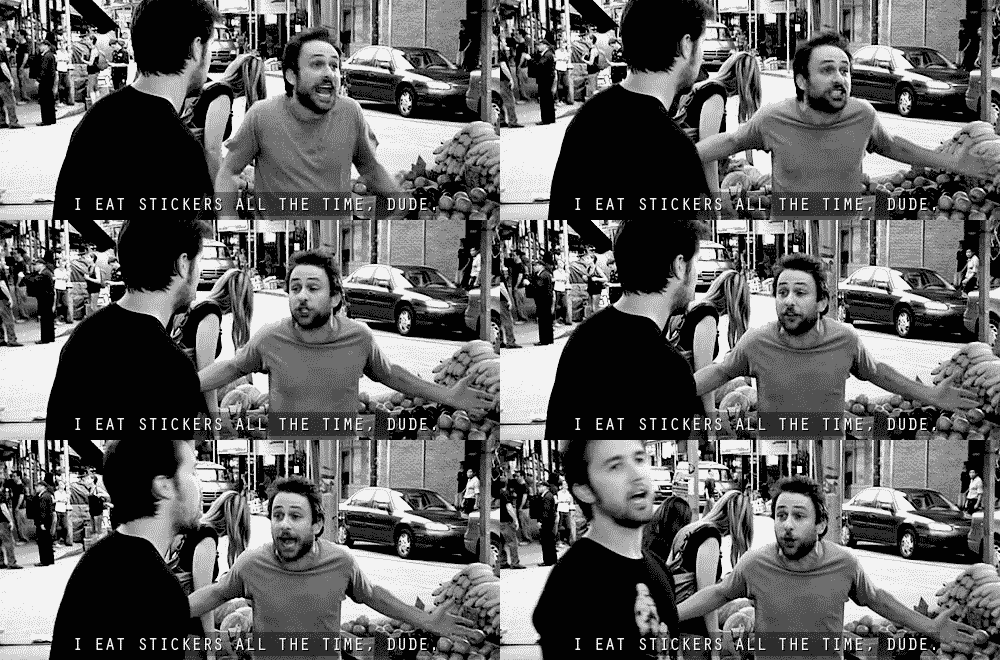
Think about it. Could you ever take a movie seriously if The Rock ever played a role like, I don't know, a tooth fairy? The ten actors in the video are some of the best examples for typecasting. With maybe one or two exceptions, none of them could ever be taken seriously in any other type of role. On of my personal favorite examples of typecasting I've recently seen has actually been discussed in a couple of my earlier posts. Charlie Day is an actor who's known for playing narrow-minded dimwits in productions such as It's Always Sunny in Philadelphia and Horrible Bosses. In his most recent project, Pacific Rim, he plays an incredibly intelligent scientist who manages to find a solution to an invasion of monsters from a different universe. Yeah, I laughed, too. It's absurd to even think about.


This wasn't supposed to be a particularly long post. Typecasting is a simple concept that people just don't often think about. Are there some actors who are able to escape the confines of typecasting and who go on to broaden there résumé? Yes. But many, many actors are often stuck in the same kind of role for the majority of their film careers.

Wednesday, October 16, 2013

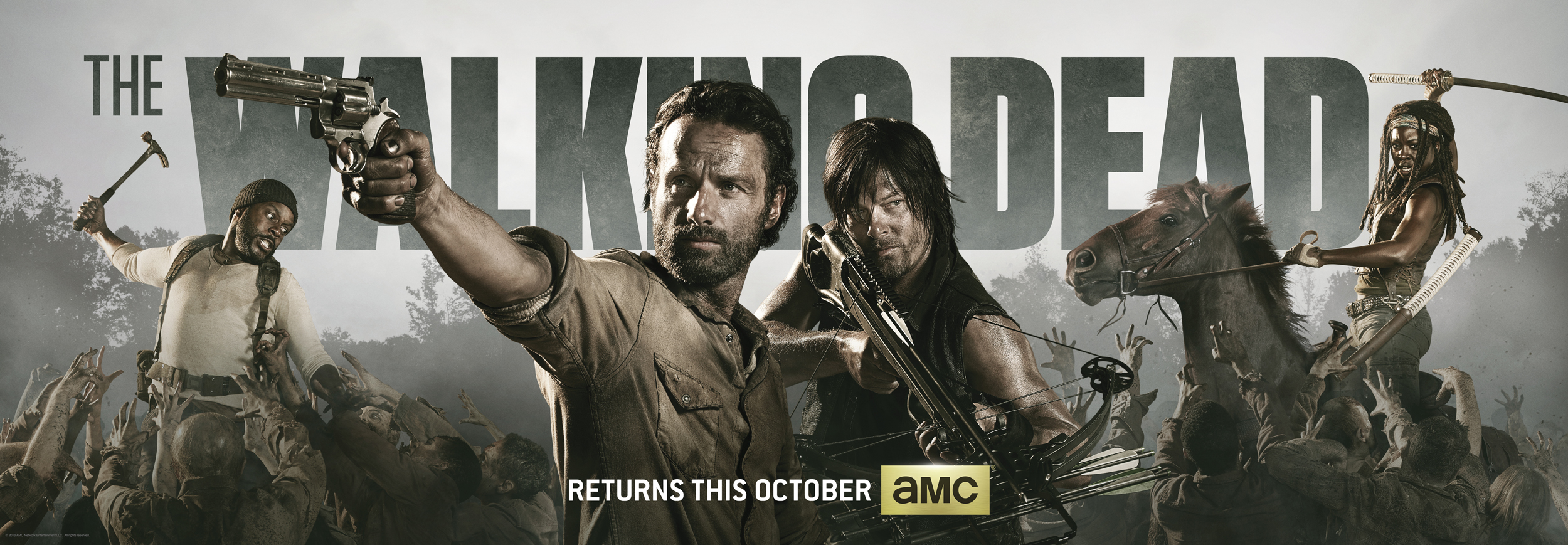
The Walking Dead and the human condition

Hello there. I'd just like to take a minute out of your busy, busy schedule to discuss The Walking Dead. More specifically, I'd like to discuss the season premiere that came out last Sunday, so if you haven't watched it yet, but intend to, I'm giving you a heads up that there may be some spoilers coming your way. What The Walking Dead does very well--at least in my opinion--is portraying characters and the human condition. Basically, the writers for the show (Frank Darabont and Scott M. Gimple) do a wonderful job subtly showing viewers how, even though there's a zombie apocalypse going on, the characters still seem to maintain their most human characteristics.

First off, let's talk about Rick. Rick Grimes--father to Carl and leader of the "resistance"--is focused on a lot in the season premiere. In the opening of the episode, we see Rick tending to the garden and pig pen which he apparently built in the off-season. As a good father, Rick tells his son not to get attached to the pigs by naming them since they're simply going to be used for food. It turns out that Rick has already given them names of his own. Like a normal person, he himself has gotten attached and cares for the things he's taking care of, basically like pets. Later in the episode, Rick finds a woman wondering around in the woods. In the midst of a zombie apocalypse, many people would have just killed her--as previous episodes have shown--but Rick wants to help her. The only problem is, his past experiences have left him very suspicious of strangers. He could have just killed her right then and there, but, holding on to what makes him human, he chooses to try and help the woman.

Next up is Carl Grimes. Carl is Rick's son. He's a character who viewers typically, well, strongly dislike. Nobody quite knows why, but we all dislike him. Strongly. Anyway, in this episode, Carl names the pig as previously stated. He gets attached to his "pets" like any other normal kid would do. He also accidentally slept in due to his reading comic books with a flashlight until really late at night. What Carl, and even Rick, often forget, is that he's still a child. Despite his many attempts to act older and more mature than his age, he is still indeed a kid. This is strongly highlighted later in the episode when he refuses to go to story time that's held everyday for the kids. He says it's too childish for him to go to, but he later sneaks into the room so that he can listen to the stories. The season premiere of The Walking Dead really did a great job subtly reminding viewers that the stubborn, protective guy they're watching is actually still a little kid.


The woman in the woods, Clara, is a character that appears towards the beginning of the episode and kills herself towards the end (sorry, I said there may be spoilers). As her and Rick walk through the woods, she talks about her husband and what he taught her. She explained how he taught her what was often necessary to survive in a post-zombie apocalyptic world. He taught her how to steal, betray, and sometimes kill other people in order to stay alive. What was so touching about the writing in this scene was that it so strongly highlighted people's tendency to want to do good. While the need to survive may out-trump our original instincts, most people are not born complete savages. In order to be able to do such terrible things, one must often be shown how.

The final character I'd like to discuss from The Walking Dead's season 4 premiere is Bob (yes, just Bob). Bob is a new character who we don't really know anything about. The reason for his appearance in this post is what he did in this one episode. While the characters were searching around a convenience store for supplies, we see Bob stop in the alcohol section of the store. He stares at a bottle of wine, seems conflicted whether or not to take it, then eventually begins putting it in his bag. He then stops himself and puts the bottle back on the shelf. Bob's actions could indicate that he's a recovering alcoholic. While he's searching for necessary supplies in order to survive, he still has trouble fighting his urges and desires. The writers did a phenomenal job with this scene because, while nothing is explicitly said, viewers can deduce that Bob most likely struggled with alcoholism at some point in his life and is still dealing with it. It doesn't matter whether or not there are zombies knocking at your front door. If a person has an addiction to something, the urges don't simply go away overnight.

In the Season 4 premiere of The Walking Dead, the writers truly did an excellent job emphasizing the human condition. The episode showed all the characters are still human despite all the nonhumans trying to eat them.

Sunday, October 6, 2013

Pacific Rim. Really?

*WARNING - spoilers to follow*
A few days ago, I finally got around to watch del Toro's Pacific Rim. I truly wish I hadn't. I really just need a place to rant about it. After just barely being able to force myself to finish the movie, I simply had to look online to see what others thought of this disaster. Turns out, a whole lot of people actually really enjoyed it. The movie somehow received a 72% on Rotten Tomatoes and a 7.5 on IMDb. Seriously? You've got to be kidding me. I'm sorry del Toro, but here's why you don't deserve those scores.

The first issue I found with the movie started, well, at the very beginning. A voiceover. That's what the director thought would be a good way to start the movie. A voiceover is probably the biggest copout anyone could use in order to catch viewers up to speed. While it's an effective way, it's the least creative and simplest way to summarize what's happened up to what we're seeing. There are dozens of other, better ways to do this.

For those of you who don't know, Pacific Rim is about an alien invasion from giant, reptile-like creatures, called Kaiju, that come from deep under the ocean's surface. Us, meaning humans, build giant Rockem Sockem Robots, called Jaegers, to fight off these creatures. The voiceover used at the opening of the movie basically summarizes the aliens' first arrival and the battle that's been going on for so many years to fight for our survival. Instead of a voiceover, del Toro could have simply used quick shots of news channels so that viewers understood what was going on. That's probably the simplest substitute. Honestly, even if there was absolutely no introduction to the issue, the plot was simple enough that viewers could figure it out on their own.

The second, and probably the largest, issue I had with Pacific Rim was the fact that there was absolutely no trace of character development. Sure, Idris Elba's character eventually warmed up to the idea of allowing his adopted daughter, Mako, to become a Jaeger pilot, but that's merely because the entire planet would be doomed if he didn't. Elba's character remains the same hard-assed man throughout the entire movie. Raleigh, the main character of the movie, never strays from his "unpredictable," loose-canon nature. I don't think his tone of voice ever really changes either. Mako, pretty much the only female character in the entire movie, simply wants revenge for the death of her family. When she was young, a Kaiju attack wiped out her entire city, which is when Elba's character finds and rescues her. One would think that, being a movie and all, Mako would eventually put her lust for revenge aside so that she can better fight the monsters and save the planet. Nope! That would simply be too close to making Pacific Rim a half-decent movie. You would probably see more character development if you replaced every single character in the movie with a sack of potatoes.

Actors are the life force that drive a movie. They have the power to decide whether a movie tanks or becomes a hit. I'm not quite sure who picked the cast for this movie, but they sure did a very poor job. The main character, Raleigh, played by Charlie Hunnam, was probably the least emotional character I've ever watched in my entire life. Hunnam's monotone voice and blank facial expressions made for a reasonably boring, one-dimensional character. I was nearly put to sleep during his few monologues.

Idris Elba, who played the role of Marshall Stacker Pentecost (which really isn't a name to begin with), pretty much had the same issue as Hunnam. At the climax of the movie, when Pentecost decides to return to Jaeger piloting, he yells "We are canceling the apocalypse!" Anyone who's at least seen the trailer knows what scene I'm talking about. This very moment should make viewers sit on the edge of their seats, overly eager to see what's about to happen. Me? I felt nothing. I was shockingly indifferent due to Elba's tone which slightly resembled that of a parent scolding a child.

I'll end this topic with one last example of poor casting. For some strange reason, whoever was in charge of putting this odd cast together thought it would be a good idea to place Charlie Day, an actor who has been reasonably successful in recent comedies, as the doctor/scientist character in Pacific Rim. I understand Day probably wanted to try out a new role, and I understand that his character was meant to add a bit of
comic relief to the movie, but what I don't understand is how viewers are supposed to take his character at all seriously. Typecasting is a thing. It's a sad fact of the movie industry, but nonetheless, it exists. If Dwayne "The Rock" Johnson was cast as a tooth fairy (oops, that's already happened), nobody would be able to take the movie seriously. It's simply too far outside of their normal roles. Some lucky actors are able to escape the monster known as typecasting, but Charlie Day is not one of them.

The final issue I found with Pacific Rim came towards the end of the movie. What many action movies like to do is state the solution to a problem and try to bullshit their way into making it sound like a discovery that required some higher level of intelligence. What really happens is that the writers of the movie can't think of a way to realistically solve the problem, so they make a solution appear out of thin air.

A prime example of this situation is demonstrated towards the end of this movie. When all hope is lost, and the resistance is convinced that the Kaiju will finally wipe out the human population, Charlie Day's character decides to use the futuristic technology that exists in the movie to connect his mind with that of a dead Kaiju's brain. Even according to him, this kind of experiment would have killed pretty much anyone, but of course, that would inconvenience the movie's plot too much. Day's character then claims, after magically surviving the procedure with little to no physical damage, he "discovered" that placing a nuclear bomb in the space-time bridge, which the monsters have been using to get to Earth, will collapse the bridge and end the invasion. There was no fictional scientific proof. There was no questioning his logic. It just worked. Poof. No more Kaiju invasion.

For a guy who honestly enjoys watching the occasional mindless action flick, I can say that I've never been so close to turning off a movie so many times. Was Pacific Rim an awesome movie? Yeah, I guess so. I'd be lying if I said it wasn't fun to watch a giant robot smack an alien over the head with a boat. I'd also be lying if I said the robots probably didn't kill more people than the actual aliens did when they would throw them through heavily populated city buildings. Pacific Rim was basically just Transformers on steroids. It was twice as awesome, but just a mindless.