I've never particularly enjoyed watching horror films, but recently, I've been really interested in figuring out some of the different techniques involved in making something scary. I know that quite a few directors get their big breaks helming scary movies (mostly because of the generally low budgets and good audience turnout) but I thought it would be cool to go back and revisit some of the classic staples of the genre. Tis the season, right?
So I started with Kubrick's The Shining. Not only had I never seen it before, but this was my first time watching any movie by Stanley Kubrick. Putting aside all of the myths and reputation that surrounds the guy (I mean, 127 takes for one scene? Come on man.) I gotta say that I was really impressed. I haven't been that drawn in and held by a 2.5 hour film - or any film, for that matter - in a pretty long time. I've read the book, and even though it differs significantly/Stephen King hated the adaptation/Nicholson is just a littleeeee too over the top, it really worked as a standalone product. It was also the kind of horror movie that I can get behind; creepy, but never made me feel like I was going to piss my pants.
Kubrick pulls out pretty much every horror movie trick in the book, but uses them all in ways that never feel trite or cliched. I'll go over just a couple of them, and try my best to explain why they're so effective.
1. The Jump Scare
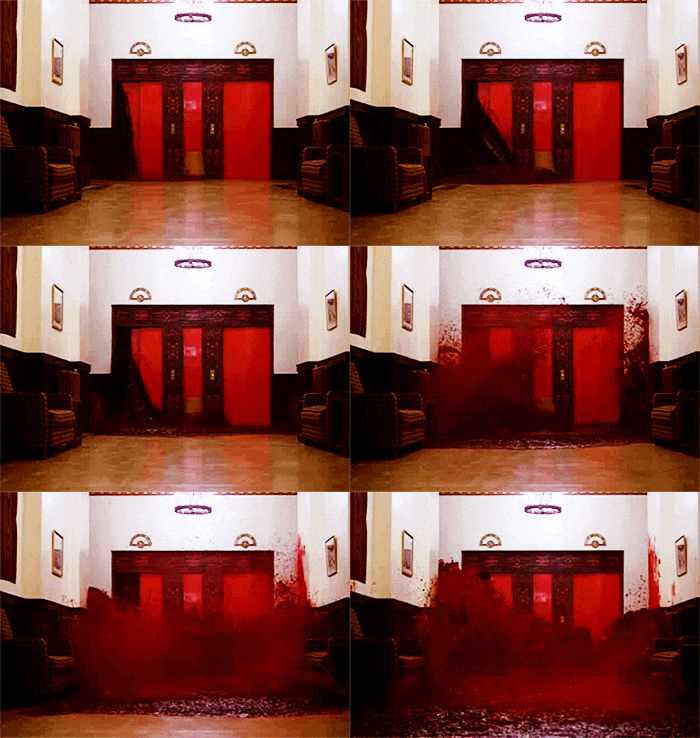
Ah, the old go-to, and the real reason why I hate a vast majority of horror movies. Kubrick uses these sparingly in Shining, but when he does, he uses them to great effect. Typically, the jump scare will be the payoff after a bit of increasingly brutal tension-building, partnered with a loud, punctuated sound effect. It works, but 80% of the time it just comes off as a cheap, annoying scare. The only time Kubrick uses these are when you least expect it. There's no build up, for example, the first time that he cuts to the blood pouring out of the elevator doors - that entire montage comes out of nowhere and is terrifying. Same goes for when Jack kills Halloran towards the end of the movie. It's entirely unexpected, and all the better for it.
2. The Reveal
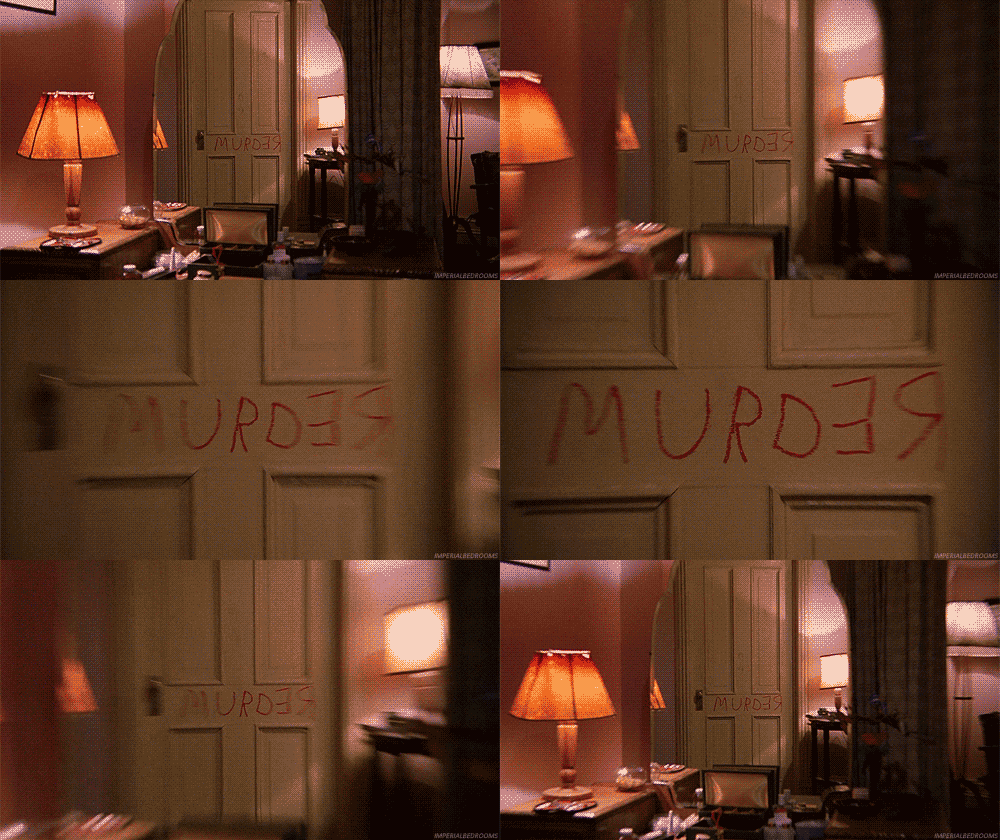
A little less extreme than a jump scare, and usually a bit more predictable, the big reveal scares can still have a strong effect. Kubrick toys with this a few times, but most notably in the "redrum" mirror reversal. Mirrors have a big role in the movie throughout, but the one in the Torrence family bedroom - having been teased for the first two or so hours - has the biggest one of all. All of the shots of Danny pedaling around the hotel corridors also use more or less the same tactic: the smooth steadicam shots lull you into a sense of security, but keep you wondering just what exactly will be around the next corner. Which brings me to the last thing...
3. Sometimes the scariest thing is never shown on screen
Pretty self-explanatory, I think. More often than not, your imagination is capable of scaring you way worse than any image actually could. This is what makes scenes like when Danny first shows up with a bruised neck so powerful. We know that he goes into room 237 and we know that HE SHOULDN'T FUCKING GO INTO ROOM 237, but for the moment, the lack of any visible antagonist is worse than anything they could have shown in the room at the time. We know it's not Jack or Wendy, so...we imagine the worst. The same thing goes for any horror movie. I've never seen It Follows or Rosemary's Baby, but apparently in both, the lack of something makes it all the more scary. Sometimes, the best way to create this sense of dread is by showing your entire environment in a wide shot, and let the audience's imagination work overtime, trying to predict where and when something will pop out. The indefinite waiting is usually worse than than the actual monster.
Also, last but not least, those whip zooms? Seriously digging it.
Steadicam shots are used in several major motion pictures today, as several of these directors and cinematographers are reaching for the limitless possibilities of camera movement. Essentially, the steadicam stabilizes the camera from jitter due to the camera operator, giving a smoother image. Its use goes back to 1975 when it was first implemented in the film "Bound for Glory," shot by Haskell Wexler, which can be seen in this shot here:
Of coarse the running sequence from "Rocky" is another early use of the steadicam that was shot only one year later. Garrett Brown, the original inventor of the steadicam, was the operator for each of these notable sequences. Then in 1980, the invention was pushed even further when Stanley Kubrick and cinematographer John Alcott asked for the camera to be lower to the ground, for certain famous sequences in his film "The Shining".
Last class I brought up that Spielberg was developing a project about Napoleon Bonaparte that Kubrick wrote, so I decided to spill a little more information about the upcoming project since this class now revolves around all things Stanley Kubrick.
Spielberg plans to make a mini-series out of the script Kubrick wrote after he finished filming 2001: A Space Odyssey. The story of Kubricks most famous unfinished script is actually quite fascinating. Apparently, after Kubrick initially wrote the piece, he was quite dissatisfied with much of it (not surprisingly, since he's known for his perfectionism) but did include a list a list of production and budget notes. When Kubrick mentioned his plans to bring Napoleon to the screen to Anthony Burgess, the author of the adapted novel "A Clockwork Orange" , he suggested that Beethoven's third symphony would work well as a template for its structure and musical
accompaniment. Kubrick agreed and asked him to turn that work into a novel so he could make it into a movie. When Burgess sent Kubrick the first half of the Napoleon Symphony manuscript, Kubrick turned down a reunited partnership, stating that the piece: "had recorded the chronology of events to the detriment of the story, lacked realistic dialogue, and that Burgess’s comic vision of Napoleon fell short of his heroic stature.” Kubrick's script has since laid untouched until now.
Below is a link where you can actually read the full script, complete with production and budget notes:
The script, although wasn't deemed "ready" by Kubrick, is said to be very ambitious and full of potential, with maximum clarity and precise details that tell this complex story extremely well, all while keeping many of the same themes to Kubrick's famous style of film-making.
Although Kubrick won't be there to direct what is perhaps the last film to ever have his name on it, I have no doubt Spielberg will do it epic justice.
Since we will be having a final exam, and it is on Stanley Kubrik, I figured using the blog to post some information about him would be a good idea. I do not know much about him as a person or a filmmaker, since I have only seen 2001: A Space Odyssey in my physics class back in high school, so this is helpful for me as well.
I know we mainly need to know about his films, but I figured it could be useful to know a little bit about him as well, so...
BIO:
Stanley Kubrik born on July 26, 1928 in the Bronx, New York. While first working as a photographer in New York City, he taught himself all of the skills needed in order to produce and direct films. He did most of his work in the United Kingdom, where he took on the roles as a film director, screenwriter, producer, cinematographer, and editor. He very often participated in more than one of these positions for each film he worked on.
In these positions, he is best noted for his attention to detail and his unique style. He covered a variety of topics including, romantic and black comedies, epic and science fiction, war, crime, and horror movies. Kubrik died in March of 1999 of a heart attack. He is still remembered as one of the greatest, if not the greatest, filmmaker of all time.
MOVIES:
Kubrik is responsible for some of the most important films of all time. These include:
A Clockwork Orange- A futuristic film based in Britain that follows Alex DeLarge. DeLarge is the leader of the "droogs," one of many gangs in the area. After committing multiple heinous acts, including multiple beatings and fighting a rival gang, he is betrayed by the droogs, arrested, and sentenced to 14 years of incarceration. DeLarge then volunteers to undergo therapy treatment to help stop crime, but it does not go as well as they planned.
Full Metal Jacket- Based in 1967, a group of Marines travels to Parris Island for training during the Vietnam War. After their training, they are set out into Vietnam to fight with the other Marines. There, they begin to see the horrible and unbelievable acts of war taking the lives of both the Vietnamese and the United States soldiers.
The Shining- This film centers around Jack, Wendy, and Danny Torrance travels to an isolated Overlook Hotel that is controlled by an evil spirit. The spirit takes over the father, Jack, making him violent and out of control. The son, Danny, who is psychic, also begins to see horrifying visions of the past and future, and the entire family enters into a period of chaos.
Other notable films include 2001: The Space Odyssey, Dr. Strangelove, Eyes Wide Shut, and Spartacus.
This past summer I spent some time in Colorado visiting family. During my time there, we took a trip up to Estes Park, Colorado, home of the famous Stanley Hotel.
The Stanley Hotel, in Estes Park, CO. Taken this past July.
The hotel was built in 1909 by Freelan Oscar Stanley, of the same family who built the famous Stanley Steamer. While this hotel is historically significant, I mention it today because of our recent discussion of Stephen King's The Shining.
While the Stanley is well-known as a historically significant landmark, it is also famous for its part in the creation of the 1980 film, The Shining.
Inspired by the haunted history of the hotel, Stephen King wrote the novel, The Shining on which the film was based after his stay at the hotel, in 1977.
The film was actually shot mostly in Oregon, at a hotel called the Timberline Lodge, however a few scenes from Kubrik's film, as well as the entire mini-series (also called The Shining, and yes, it is confusing) were shot on location at the Stanley.
While in Estes Park, my family and I took a tour of the haunted hotel, visiting infamous rooms, such as room 217. It is said that every room in the hotel is haunted, with supernatural events occurring everywhere. Things such as strange noises, moving objects, footsteps, and more have been reported.
In addition to being the birth place of The Shining, other films have been shot in the picturesque Estes Park, such as Dumb and Dumber and multiple episodes of Ghost Hunters. Overall it was a really cool experience to visit such a historic hotel. Learning about the history of both the hotel and the area was really interesting. Here are some pictures I took on my trip. Some were on a DSLR, and some were taken on my iPhone, but I hope you like them! See you next week...
An aerial shot of Estes Park, CO
Room 217
Signed photo of Shelly Duval from The Shining at the Stanley hotel
As this summer drew to a close I found myself going through my father's old record collection. I wasn't surprised by anything I found until I got to the bottom of the second box and found the soundtrack to 2001: A Space Odyssey. I couldn't wait to listen to the soundtrack, but I had to wait until I got to school and set up my record player, seeing as how it had already been packed away. After the craze that was the first week back at school I found myself with some downtime, so I decided that it was finally time for me to watch 2001: A Space Odyssey for the first time after seeing the LP that I had packed away. I was struck by this movie. Each shot was perfectly composed, I found myself in awe of each new successive shot. The soundtrack impressed me just as much, every piece of music that was used drew upon all of the visual information and mood from the scene and amplified it perfectly. The most intense scene in the film was devoid of music, it was filled with the silence that is space. "I'm sorry Dave, I'm afraid I can't do that." The absence of sound in that scene is what, for me at least, cemented it as one of the greatest scenes in film that I have ever seen. After the film finished, all I could think about was how glad I was that I stumbled across that record. If I hadn't, I would have most likely never taken the time to watch one of the greatest films.
When you go to see the latest summer blockbuster, part of the excitement is being blown away by the incredible special effects. As technology has advanced, more and more of these special effects have been done on the computer rather than the camera. Computer generated imagery allows filmmakers to open their imaginations beyond the limitations of reality. However, regardless of how far technology advances, there is still something different about in camera effects.
Case and point: Inception. This incredible, interwoven movie not only had a stellar plot, but it had special effects that enhanced the story rather than distract from it. Admittedly, many effects were digitally generated. However, Director Christopher Nolan knew the value of keeping some effects staged in reality. Not only that, but he also had the vision and planning to creatively realize his world, and integrate it seamlessly with the rest of the film. Take a look the behind the scenes feature on the anti-gravity fight scenes:
What is even more incredible, however, is that effects of this level were achieved over 40 years ago! Master Filmmaker Stanley Kubrick used the exact same techniques in his 2001: A Space Odyssey. From building rotating sets to dangling actors down vertical shafts, Kubrick pioneered the path that Inception followed four decades later. And what is truly incredible is how, after all that time, the old-fashioned way of doing it is still considered the best for these filmmakers. It's amazing to consider where we are going in filmmaking, but it is equally important to know where we came from as well.