I've never particularly enjoyed watching horror films, but recently, I've been really interested in figuring out some of the different techniques involved in making something scary. I know that quite a few directors get their big breaks helming scary movies (mostly because of the generally low budgets and good audience turnout) but I thought it would be cool to go back and revisit some of the classic staples of the genre. Tis the season, right?
So I started with Kubrick's The Shining. Not only had I never seen it before, but this was my first time watching any movie by Stanley Kubrick. Putting aside all of the myths and reputation that surrounds the guy (I mean, 127 takes for one scene? Come on man.) I gotta say that I was really impressed. I haven't been that drawn in and held by a 2.5 hour film - or any film, for that matter - in a pretty long time. I've read the book, and even though it differs significantly/Stephen King hated the adaptation/Nicholson is just a littleeeee too over the top, it really worked as a standalone product. It was also the kind of horror movie that I can get behind; creepy, but never made me feel like I was going to piss my pants.
Kubrick pulls out pretty much every horror movie trick in the book, but uses them all in ways that never feel trite or cliched. I'll go over just a couple of them, and try my best to explain why they're so effective.
1. The Jump Scare
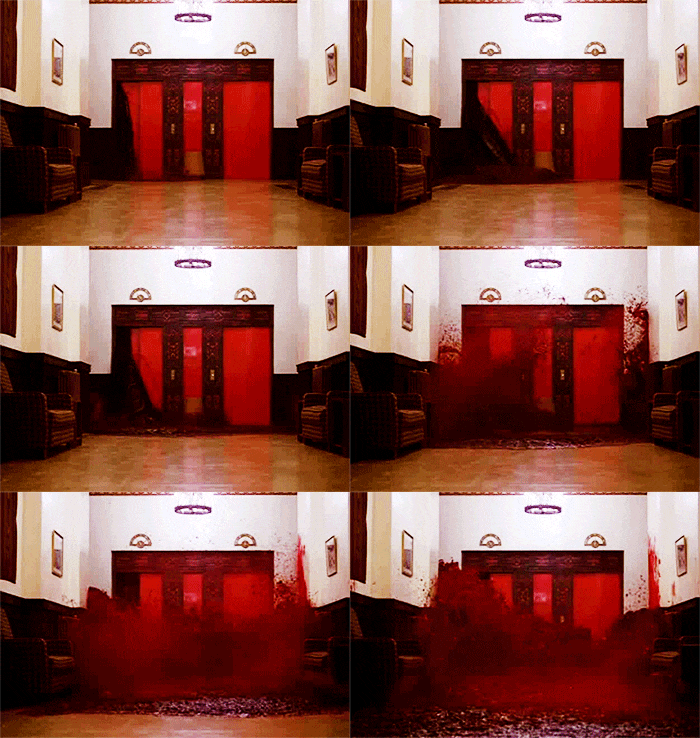
Ah, the old go-to, and the real reason why I hate a vast majority of horror movies. Kubrick uses these sparingly in Shining, but when he does, he uses them to great effect. Typically, the jump scare will be the payoff after a bit of increasingly brutal tension-building, partnered with a loud, punctuated sound effect. It works, but 80% of the time it just comes off as a cheap, annoying scare. The only time Kubrick uses these are when you least expect it. There's no build up, for example, the first time that he cuts to the blood pouring out of the elevator doors - that entire montage comes out of nowhere and is terrifying. Same goes for when Jack kills Halloran towards the end of the movie. It's entirely unexpected, and all the better for it.
2. The Reveal
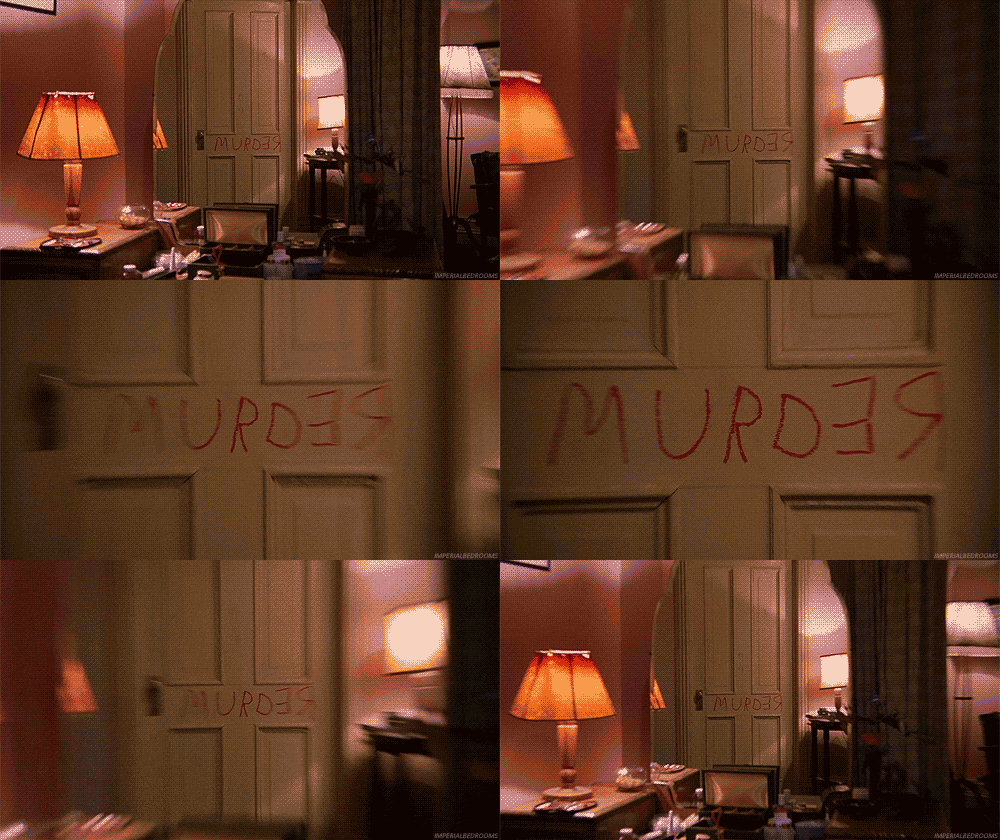
A little less extreme than a jump scare, and usually a bit more predictable, the big reveal scares can still have a strong effect. Kubrick toys with this a few times, but most notably in the "redrum" mirror reversal. Mirrors have a big role in the movie throughout, but the one in the Torrence family bedroom - having been teased for the first two or so hours - has the biggest one of all. All of the shots of Danny pedaling around the hotel corridors also use more or less the same tactic: the smooth steadicam shots lull you into a sense of security, but keep you wondering just what exactly will be around the next corner. Which brings me to the last thing...
3. Sometimes the scariest thing is never shown on screen
Pretty self-explanatory, I think. More often than not, your imagination is capable of scaring you way worse than any image actually could. This is what makes scenes like when Danny first shows up with a bruised neck so powerful. We know that he goes into room 237 and we know that HE SHOULDN'T FUCKING GO INTO ROOM 237, but for the moment, the lack of any visible antagonist is worse than anything they could have shown in the room at the time. We know it's not Jack or Wendy, so...we imagine the worst. The same thing goes for any horror movie. I've never seen It Follows or Rosemary's Baby, but apparently in both, the lack of something makes it all the more scary. Sometimes, the best way to create this sense of dread is by showing your entire environment in a wide shot, and let the audience's imagination work overtime, trying to predict where and when something will pop out. The indefinite waiting is usually worse than than the actual monster.
Also, last but not least, those whip zooms? Seriously digging it.
Martin Scorsese has made dozens of incredible films, many of them being classics. But the one that earned him is one and only Academy Award for Best Director and Best Picture was his 2006 film, The Departed. Set in South Boston, Billy Costigan (Leonardo DiCaprio) is assigned to be an undercover cop in the Irish mob run by ganglord Frank Costello (Jack Nicholson). Collin Sullivan (Matt Damon) is a criminal working for the Irish mob and Costello, who has become a Massachusetts State Police Detective. Both Billy and Collin attempt to gain information about the organizations they have infiltrated. However, both the police and Irish mob become aware of the moles inside their organizations and Billy's and Collin's lives are suddenly put into danger. Each man must work quickly to find the other man and take him out before they get taken out by the organizations.
With an amazing cast featuring Leonardo DiCaprio, Matt Damon, Jack Nicholson, Mark Wahlberg, Martin Sheen, Ray Winston, Vera Farmiga and Alec Baldwin, The Departed is an outstanding film that everyone should go see, if you can get past the abundance of violence and cursing that is in the film. This film simply has it all. A great cast, great cinematography, great editing and a great script. It is one of my personal favorites and every time I watch it, I am sitting at the edge of my seat.
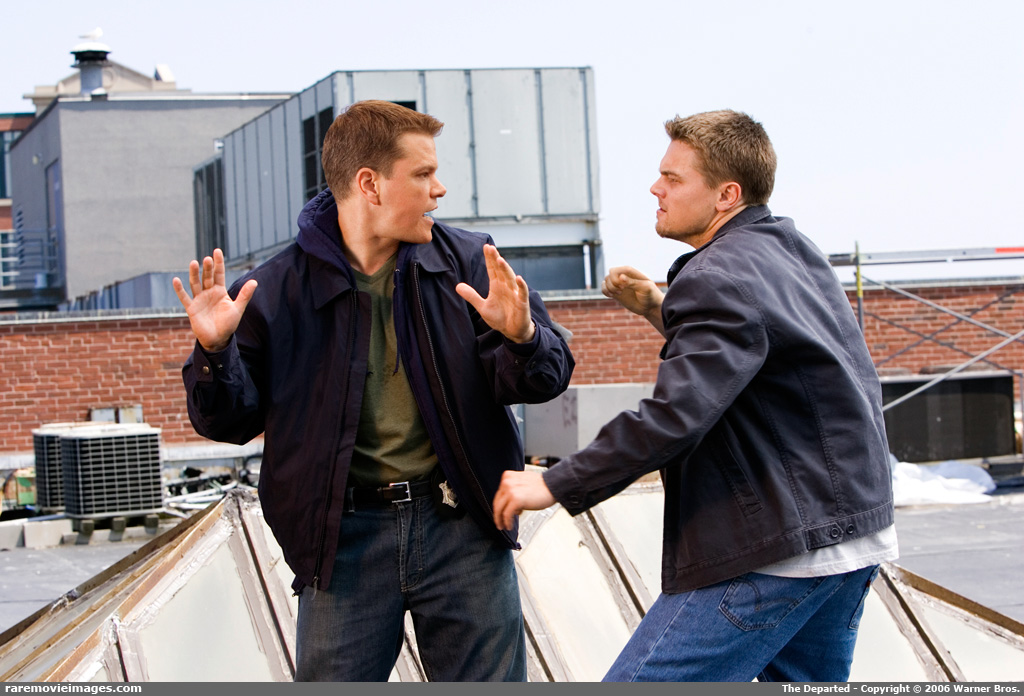
I think my favorite part of the film is the scene on the top of the rooftop, (SPOILERS AHEAD). Both Billy and Collin have found out that the other is the rat in the organizations. Billy told Collin to meet him on the top of the roof and when he arrives, Billy arrests Collin. Detective Brown, played by Anthony Anderson, also comes to the rooftop because he knows who both Billy and Collin are. Billy takes Collin down the elevator at gunpoint and as soon as the elevator doors open, Barrigan, who is another detective working for the Irish mob, puts a bullet through Billy's head and Detective Browns. Collin then puts a bullet through Barrigan's head, making sure that there are no loose ends. This scene is very intense and you do not see the murders coming at all. I jumped in my seat when I heard the loud bangs.
Also just as a side note, my brother actually works in the building where this scene was shot.
The Departed is a terrific film and I think it is Scorsese's best.
This past summer I spent some time in Colorado visiting family. During my time there, we took a trip up to Estes Park, Colorado, home of the famous Stanley Hotel.
The Stanley Hotel, in Estes Park, CO. Taken this past July.
The hotel was built in 1909 by Freelan Oscar Stanley, of the same family who built the famous Stanley Steamer. While this hotel is historically significant, I mention it today because of our recent discussion of Stephen King's The Shining.
While the Stanley is well-known as a historically significant landmark, it is also famous for its part in the creation of the 1980 film, The Shining.
Inspired by the haunted history of the hotel, Stephen King wrote the novel, The Shining on which the film was based after his stay at the hotel, in 1977.
The film was actually shot mostly in Oregon, at a hotel called the Timberline Lodge, however a few scenes from Kubrik's film, as well as the entire mini-series (also called The Shining, and yes, it is confusing) were shot on location at the Stanley.
While in Estes Park, my family and I took a tour of the haunted hotel, visiting infamous rooms, such as room 217. It is said that every room in the hotel is haunted, with supernatural events occurring everywhere. Things such as strange noises, moving objects, footsteps, and more have been reported.
In addition to being the birth place of The Shining, other films have been shot in the picturesque Estes Park, such as Dumb and Dumber and multiple episodes of Ghost Hunters. Overall it was a really cool experience to visit such a historic hotel. Learning about the history of both the hotel and the area was really interesting. Here are some pictures I took on my trip. Some were on a DSLR, and some were taken on my iPhone, but I hope you like them! See you next week...
An aerial shot of Estes Park, CO
Room 217
Signed photo of Shelly Duval from The Shining at the Stanley hotel
This past Friday I saw The Shining for the first time. This past Saturday I saw The Shining for the second time. Throughout my first viewing I was gripped by every shot, I was captivated by every aspect of every shot because I knew that everything in the frame was there for a reason. There were no accidents in the final product. Every single detail means something. Throughout my first viewing I was also struck by how much tension and fear was created solely by the score. Scenes that would have been absolutely normal otherwise took on a sinister tone with music. You can feel yourself being drawn into the warped insane character that is Jack. The film isn't scary in the sense that it makes you jump, it is terrifying because of the implications of the actions of the characters. This film is truly terrifying, you are filled with a distinct unease and fear throughout. My second viewing was entirely different, I had read up on some of the symbolism in the movie after my first viewing and set out to see the film from a new perspective the second time around. One of the major "conspiracies" surrounding the film is the assertion that it is Kubrick's confession to faking the moon landing. I knew that there was some conspiracy regarding the moon landing but on my first viewing I didn't pick up anything. On my second viewing it became clear to me that the Overlook Hotel is supposed to symbolize America in that it is this vast space that is literally built upon a Native American burial ground, it looks beautiful from the outside but is deteriorating on the inside. Stuart Ullman is JFK, enlisting Jack to take care of this very important task for them and roping him into an extended commitment. Jack and Danny are a split version of Kubrick dealing with the pressures of faking the moon landing. Jack is the logical side of Kubrick while Danny is the young artist who is confused and horrified by the process. Wendy is supposed to be Kubrick's wife who is just mentally exhausted and abused by the task her husband has taken on. There are so many intricacies to this film that it would be near impossible to explain them without actually watching the film. This movie is made to be thought about, there is no clear thing that everyone takes away from it. You watch it and you feel something, your perception of what happened is entirely up to you. The audience is free to give meaning to the film in their own way. I could not recommend this film more, I will be watching it again for the third time within the next few days.
I'm going to go ahead and assume that some, most, or hopefully all of you have seen the movie Little Shop of Horrors. This is a great film directed by Frank Oz, who has a pretty outstanding resume. Some of you may know him as a puppeteer and voice actor for The Muppets, or the voice of Yoda in Star Wars. He does not have much of a directing background, but this hit movie has been deemed a 'cult classic,' which is good, I think. But, where did this all start?
Way back in 1960, a man named Roger Corman directed and produced a movie in only two days. For those of you keeping score at home, thats a 70 minute feature-length movie that was shot in 48 hours. This was the last two days before the set that was used was to be taken down, as in the previous 5 days, Corman had just filmed another feature-length movie called Bucket of Blood. Wait, what?! That's right, Corman shot TWO movies in ONE week. Mind you, these were very low-budget films, and not highly enjoyable by today's standards, however I still find this a great feat. So I guess to get his money's worth out of the set, he decided to film a second movie rather than let the set go to waste with its final two days. Somehow, they wrote a script and shot the entire film in these two days, and the result was a far-fetched, quirky, interesting, and entertaining film. It even features a very young Jack Nicholson in his third Hollywood role he had ever played.
Next, this odd little movie became far more popular than they ever anticipated it to be, and years later (1982), a man named Howard Ashman adapted and wrote it into an off-broadway musical. Again, this production became far more popular than anyone had ever imagined, and was quickly re-adapted to film in 1986. This is where Frank Oz picked it up and made it into the film everyone thinks of today when they hear of Little Shop. Oz's rendition kept the stage style of the musical by using a limited number of sets, and lengthy wide shots, which Oz refers to as "master shots". One of these shots includes a ginormous crane up while a character runs up a flight of stairs mid-song. Unhappy with the first 31 takes, the 32nd was finally used. Anyways, this film had quite a historic journey before it came to be what we know today. Also, with the success of Oz's movie, the stage musical was then picked up by Broadway.
I can't decide what part of that history that I find most fascinating, but it does put into perspective how one seemingly small production can become such a big phenomenon.
I saw Chinatown for the first time yesterday and it was everything you said it would be; simply a movie masterpiece. Although I disagree with Mr. Polanski's extra curricular activities his directing abilities are undeniable. Not to mention, Jack Nicholson's portrayal of good-natured, but strong willed private detective Jake Gittes is a prime example of his genius on the silver screen; you want to root for him. For methough, Chinatown's story development is what makes it so enjoyable it feels as if right alongside Jake Gittes as he navigates through a world of crooks. Plus, the plot keeps you guessing all the way up to the very end. After seeing one of Mr. Polanski's earlier works I am eager to compare it to one of his more contemporary pieces!
This movie had a lot of problems getting enough money to film, and for good reason. If I told you that I wanted to make a feature film about an institutionalized man, only during his time while in the institution, you would think I was the crazy one. How could this be a good film, there is no action, there are no love interests or bad guys. The story does not sound like the kind of movie that would be remotely interesting. Yet the movie is fantastic. It is amazing to watch this man simply get into the lives of institutionalized people who are in a routine and shake their lives up. It has great character development and the viewer actually knows each of the characters by the end of the movie. It all happens in about three locations and most of it is them just sitting in a circle, yet it is engaging, it makes you want to know what is going to happen, and how these very different and very extreme personalities can fit together. It is fun to see how this story was written and how it was converted from the book, there is a lot to be said for a writer that can externalize so many emotions and ideas that are primarily internal (Lawrence Hauben, Bo Goldman, screenplay writers). Its a great movie, bottom line, watch it.