I hadn't seen Gravity until after it won several Academy Awards and after I'd heard raving reviews, but it was well worth the wait. Despite giving me anxiety attack-like symptoms throughout the entire movie, I couldn't look away until the end credits rolled.
The cast was made up of just a few secondary characters that appeared only briefly as well as two A-list actors, George Clooney and Sandra Bullock. Despite having a small, focused, top of the line cast, the movie didn't focus on promoting Hollywood and Hollywood actors but rather on the characters and the story. Sandra Bullock played her part so well that I forgot that she was Sandra Bullock, famous actress, and saw her only as Dr. Ryan Stone, the alone and afraid medical engineer on her first shuttle mission to space. I felt her fear more than I'd ever felt fear from a character. I imagined myself in her place and I panicked inside.
Dr. Stone spent the vast majority of the movie floating around in space with no space shuttle to return to, no real knowledge of how to get back down to Earth, and no one to help her. Since I already had an irrational fear of outer space, this was particularly horrifying for me to watch. I was rooting for Stone the entire time, as was everyone else who saw the movie, I'm sure. I wanted nothing more than for her to choose to live and to figure out how to get home. However, that didn't seem like a likely possibility to me, given the circumstances, her lack of experience in outer space, and her lack of training in this type of situation.
For those reasons, I was utterly shocked but also unbelievably happy when she finally crashed down into the ocean on Earth. She had made it, and I couldn't imagine the amount of courage and calm that it would take for a person to do that.
But it couldn't be that easy. When she opened the door to the tiny shuttle she was in and the ocean water started rushing in, my panic attack began. How could she get through a catastrophe like that in outer space by herself only to get home and drown?! Apparently Dr. Stone thought the same way and she just kept on fighting until she got herself out of the shuttle and swam/drifted to shore.
The last shot of the movie was of Dr. Stone grabbing onto the beach she washed up on and finally standing up on land for the first time since she left Earth and experienced that disaster in space. We see her muster up the strength to walk into the land and the credits roll. That last shot really got to me. I can't imagine what it must feel like to feel the land beneath your feet and the force of gravity for the first time after spending a while in outer space, floating around. After the turmoil that Dr. Stone experienced, it must've been an incredible feeling.
I had to remind myself several times during this film that it was just a movie and that Dr. Stone was just a character. I became more emotionally attached to the character than I normally do. At the same time, I spent a lot of time wondering how the filmmakers made this movie. The visual effects were amazing, and I think the simulation of zero gravity is really interesting and even more interesting when an entire movie is filmed using it. There wasn't a single aspect of this film or its making that didn't grab my attention and hold onto it for its duration. I'm glad I finally got around to see it, and I think everyone should do the same, if they haven't already.
Showing posts with label Alfonso Cuarón. Show all posts
Showing posts with label Alfonso Cuarón. Show all posts
Saturday, April 5, 2014


Friday, January 24, 2014
The Sound of Gravity
The movie Gravity, written and directed by Alfonso Cuaron elevated the standard for how things should sound in outer space entirely. Although their have been so many brilliant films located in space, such as Star Wars, and Alien, Gravity set a more realistic version of space's ambient tone. Because in space sound cannot be transmitted throughout the atmosphere, essentially nothing can be heard. But because of brilliant audio engineers, and Cuaron's artistry the sound comes from the perspective of the actors interaction with elements. If the actor grabs or touches something the vibration will travel into their ears. For people who haven't worked on sound, or know very little about it, this means all of the sounds you hear in the movie DOES NOT come from recordings on set, it is entirely recorded separately.
If you haven't seen the movie, which I recommend you do the film is about shuttle explorer STS-157, on which Dr. Ryan Stone (played by Saundra Bullock) who is on her first mission. She is accompanied by Matt Kowalski (played by George Clooney) who is on his last expedition. During a spacewalk mission control channels the Explorer (the name of the shuttle) that there has been a Russian missile strike and the debris is headed their way. Minutes later a cloud of debris hits the shuttle and detaches Stone leaving her drifting alone throughout space.
What I find so fascinating about the movie, is because it comes from the actors perspective, who is flying around in space, the music and the sound are constantly traveling around you. Cuaron and the engineers composed the sound to surround you and pan into different speakers. What this did was it built up the emotion and fear into being lost in a completely different world, and made you feel like you were there. For sound nerds like me, the plug-in the engineers used to pan the sound and the score is called "Atmos" which is located in Pro- Tool 7. Whats so cool about this plug-in is most of the panning is automatically tuned by the program itself. According to the re-recording mixer Skip Lievsay who worked on No Country for Old Men, Fargo, and No Country For Old Men, most of the scenes were autopanned with Atmos.
The love and the passion that Cuaron puts into the cinematic experience of the movie encourages me as I enter the beginning stages of my career. It proves that with countless hours of work, very little sleep, and a lot of drive you can create anything. I sincerely hope this movie lives up to its potential at the Oscars. For 90 minutes I was convinced I was lost along side Saundra Bullock traveling with nobody in outer space. And the music and sound had me on the edge of my seat during this terrifying situation.
If you haven't seen the movie, which I recommend you do the film is about shuttle explorer STS-157, on which Dr. Ryan Stone (played by Saundra Bullock) who is on her first mission. She is accompanied by Matt Kowalski (played by George Clooney) who is on his last expedition. During a spacewalk mission control channels the Explorer (the name of the shuttle) that there has been a Russian missile strike and the debris is headed their way. Minutes later a cloud of debris hits the shuttle and detaches Stone leaving her drifting alone throughout space.
What I find so fascinating about the movie, is because it comes from the actors perspective, who is flying around in space, the music and the sound are constantly traveling around you. Cuaron and the engineers composed the sound to surround you and pan into different speakers. What this did was it built up the emotion and fear into being lost in a completely different world, and made you feel like you were there. For sound nerds like me, the plug-in the engineers used to pan the sound and the score is called "Atmos" which is located in Pro- Tool 7. Whats so cool about this plug-in is most of the panning is automatically tuned by the program itself. According to the re-recording mixer Skip Lievsay who worked on No Country for Old Men, Fargo, and No Country For Old Men, most of the scenes were autopanned with Atmos.
The love and the passion that Cuaron puts into the cinematic experience of the movie encourages me as I enter the beginning stages of my career. It proves that with countless hours of work, very little sleep, and a lot of drive you can create anything. I sincerely hope this movie lives up to its potential at the Oscars. For 90 minutes I was convinced I was lost along side Saundra Bullock traveling with nobody in outer space. And the music and sound had me on the edge of my seat during this terrifying situation.
Friday, October 11, 2013
Gravity: A Movie Out of this World

Cut to black. Credits roll. I usually stay through the credits when I see a movie. I mean, I want people to stay through the credits when my name is up there. But I didn't just stay through the credits. I stayed about ten minutes after the credits ended, until the man trying to clean up asked my friends and me to leave. The words spoken between us were few in that car ride home. We were actually speechless, completely shocked by what we just experienced. We needed to take it all in.
I knew Gravity would be incredible, but I did not expect to leave feeling the way I did. To be truthful, I've never left a movie theater feeling that way. I imagine it's how audiences, back in the start of cinema, felt when a train went by and they thought it was going to hit them. Or possibly how the audiences at the first Star Wars film felt. But this, this was unlike anything I have ever seen.
The story was nothing we haven't seen before. Astronauts up in space. Something disastrous happens. Stuck up there, trying to survive. Even down to the George Clooney character, Kowlaski, of the veteran astronaut in a state of nostalgia on his last mission to space. Nonetheless, I was sucked into this world. Completely captivated by the world Alfonso Cuarón created within minutes, I can only really describe the experience as an hour and a half long anxiety attack...in the best way possible, of course.
The movie is easily Sandra Bullock's best work. I so quickly felt connected to her character, Stone, despite barely being able to see her face through her spacesuit. Cuarón pushes her to new levels that we've never seen from her as an actress. She has my full support for the Oscar for Best Performance by an Actress in a Leading Role. But I could go on about how incredible Gravity is forever. So I'm sticking to the opening shot. The 17-minute take is an absolute masterpiece, shot by cinematographer Emmanuel Lubezki. Beware: spoilers of the first 17 minutes of the film lie ahead.
The film opens to a shot of earth from space, which is the most realistic earth I have ever seen. Slowly, signs of life begin to emerge, as we hear faint radio chatter and a distant space shuttle, satellite, and astronauts enter into frame. While Kowlaski jokes around with mission control, Stone clings onto the telescope, having minor health issues and struggling to fix a component. The camera weightlessly glides from each character, almost as if it drifts along in space with everything else.
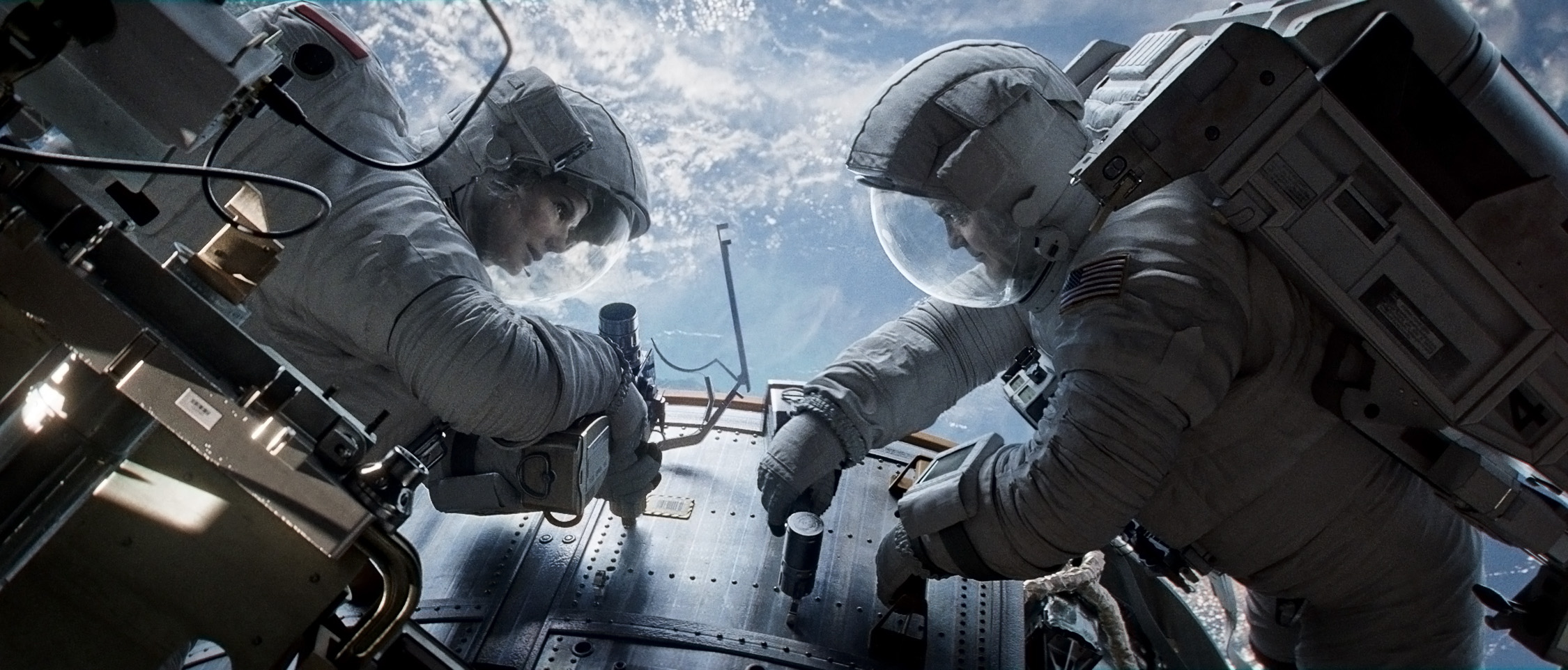
The tranquil scene is disrupted when mission control tells them to abort the mission, explaining that debris from a broken satellite has created a domino effect. Before they get the chance to make it back to their shuttle, the debris arrives bringing a deadly hail of missiles towards them. The camera pans to the astronauts who try to evacuate, with debris flying past them, so realistic that I flinched.
When something big crashed into the shuttle, it starts spinning, bringing Stone with it. The camera watches as she spins around and around with earth in the background. When something else crashes into the shuttle, the arm attaching Stone to the shuttle breaks off. The camera fluidly focuses in on Stone and begins to spin with her, close up on her terrified face. Then seamlessly, the camera turns, as if moving naturally in zero gravity, making its way behind Stone's glass. Now inside her space helmet, we see the background turn from space to earth to space to earth as we move with her. Over the radio, we hear Kowlaski tell her to detach herself before she gets too out of reach, so she does and the camera breaks away from her as she tumbles away from earth. She gets smaller and smaller until finally the camera cuts.
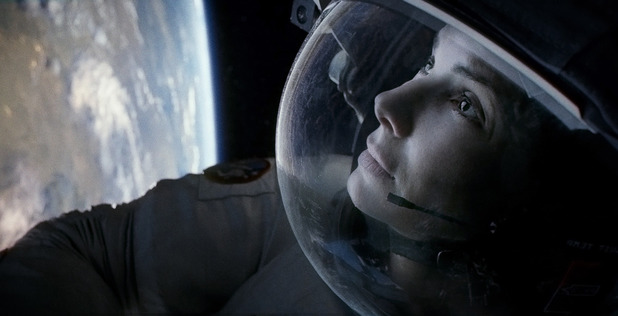
The genius of such a long, cinematically fascinating shot is that it brings the audience directly into the story. First, we are slowly introduced to the environment and then suddenly shifted right into the action. The cinematography of the long and thorough shot made you feel as though you were right there with these characters, experiencing this horror with them. Absolutely brilliant.
If you haven't already, you need to go see this movie. It is a revolutionary cinematic experience with groundbreaking special effects. Gravity might just be the most technologically impressive films ever made. It isn't often that you can walk out of a movie thinking, "How in the world did they do that?" You can place you bets on Gravity for all major awards in the categories of cinematography and visual effects. Go see it, and see it in 3D.
Lastly, the only negative reviews I have read of the film are about the scientific inaccuracy of some of the events. It almost angers me how stupid that is. If you're looking for a science lesson on space, go watch some informational documentary or rent a book or something. Nobody's going to this movie expecting to leave understanding outer space. This movie is made for entertainment. And truth be told, it is one of the greatest pieces of entertainment that society has ever seen. Gravity is out of this world. Pun intended.
Friday, March 1, 2013
A new way of looking at films
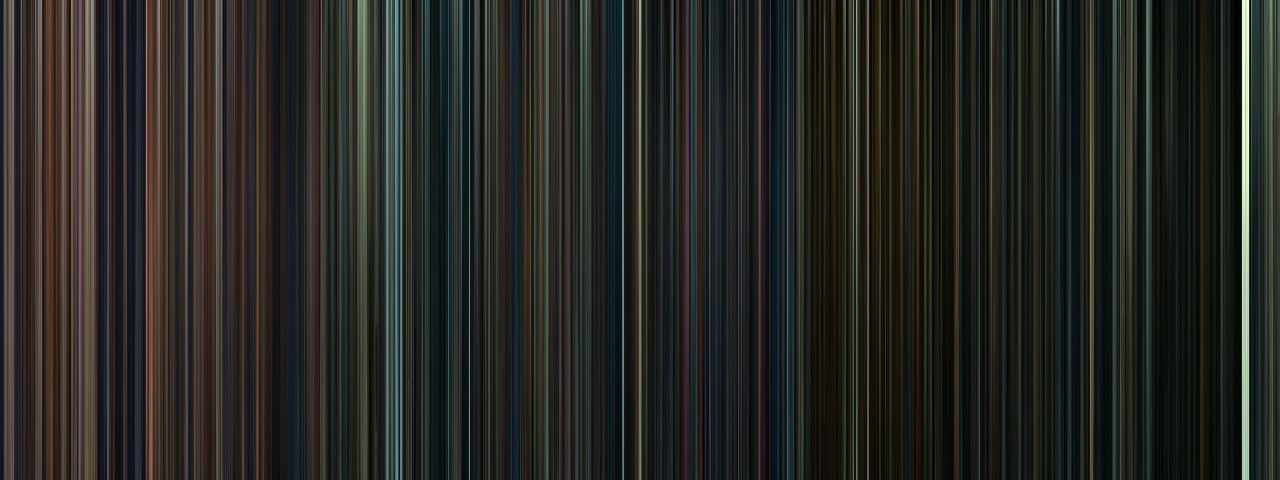
I recently discovered a new tumblr, which is often dangerous to my productivity, but I've found this one particularly interesting as it offers an interesting new way of looking at films. It is called moviebarcode, and it posts single images, or barcodes, representing the entire course of a movie. These images are made up of a number of still frames, evenly distributed throughout the movie, which are then stretched upward so that only the main color information remains. It offers a very nice, birds-eye view of the art direction and overall color tones and moods of a film. There is also an index so that you can easily look up movies you are interested in.
For example, this is the barcode from the 2000 film "O Brother, Where Art Thou". This was the first film to be digitally color graded in order to make an artistic choice. In this case, much of the footage was tweaked to make the landscapes look drier and more golden, to fit the setting of the Dust Bowl in the midwest. This is easily apparent in the barcode, which is overwhelmingly gold and beige. You can also see, right at the very beginning, how the film starts out in black and white, before the saturation is added back in to produce the color.
Here's another example: The Matrix. Almost every scene in The Matrix has a distinctive green tint to it, which is easily apparent in this image.
This is one of my favorite examples, because it shows some of the applications that these images could have. This is all eight Harry Potter movies, sequentially, which means we can see some interesting trends. First of all, we can see that the mood of the series gets progressively darker, until the last installment is almost entirely black. This visual trend clearly follows the tone of the films and the stories themselves. It also shows the differences in the styles of the directors; for instance, Chris Columbus filmed the first ones primarily inside, which is shown by all the warm tones at the beginning of the image. When directing the third installment, Alfonso Cuarón made the conscious decision to shift to a more outdoors, location based film, which is shown in the abrupt transition to blues and greens.
By looking at multiple films at once like this, we can observe patterns, similarities, and differences that are both interesting and useful. Using these images could be an easy way to examine multiple films by broad categories such as genre or time period, which might expose some of the stereotypes or tropes that are used in different types of filmmaking.
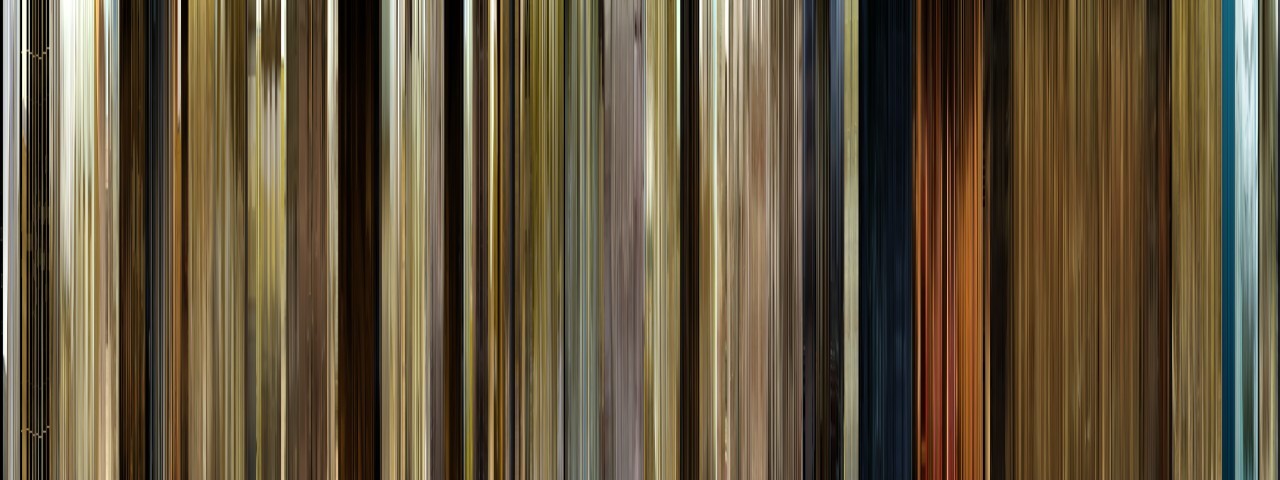 |
| O Brother, Where Art Thou (2000) |
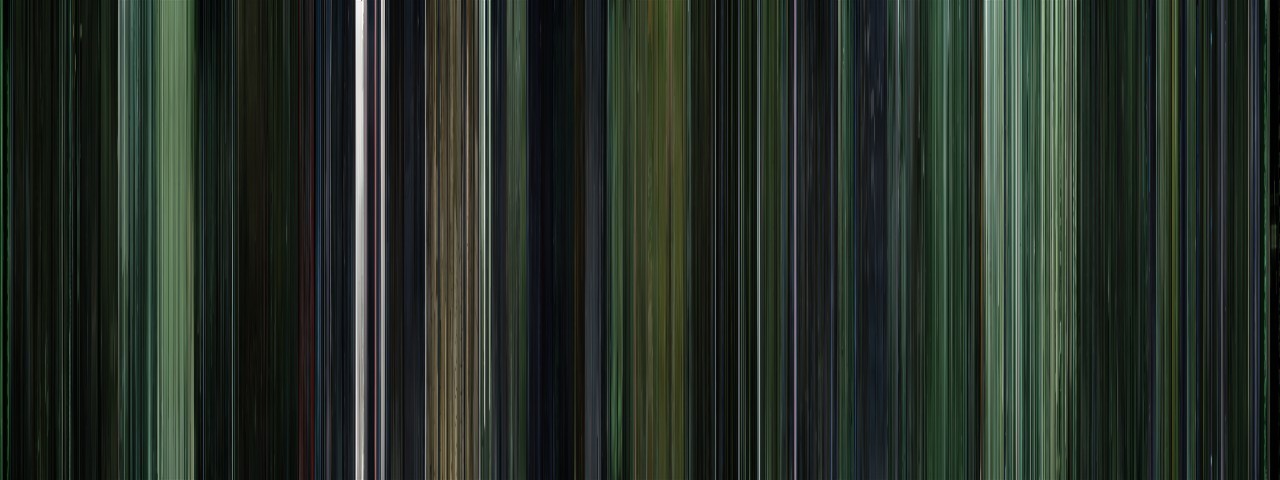 |
| The Matrix (1999) |
 |
| Harry Potter: Complete Series (2001-2011) |
By looking at multiple films at once like this, we can observe patterns, similarities, and differences that are both interesting and useful. Using these images could be an easy way to examine multiple films by broad categories such as genre or time period, which might expose some of the stereotypes or tropes that are used in different types of filmmaking.
Subscribe to:
Posts (Atom)