Showing posts with label time. Show all posts

Tuesday, September 1, 2015

Time + Money + People = Producing College Film

I know I'm not the only one that has really started to reflect on the crazy realization that this will be the last film that I make while at Ithaca College.  There have been some stellar ones, some average ones and some projects that we just don't talk about. I'm probably not the only one who didn't wind up doing what they thought they would be doing at the tail end of four years.  As a freshman, I thought it was going to be directing.  I'm not the type of person who likes getting caught up in the hands-on details of things.  Rather, I prefer to think as big picture as possible.  Somewhere between sophomore and senior year, directing became producing because I fell in love with it in a way I never did with directing.  Before I get stuck in nostalgia, or something far worse, I'll cut to the chase about what I've figured out about producing thus far...

Producing film (and TV), at least in college, can be boiled down to the management of three resources. These three resources will always be in significantly shorter supply than you'd like AND, as the producer, you will be the one held responsible if any of them are mismanaged. 

Time is one of the three things that is mine to handle.  This one is arguably the most difficult to get a hold of at the college level, and I'll venture a guess that the real world isn't all that different.  Long before I was at Ithaca College, I stage managed a number of theatrical productions back home.  Somewhere along the line there, time management became a part of my brain that doesn't shut off, ever.  When I am asked to produce a film, the first thing I do is read the script, duh. The main two time factors that I am crunching in my head as I read are: "How long is it going to take to shoot this?" and "How many weeks of preproduction do we need to get it ready to shoot?" (the third is post-production, but this usually doesn't take long to calculate).  To be honest, I'd say that the first question is usually much easier to answer for me.  If I get a good enough sense from the director as to the vision, I can usually ballpark a good schedule based on a few things: "Day/Night Shooting", "Elaborate Set Ups/Stunts", "Script Length", "Number of Characters", "Complexity of Action/Background Action".  
Right off the bat, some of these are going to be much easier to understand than others.  When the directors come to you with a script for a musical with five different dance numbers, you know those are going to each take at least two, if not three hours to shoot based on complexity. If the directors want to shoot on Cayuga Lake, you know that too will take some extra time. If there is a need for day4night or night4day, then your set ups will take significantly longer. Now the tricky thing about the way to schedule these is that while there are guidelines, there is no true right answer, and that is frustrating as all get out. My solution is that I take my time, and never go it alone. Any time I schedule a film shoot, it is with the AD, Line Producer and Director (and often DP). There is no sense  making a schedule that your crew will kill you over. More on people later! As for trying to assess the amount of preproduction needed, at the college level this is tricky.  It is tricky because of schedules.  We aren't professionals yet, and unfortunately we aren't paid to exclusively do this.  This means that when I plan preproduction I need to look at the schedules of the Director, Producers, Director of Photography and the Production Designer more than anyone else.  What other films are they making? How many classes are they in? Are they working part time jobs? Any other extra curriculars? Once you take all of their commitments into account, you then need to see where priorities lie.  Unlike scheduling shoots, planning preproduction has a much, much looser formula; this is not something I have ever been thrilled about.  I used to believe that it was always best to throw time at preproduction, but my opinion on this has changed.  If your team has all the team in the world, they lose their sense of urgency.  Well that certainly won't be a worry on this one. Five weeks until production!
Money is usually the next biggest hurdle to have to jump through.  Much like time, this management is also broken in to two main parts: budgeting and fundraising.  Not only am I the final say on how we spend our money, but I am also responsible for getting us the money to spend.  This may be one of of my favorite parts of the job.  Managing a budget starts with reading the script, marking it up and assessing what the needs will be from each department.  The highest costs are always going to be production design and camera department, at least on student film.  Ideally you would want to use as much of PPECS's equipment as possible, but there are some things they just don't have; this is where rentals come in, and they ain't cheap.  Creating the world for the film to take place in is not a time for short changing, and production design should never be underestimated.  Once the DP and Production Designer are hired, I then compare my notes with theirs to verify that my estimates are fairly on track.  The same can be said of every other department and its keys.  It is especially easy when I am the key to parts of the budget, like PR. Once the estimates are pretty locked in, I input them into a Google Sheet, which tracks our departments' estimated budgets in comparison to their actual expenditures.  As preproduction continues, it is important to keep each department in the black, as there will be unexpected costs in production (which I try to build contingency for). 
Fundraising is the other side to the coin.  Indiegogo is not a perfect platform but it does manage to get the job done! If you want a fast way to get in touch with friends, family, family friends, to communicate your need for their support, then it is perfect.  There are some serious limitations to it though.  The platform was initially created for film fundraising but it is actually the most difficult type of fundraising to do on Indiegogo.  Tech fundraisers can promise prototypes or other fancy forms of swag that filmmakers just can't.  At the end of the day, this leaves film Indiegogo pages (those of the non-famous variety, for an example of the successful ones check out Con Man) struggling to break what I like to call the "middle class ceiling".  If you are coming from a middle class background, your ability to fundraise on Indiegogo is going to tap out somewhere just above $5000, in all likelihood (that's a team of roughly three students and this is just my observation).  This leaves you looking for slightly deeper pockets.  This can be other connections such as alumni, businesses or grant applications.  I am currently in the process of designing some literature which I hope to turn in to a few thousand dollars, fingers crossed.  Really it comes down to getting the money, however you can, even if that means taking a water balloon full of hot sauce to the face. 

People wind up being the resource that is the easiest to find at the college level, and it doesn't take a lot of brains to see why.  This school is full of some of the most intelligent and gifted people I have ever met.  The tricky thing that I am starting to realize as a senior is that I no longer have anyone older than me to recruit for films.  For the first time, I have to hire on people in to major roles that are one or two years younger than me.  Admittedly this took a little getting used to, but age really is just a number, and not always an indicator of skill level.  
Some positions will always be more difficult to fill than others.  Finding good production designers, gaffers and producers is always the most difficult thing to manage, for a variety of reasons.  Production design is one of those jobs that takes a hell of a lot of effort, but arguably the least glamorous of the most difficult jobs; it also takes someone who is both detail oriented and able to see the big picture.  Gaffers just seem to not exist all that much from a "I can create a beautiful look" for this scene level.  Honestly I think this has more to do with our education than anything.  Cinema majors get a decent grounding in this, while TV/R majors can expect very little in lighting aesthetics (not to say that we don't make good grips, we kill that game).  

As for producers, well we have the job that almost nobody wants.  We have to be able to constantly ask for things to get done, without being a nag. We have to deliver bad news in the best way. We have to be able to stay friends with our peers, while also having to supervise their work. We are the organizers, the brainstormers, the hand holders, the blame takers, the huggers and the ones who get to lose sleep over it all; we are the crazy ones. We have the job that most people find either too boring or too much work. I have heard a number of times from others that we don't make art, because we don't touch cameras, write scripts, use paint, or call action. It took a long time to realize this isn't true.  True, there really isn't much art in the excessive amount of paperwork I have to do.  You have to look broader, from development to distribution, we connect everyone and everything. If you look for our art in the film you won't find it, because you aren't looking in the right place. Our art is in the film production itself. We line it all up. I don't play an instrument...

Friday, January 23, 2015

ABOUT TIME

Due to the excessive boredom during winter break which included;
  • irregular sleeping patterns 
  • excessive partying 
  • streaming movies illegally 

I was running out of movie options.. With a failed relationship the last thing I wanted to watch was a "love movie". Especially a movie that includes Rachel Mc Adams. You may know her from The Notebook, The Time Travelers Wife, and The Vow.  Don't get me wrong I believe she is a great actress, but in almost every movie I have seen (which include the above), the central theme involves love. As you can imagine I was not in a great state of mind to watch a love movie. However, I later made the decision to watch About Time.

About Time, was written and directed by Richard Cutris. The idea is simple, yet complex.  It's the idea of a man who has the ability to time travel to change his past in order to have a better future. Although, this movie is unrealistic because I mean I can't time travel to change my past. </3 However, not only does this movie show the love that Tim has for Marie. But, it shows the love that Tim has for his father and his freelance, carefree awesome hippy sister Kit Kat.


Tim tries to keep his family together. In all essence this movie was really a touching drama about the love between father and son. The end of the movie shows the closing to one of his last time traveling trips to visit his father, where he says his last good-bye.


There is a huge moral that lies in this story: Enjoy the important things in life, love, family, children and so forth.

Wednesday, November 20, 2013

Editing film with a deadline


As of now, I have been awake for almost twenty-four straight hours, about ten of which have been spent editing my group's short film, "Cracked". After having been up editing until about 3 or 4AM for the past four days, I've decided tonight was the night when sleep was simply not an option. Tonight's cutoff time was about 5AM. This wasn't due to being kicked out of the library or to my roommate yelling at me to turn off the light. It was due to the fact that most of us working on the film's picture-locked draft tonight reached the point where no good could come out of continuing our work. The last 4 days have been some of the most taxing and fulfilling days of my life, and since I'm running on little to no sleep due to the deadline I've been given to have this film finished by, I figured now is the best time to give you my honest opinion of editing with a deadline.

It's difficult.
Editing is difficult. There's no question about it. It takes a lot of time, patience, and skill. Sometimes, none of these are available. Having approximately four days to edit a seemingly twenty-minute, picture-locked copy so that our sound designer can have ample time to make our project sound as professional as possible, time is simply not of the essence. It's unfortunate, but it's the hand I've been dealt, nonetheless.

Patience is not one of my virtues. That's a fact. If something isn't working the way I want it to, I've been known to begin cursing out my laptop at a reasonable volume right in the middle of the library. The problem with this is the fact that, in order to edit something just right, an editor needs patience so that he doesn't accidentally scare everyone sitting within a fifty-foot radius of him. Very few things ever fit together perfectly with ease in the editing process. It's important to remember that.

Clearly, one needs to have some level of skill in order to be good at his job. Now, I'm not saying that I'm a bad editor. I like to think that I have some level of talent. The fact is, though, I'm still learning new things everyday. Just tonight, actually, I must have learned at least three new editing techniques from my fellow group members that I had no idea were available to me. These three or so new techniques I learned are certainly going to come in handy sometime soon down the road, but I really wish I knew them a few months ago. It just goes to show that an editor is never done learning.

It's stressful.
Four days. Really? Four days to edit an entire twenty-minute short film. That's all I was given. The deadline I was given was set for a very good reason. We need to have the film's audio mastered by someone who truly knows what they're doing, but seriously? In order for a person to provide you with his best work, you better give him the necessary time to do so. The more rushed an editor is, and the less sleep he has, the more difficulty he's going to have in turning in a quality project.

The most stressful part about the whole thing is that, despite the little time film editors are often given, the entire project still comes down to you. It's basically like the last five seconds of a basketball game. Your team as retrieved the ball. They've gotten it down the court. They've set you up with a perfect shot. It's now up to you. You can either score the game-winning point, or you can miss the shot and your team's effort was all for nothing. An editor can either be the hero or the complete screw-up on a film crew.

It's bullshit.
No matter how well the preproduction and production of a film go, the editors always seem to get screwed over. You'd think the editor would be given as much time as they needed to make the final product their best possible work, but no. Editors always seem to have the shortest deadline out of anyone on the entire production crew.

Sure, being the editor has its perks. The most evident one is the fact that I had to do little to no work up to this point in the project process. What could I do? There was nothing for me to edit. Another major advantage would have been--if we hadn't needed someone to work audio for our first two shoots--that I wouldn't have been required to go to the actual shoots. That could have easily been more time to relax or to edit what we had already shot (which I was luckily given for our group's final shoot on Sunday).

Despite how fair it really is that I have to run off little to no sleep for a mere four days, instead of having work the entire semester, I still attempt to put the idea in my head that the whole thing is bullshit. Don't ask me why. I'm just tired.

It's totally worth it.
At the end of the day, and at the end of the whole process, editing is truly one of the most rewarding positions in the entire crew, especially with such a short deadline. To be able to look back and say, "Wow. I did all that in four days?", is all the reward I need. To have the privilege to be able to see the entire progress from a script, to a shoot, to a cluster of files, to a beautiful film is an absolutely indescribable feeling. The editor is the final puzzle piece to a film, and it's an honor to be that final piece.

Friday, September 27, 2013

Lucasfilm Predicts the Future

There have always been three stages to the filmmaking process: pre-production, production, and post-production. These three components rely on each other to create a polished final product. Regardless of being a documentary, a promotional video, or feature film, all film productions require these three steps. 

"Over the next decade video game engines will be used in film-making, with the two disciplines combining to eliminate the movie post-production process."


This is the ambitious claim made by Lucasfilm, the production company behind the Star Wars franchise. 


Speaking at the Technology Strategy Board event at BAFTA (British Academy of Film and Television Arts), the company’s chief technology strategy officer, Kim Libreri, introduced a new style of filming: 


As you can see, the company has figured out a way to implement special effects in real-time, moving a large amount of post-production work into the pre-production and production phase. Although Lucasfilm is able to show off this technology now, it is still more of a future concept and calling it a complete replacement to post-production is laughable. As you can see from the video, the graphics are not exactly feature-film quality. But this is, more then anything, is a sign of things to come. It could also be considered an advanced style of storyboarding, enabling special effects artists to see their work before actually implementing it.  


All of the effects in the video have been possible in the past, except before you had to process, tweak, and render the footage. Now they are able to do it incredibly faster to the point where it's instantaneous. In movie making time is money, so what this means is that films will be able to implement special effects on a much smaller budget. I know some people favor practical effects so this may not be an entirely good thing... but I'm very interested to see what happens when high-end graphics become assessable to a very wide audience.


Oh... and speaking of the future. Check out this cool film I found that interviews Steven Spielberg, George Lucas and Martin Scorsese. They ask them about the future of movies... but in year 1990. Quite the interesting perspective.


Monday, September 24, 2012

Dear Photograph


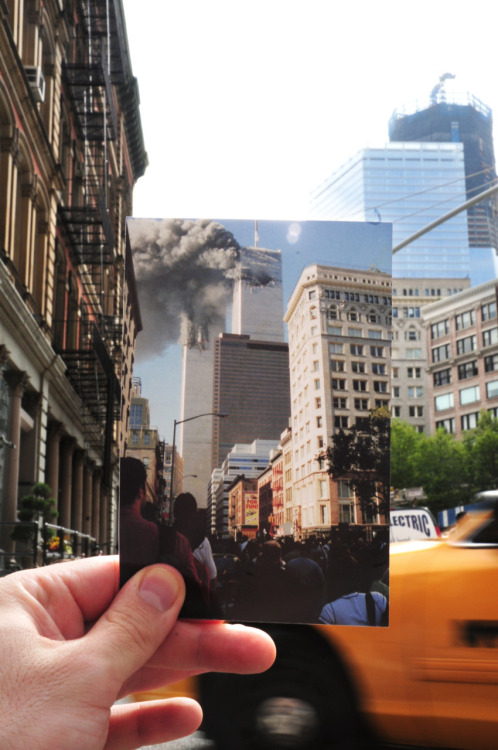
     Right now I want to share a website with anyone who reads this post. The website is http://dearphotograph.com and what they do is creative and meaningful. What they do is have a picture in the foreground and take a picture of it. They take the picture in the same place and have the same orientation so they are lined up. One of the things this does is show how things change due to the passage of time. The way I stumbled across this is through this 9-11 picture a year ago.
     A lot of the pictures tend to be of family members, old houses, things along that line and as stated before it shows the passage of time. There is then a caption added to each picture, addressed like a letter often giving a back-story that you would not be able to tell just by looking at the picture. This project could be a cool concept if transposed to film. This is similar to the one shot project we are doing though. The point of the photographs is to tell a powerful story in a very brief amount of time and use generic or relatable moments, but with a slight twist.
     I find this project pretty amazing because it shows the meaning in objects or places where you wouldn’t see it at first by telling a story. While some people say that not everything needs a story, I am a firm believer that everything has a story.