For ages, movie producers have tried to find new and innovative ways to make their movie a blockbuster. One common trend that has been observed most frequently in the past decade has been the use of birds in the titles of movies.
Some of the most successful and highly-acclaimed movies of all time have used birds in their title: Black Swan (2010), One Flew Over the Cuckoo's Nest (1975), and Chicken Little (2004) to name a few.
There is speculation over when this trend started but most movie buffs agree that the first big movie that used a bird in its title was Alfred Hitchcock's 1963 thriller, The Birds. After The Birds's gigantic success, many movies followed in its path, but were forced to take circuitous methods of using bird names.
There are many ways you can go about using birds in your title. Some movie makers like to make movies about penguins and be very straightforward with their titles such as Penguins of Madagascar (2014) and March of the Penguins (2005) while others like to take trickier approaches such as Robin Hood (1973), Robin Hood (2010), and Black Hawk Down (2001).
Although these movies took the approach of adding a bird in the title while keeping birds out of the plot, nobody has done as good of a job at subliminally inserting a bird in a movie title than Michael Moore with his widely successful 2002 documentary Bowling for Columbine which cleverly inserted the word "owl" into the title.
We might never know if the fact that birds are in the titles of these movies are what made them successful but we can at least say with some certainty that the use of birds didn't hurt the films.
Thursday, February 11, 2016


Birds I'm Glad Don't Exist
Birds are great! They are pleasing to they eye, elegant, and fun to watch. But some birds can have quite the opposite reaction!
Like this bird for example:

Don't worry though, this picture is photoshopped, birds don't usually have teeth.
If you thought this bird is scary, wait till you see this next one!

The fabled dragon. Personally, its the scariest bird I can think of, and couldn't be happier that it doesn't exist. I remember watching Reign of Fire (2002) and being scared half to death thinking about how much it would suck if dragons really existed. It was one of my first encounters with a dragon on the big screen and man was it a powerful one.
How To Train Your Dragon (2010) was a much more kid friendly dragon movie that tried to break the mold of dragons being terrifying and put a delightful twist on it. The movie focused around a boy who befriends a dragon only to realize that dragons have been sorely mistaken and are actually very nice.
Although the movie does a great job in helping the audience sympathize for dragons, I still think the world would be a lot worse of a place if they actually existed.
Like this bird for example:
Don't worry though, this picture is photoshopped, birds don't usually have teeth.
If you thought this bird is scary, wait till you see this next one!

The fabled dragon. Personally, its the scariest bird I can think of, and couldn't be happier that it doesn't exist. I remember watching Reign of Fire (2002) and being scared half to death thinking about how much it would suck if dragons really existed. It was one of my first encounters with a dragon on the big screen and man was it a powerful one.
How To Train Your Dragon (2010) was a much more kid friendly dragon movie that tried to break the mold of dragons being terrifying and put a delightful twist on it. The movie focused around a boy who befriends a dragon only to realize that dragons have been sorely mistaken and are actually very nice.
Although the movie does a great job in helping the audience sympathize for dragons, I still think the world would be a lot worse of a place if they actually existed.
Diversity at the Oscars
Although in my last blog post I touched briefly upon Leo and his outstanding performance in The Revenant, this post is about how unfair it will be if he wins. For many years, the academy has lacked a sense of diversity, therefore most of the winner, in fact 74% of them are white. This is a huge problem with film, and in the world in general. Truly, this world is run by the "white man" and because of that most of the lead roles in hollywood are of white people, but interestingly enough, those roles that are of minorities are usually supporting roles. This year was a little different, we saw Will Smith in Concussion,
As we all know the Oscars are films biggest award shows highlighting the best pictures, and performances of the year:


As we all know the Oscars are films biggest award shows highlighting the best pictures, and performances of the year:

But did you take the time to notice, that none of those people are not of the white race? In fact last year the academy had a similar issue:

Those people are all white too! Basically the academy is saying if you are not white, your not in! But this truly is not just a problem with Hollywood, its a problem with the entire world.
Scene Reenactments
Shooting scene recreations
Scene recreations are a common form of documentary technique that is often used when there is a lack of archival footage or the archival footage is not adequate quality. There are many issues that arise with the use of reenactment. Some people consider it to be untruthful, but others argue that if the truth is already known, re-enactments can deliver it cinematically.
In 1988, documentary filmmaker, Errol Morris released a documentary that proved the innocence of a death row inmate and resulted in his release. The New York Film Critics Circle named A Thin Blue Line the best documentary feature of that year. On top of that it received numerous awards and recognition. Despite this film’s praise when the Oscar nominations of the year came around, this film was nowhere to be found. Roger Ebert, a top film critic, was outraged. He called it “the worst non-nomination of the year,” and blamed it on the academy’s “inability of academy voters to appreciate innovative filmmaking.”
This film was made in 1988 about a crime that took place in 1976. Morris’ signature style of filmmaking is his use of dramatic reenactments. A Thin Blue Line was one of his earlier films, but today he is known for these reenactments. Morris attributes this technique as to why A Thin Blue Line was overlooked, “Critics don’t like re-enactments in documentary films – perhaps because they think that documentary images should come from the present, that the director should be hands-off.” Although the crime occurred in the past, Morris was not given a pass for his use of reenactments. He even had one confused Dallas Morning News reporter ask him, “So, how is it that you managed to be on the roadway (the crime scene) that night?”
Morris disagrees with the academy’s decision to not acknowledge his film as a true documentary because of the techniques chosen. Re-enactments, like any other type of film, photography, or communication, can be used to search for the truth or subvert it. It is not the use of re-enactments itself that is wrong, but how they are used. Morris and the Texas Court of Appeals believe they were used to uncover the truth.
Morris disagrees with the academy’s decision to not acknowledge his film as a true documentary because of the techniques chosen. Re-enactments, like any other type of film, photography, or communication, can be used to search for the truth or subvert it. It is not the use of re-enactments itself that is wrong, but how they are used.
Trainwreck: The Evolution of The RomCom
The third wave of feminism is, I would argue, being dominated by shifts within media and the representation of female narratives and experiences. Trainwreck, starring Amy Schumer and Bill Hader, flips conventional notions of gender and the romantic comedy genre on its head. The story follows Amy, a young adult living in New York City, whom grew up thinking that monogamy was unrealistic. She carries that mantra with her as an adult and fills her life with one night stands, but never anything more. She's happy that way, and funny enough it's the men she sleeps with that crave intimacy and a relationship--a total twist on traditional notions of what women are seeking vs what men are seeking in the world of love and romance.
We're seeing a slow evolution of the romantic comedy--and it's much needed. What was once a standard, stereotypical formula ripe with rigid gender roles is being reinvisioned by fresh plots. It's about time.
Waste of Time
A recent study by mobileinsurance.com has revealed that the average person spends 90 mins a day on their phone. That figue may not sound like a lot but that amounts up to 23 days a year and 3.9 years of the average person's life is spent staring at their phone screen.

Americans aged 18-64 who use social networks say they spend an average of 3.2 hours per day doing so,according to new research released by Ipsos Open Thinking Exchange (OTX).
The amount of time I spend on social media and on any technology in a day is pretty significant. I wake up in the morning and immediately check my phone and I check my texts, emails, social media and any other notifications I get. I would say I spend about 15 to 20 minutes in the morning on my phone every morning.

Then after doing my morning routine I check my phone again to make sure I am not behind on texts or emails. Then I head to lunch and I usually surf the web for about an hour and do homework or research. Then I go to class and my teacher is usually using the Internet and I use the Internet to look up information so that’s another hour of using technology. Then after class I check my phone and go on social media for another 10 minutes. I usually head home after class then sit down for 1 hour of 2 and watch TV usually the discovery channel. Then I head back to class and that’s another 1 hour of my laptop. After class and the rest of the night I am on my laptop for 2 more hours and probably watch 1 more hour of TV.

The next time you pick up your phone try to spend less time on it and do something more productive!
Tuesday, February 9, 2016
I Know When That Hotline Bling...
Confession: all my life I have tried my best to avoid phone calls like the plague.
I don't know what it is, but I have never particularly enjoyed talking to people on the phone. I can't even tell you how many times I have let a friend's call ring through to voicemail then texted back a little while later claiming that I was "too busy" to talk. Then I got to college, and things started to change.
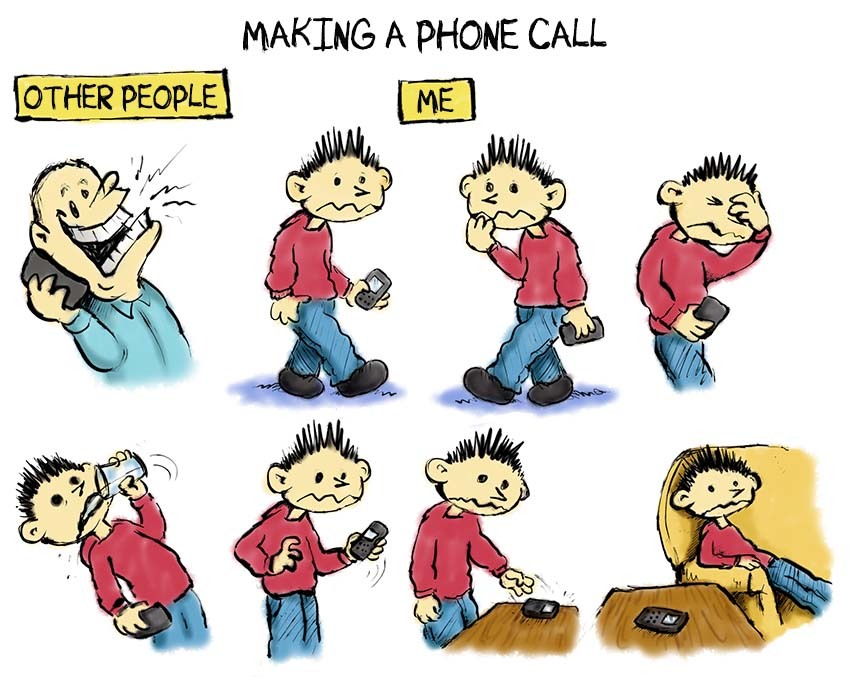
Last semester, while working on a documentary that took place in New Orleans, I had to quickly get over my fear of talking on the phone. I realized that if I want to be a documentary producer, I need to pick up the phone and start making calls like my life (or at least my project) depended on it. I've always been fine with talking to people face to face, in fact I love building connections and learning people's stories, but I think making important phone calls is a skill set that needs to be learned.
I've spent courses in school where we learn how to conduct an interview, I've gone to workshops where we learn how to handle ourselves in a meeting or presentations, but that all changes a bit when you get on the phone. Why? Because body language has been eliminated from the equation. Can they hear me? Do they care? Am I talking too little? Too much? The answers to a lot of those questions can be solved by observing someone's body language, but on the phone you just can't tell.
I'm starting to learn some techniques to feel people out in a phone conversation, but I still don't feel like a master yet. If given the option, I would choose face-to-face or email every time, but I'm getting there. Slowly but surely I'm learning to embrace calling people, but I just need to know one thing: do other people share this weird fear of phone conversations or am I the only one?

I don't know what it is, but I have never particularly enjoyed talking to people on the phone. I can't even tell you how many times I have let a friend's call ring through to voicemail then texted back a little while later claiming that I was "too busy" to talk. Then I got to college, and things started to change.
Last semester, while working on a documentary that took place in New Orleans, I had to quickly get over my fear of talking on the phone. I realized that if I want to be a documentary producer, I need to pick up the phone and start making calls like my life (or at least my project) depended on it. I've always been fine with talking to people face to face, in fact I love building connections and learning people's stories, but I think making important phone calls is a skill set that needs to be learned.
I've spent courses in school where we learn how to conduct an interview, I've gone to workshops where we learn how to handle ourselves in a meeting or presentations, but that all changes a bit when you get on the phone. Why? Because body language has been eliminated from the equation. Can they hear me? Do they care? Am I talking too little? Too much? The answers to a lot of those questions can be solved by observing someone's body language, but on the phone you just can't tell.
I'm starting to learn some techniques to feel people out in a phone conversation, but I still don't feel like a master yet. If given the option, I would choose face-to-face or email every time, but I'm getting there. Slowly but surely I'm learning to embrace calling people, but I just need to know one thing: do other people share this weird fear of phone conversations or am I the only one?
Thursday, February 4, 2016
How Birds are the Embodiment of Film
Watch this bird:
This is film in a nutshell. And I will explain why.
If you were to describe a bird in three adjectives, which would you use? Precise? Elegant? Free? Birds are beings of freedom and grace. The miracle of flight is something spectacular to observe. The first time in your life that you truly analyze flight, you are in awe. The miracle of flight mirrors the miracle of film.
Film is in every sense of the word, a miracle. To capture the motion, the emotion, and the reality of life on film is incredible. The first time you look at film in an analytical way, you realize how truly unbelievable it is.
Like a bird in flight, the filmmaker explores new avenues, using creativity to venture through space and time to achieve his/her goal.
In the video, at 11 seconds, another bird flies in front of the main bird. Every bird is influenced other birds. You can observe this in "bird V's". Each bird follows the birds before themselves, but take slightly different paths.
Just like these birds, filmmakers are influenced by the filmmakers before them. They draw influence and create their own paths based on the filmmakers of old.
An observer of birds is an observer of film, and I strive to be both.
If you were to describe a bird in three adjectives, which would you use? Precise? Elegant? Free? Birds are beings of freedom and grace. The miracle of flight is something spectacular to observe. The first time in your life that you truly analyze flight, you are in awe. The miracle of flight mirrors the miracle of film.
Film is in every sense of the word, a miracle. To capture the motion, the emotion, and the reality of life on film is incredible. The first time you look at film in an analytical way, you realize how truly unbelievable it is.
Like a bird in flight, the filmmaker explores new avenues, using creativity to venture through space and time to achieve his/her goal.
In the video, at 11 seconds, another bird flies in front of the main bird. Every bird is influenced other birds. You can observe this in "bird V's". Each bird follows the birds before themselves, but take slightly different paths.
Just like these birds, filmmakers are influenced by the filmmakers before them. They draw influence and create their own paths based on the filmmakers of old.
An observer of birds is an observer of film, and I strive to be both.
All About Eve and Good Backstage Drama
With actors involved there's always drama. All About Eve is a backstage drama written and directed by Joseph L. Mankiewicz centering around an aging theater star. Bette Davis plays Margo Channing, a snide actress on her way out who takes a young girl named Eve under her wing.

 The movie begins with Eve, played by Ann Baxter, accepting an acting award. We don't know who she is or why she's won, we just know that the guild loves her. And we meet Margo and her friends who don't applaud at the acceptance ceremony. Eve, is young with no connections. When a friend of Margo's introduces them Margo is warmed by Eve's love of the theater and her love of Margo as an actress. Margo allows Eve to work for her as her assistant and the two strike up a friendship.
 Quickly though Margo grows tired of Eve. She's always around and sometimes she makes important personal decisions, like telephoning Margo's boyfriend, without consulting her first. Margo drops Eve and feels excluded by her friends who are all smitten with her.


 The movie begins with Eve, played by Ann Baxter, accepting an acting award. We don't know who she is or why she's won, we just know that the guild loves her. And we meet Margo and her friends who don't applaud at the acceptance ceremony. Eve, is young with no connections. When a friend of Margo's introduces them Margo is warmed by Eve's love of the theater and her love of Margo as an actress. Margo allows Eve to work for her as her assistant and the two strike up a friendship.
 Quickly though Margo grows tired of Eve. She's always around and sometimes she makes important personal decisions, like telephoning Margo's boyfriend, without consulting her first. Margo drops Eve and feels excluded by her friends who are all smitten with her.
As things begin to unravel it becomes clear that Eve is more than she appears to be. She is manipulative of everyone in the film. Eve is an actress and a damn good one. She's put on a different face for every person that she meets.

All About Eve is an Oscar winning film for one reason. It created a character who wanted something and showed to the lengths in which they would go to get that. The conflict of Al About Eve isn't terribly complicated, the cinematography isn't out of this world. But it's simple storytelling that makes the film so effective. That and Bette Davis in full form.

Birds: An Under Utilized Scare Tactic In Film
"A parrot walks into a bar and asks for a scotch on the rocks, after knocking back the drink, he ask for the same again. This is also downed in one gulp, and he points his wing at the empty glass. This time the barman ask for some payment, to which the parrot replies - put it on my bill"
If you didn't find that funny, then you probably don't enjoy birds.
Congratulations, you fall into the 85% of American's who don't enjoy birds as well. To most, birds are a nuisance, inferior vertebrate that poop all over everything and ruin crops. The worst part about birds is that they are in a way, "above" us, soaring over us in places that we can't reach without the aid planes, or jetpacks, or even ladders. This fear of inadequacy hunts us to our core, and it is this exact fear that has produced some of the scariest movies in Hollywood.
The Birds (1963)
Alfred Hitchcock
A perfect example of the aeronautical capabilities of birds combined with a human's natural fear of birds. Alfred Hitchcock was able to capitalize on this fear in his film The Birds. A film about a wealthy San Francisco socialite who goes to pursue a potential boyfriend to a small town in Northern California when things take a bizarre turn after birds of all kinds suddenly begin to attack people.
Pterodactyl (2005)
Mark L. Lester

Another prime example of being spooked by birds. Mark L. Lester takes things to a whole new level when he introduces the Pterodactyl, the scariest kind of bird, to the silver screen. Nothing is scarier than a bird that eats meat, especially a BIG bird. Lester sends shivers up his audiences' spine with this horror about a dormant volcano deep in the Turkish forest that holds within it a deadly secret, that being a perfectly preserved nest of pterodactyl eggs ready to hatch
Both movies pushed the boundaries of horror and what it means to truly be scared. To this day, I am still waiting for the next Pterodactyl, a chance for me to really be taken out of my element, a chance to be chilled to the bone.
Baskets
So, when I originally signed up for the thesis class, I had my idea/story for a short comedy film about Flex the Clown - a washed up clown that never takes his clown suit off because it's a part of who he is. But then, I learned that Zach Galifianakis and Louis C.K. (two of the biggest comedy geniuses of our time) were working on an FX original called Baskets. Although, little to no plot information was given away in the advertisements, I knew it was about a clown that was trying to break into the clowning profession. Here's a poster from the show.

So anyways, I thought this was going to ruin my thesis idea. I didn't want to rip off the new show so I decided to scrap Flex the Clown and figure out a different idea.
But then, I finally decided to watch Baskets to see what it was all about. And although, I did enjoy the pilot episode, I also realized that it's a lot different than the story I had in mind for my thesis. Baskets is about Chip Baskets, who is passionate about being a clown. He struggles to pass clown school in France, but eventually, fails out because of a language barrier. Then, he returns home to get back on his feet.
If you're familiar with Louie C.K. and Zach Galifianakis' humor, then you know it contains a lot of painfully awkward and tragic situations. Baskets is just like that. And though I enjoyed the pilot I felt that Baskets failed to really capitalize on the actual "clown" aspect. In my thesis, I'm going to focus more on the "clowning" of the story.

So anyways, I thought this was going to ruin my thesis idea. I didn't want to rip off the new show so I decided to scrap Flex the Clown and figure out a different idea.
But then, I finally decided to watch Baskets to see what it was all about. And although, I did enjoy the pilot episode, I also realized that it's a lot different than the story I had in mind for my thesis. Baskets is about Chip Baskets, who is passionate about being a clown. He struggles to pass clown school in France, but eventually, fails out because of a language barrier. Then, he returns home to get back on his feet.
If you're familiar with Louie C.K. and Zach Galifianakis' humor, then you know it contains a lot of painfully awkward and tragic situations. Baskets is just like that. And though I enjoyed the pilot I felt that Baskets failed to really capitalize on the actual "clown" aspect. In my thesis, I'm going to focus more on the "clowning" of the story.
The Eric André Show and Public Access TV
This week, after it being recommended by a friend, I watched The Eric André Show for the first time. This friend had no idea of my plans to produce a public access cooking show, nor did I have a clue that The Eric André Show was a sketch-riddled comedy program parodying public access talk shows. Though when it comes to this style I prefer the tastes of Tim and Eric, I found The Eric André Show funny. I especially liked how genuinely uncomfortable the guests felt during their interviews, which seems to have been part genuine, part editing magic.
Tonight I visited Pegasys, the public access studio mecca in Fall Creek in which we plan on shooting/editing together Baking and Entering. They have one studio that is as wonderfully archaic (i.e. analog-based) as we had hoped. There are generic set pieces, curtains (one chroma), a big chunky TV monitor, plenty of lights, and a tall ladder to shoot from. We set up two cameras, plugged in a mic, and fooled around in the control room. I had fun adapting to this much-older version of boards I learned to operate two years ago.
I can see why Eric André wanted to use analog cameras and film in the style of public access television; there's something thrilling about being "limited" in that sense. It's also fun to borrow/imitate a style that is frequently jabbed at feeling uncreative or boring. I'm excited to make the most of public access television this semester.
Tonight I visited Pegasys, the public access studio mecca in Fall Creek in which we plan on shooting/editing together Baking and Entering. They have one studio that is as wonderfully archaic (i.e. analog-based) as we had hoped. There are generic set pieces, curtains (one chroma), a big chunky TV monitor, plenty of lights, and a tall ladder to shoot from. We set up two cameras, plugged in a mic, and fooled around in the control room. I had fun adapting to this much-older version of boards I learned to operate two years ago.
I can see why Eric André wanted to use analog cameras and film in the style of public access television; there's something thrilling about being "limited" in that sense. It's also fun to borrow/imitate a style that is frequently jabbed at feeling uncreative or boring. I'm excited to make the most of public access television this semester.
Route 66 and the Daily Life Behind Tourism
Historically, Route 66 represents westward expansion and industrial revolution. Built in 1926, the highway was meant to connect two major cities on either coast - Los Angeles and Chicago. Following The Depression, the highway was a symbol for opportunity. What could no longer be found on the east coast might be found on the west. In the 1960s and 70s, the highway was a popular tourist attraction, even prompting a TV show and a hit song. However in classic American fashion, there is always a marginalized history behind the mainstream.
What happens to the people who travelled along Route 66 in search of adventure and a new life, but never found it? In Arizona, the rural homeless population is rapidly increasing. Many homeless people can be found along - you guessed it - Route 66. Recently, a woman by the name of Lori bought Route 66 Motel to transform it into a homeless shelter called ANEW Living. A documentary film would tell the stories of the people in this motel. It would tell the daily life behind a tourist attraction. The truth behind the facade. The reality behind the show.
What happens to the people who travelled along Route 66 in search of adventure and a new life, but never found it? In Arizona, the rural homeless population is rapidly increasing. Many homeless people can be found along - you guessed it - Route 66. Recently, a woman by the name of Lori bought Route 66 Motel to transform it into a homeless shelter called ANEW Living. A documentary film would tell the stories of the people in this motel. It would tell the daily life behind a tourist attraction. The truth behind the facade. The reality behind the show.
The Art of The Docudrama
My plan for Tuesday night was to watch The People v. O.J. Simpson: American Crime Story, but the episode was on until 11:20 and admittedly that is past my bedtime. However, I did get a chance to watch it the next day, and it was definitely worth the wait. In case you have no clue what I am talking about, here is a video to get you interested.
Blame it on my age, or ignorance, or a mixture of both, but I really do not know much about the O.J. Simpson case; so when I found out FX was releasing a docudrama miniseries about the case starring Cuba Gooding Jr., John Travolta, and David Schwimmer, I was all for it. The camera work and acting blended with the dramatic reality of the entire case made for great and informative television. It is almost too good to be true, but fact checkers across the internet have found the majority of the series' portrayal accurate.
From a documentary production standpoint I took a lot of notes as well. Sure, a lot of the shots would not be realistic to achieve in an actual documentary, but the episode actually contained a lot of oners and handheld shots that would be possible in a documentary. A lot of times documentary shots tend to be a bit stagnant, but cinematographers can definitely (and should) study docudramas to find some inspiration for more dynamic shots. I wish I could find a clip online to explain what I am talking about, but I guess you'll just have to watch American Crime Story and see for yourself.
What A Lovely Day: Why Fury Road should win Best Picture.
Look, Spotlight is a great movie. With fantastic performances from a stellar cast and a compelling story, it's almost certain to win Best Picture at the Oscars this year. However, there was another film released in 2015 that has stuck with me more than any other movie in a long time. If you read the title of this blog post you'll know that that movie is Mad Max: Fury Road.
Mad Max: Fury Road is the fourth film in director George Miller's post apocalyptic saga. It was released 30 years after the previous film in the series Beyond Thunderdome, came into theatres. To briefly summarize the movie for those who haven't seen it, Fury Road follows the titular Max (Tom Hardy replacing Mel Gibson) who joins a woman named Furiosa (played by Charlize Theron), in transporting the slave wives of a warlord to safety all while being pursued by the Warlord. To someone who hasn't seen the movie, the plot can sound like a somewhat generic action movie. However, Mad Max: Fury Road is anything but. The movie excels in countless ways and becomes in this writer's opinion, a perfect action movie that should, even though it will lose to Spotlight, win best picture. Let's examine a few reasons why.
Just take a look at the gif above, or at this 20 minute video of all the fight scenes in Transformers. The action is all over the place and quickly becomes very hard to follow. The shaky camerawork and near constant explosions make taking in the action an overwhelming and difficult task that quickly becomes an eyesore. I'm just picking on Bay for this post but it happens with a lot of actions movies. However this is where Miller excels. Actually, I should say this is where Margaret Sixel excels, as she is the one who edited this movie. What makes the editing of Fury Road so interesting is that it isn't edited like an action movie. In fact, Sixel, who is Miller's wife, had never edited an action film before Mad Max: Fury Road. Miller, when asked why he selected Sixel to edit the film said that had it been edited by "the usual kind of guys, it would look like every other action movie we see" The result of Margaret Sixel's editing is high octane action scenes that are easy to follow.





Furiosa's journey is what drives (see what I did there) the plot. Max is simply along for the ride. (see that I did there) The entire film has a strong feminist message. Furiosa is never a damsel in distress and is never seen as inferior to Max. In fact, she saves Max's ass a few times. Her character is given depth and important backstory which the plot gives proper attention to. She is not oversexualised or just made to be an object of male gaze. She is smart, independent, and very resourceful. What works well with the film is the mutual respect she and Max have for eachother. Max never assumes she is unable to perform a task, he is simply weary of her at first. Furiosa however is not the only female character in the film. Joining her are Immortan Joe's fives wives, also referred to as breeders, used to bring Immortan healthy sons. Each of the wives in the film stands out in their own way and is unique from the others. Again giving character development to them. They too are able to hold their own in a fight. the film easily passes both the Bechdel_test and the Mako Mori test. The film does such a good job with its female characters that a group of Men's Rights Activists, which is sadly a real thing, protested the film calling in feminist propaganda. I'm not going to give the link to the article, but if you can find it pretty easily. The story as a whole improves the film. Despite these many complex characters, the overall plot is simple. This benefits the film and allows the visual aspect and action to do the rest of the storytelling. There is no need for any subplots or things that go nowhere, the film simply tells one story and focuses entirely on that.
 |
| Fury Road summarized in one image. |
1. Editing.
One of the biggest faults the modern action movie suffers from is the editing. The movies are so concerned with action that the become nearly impossible to watch or even understand what is going on.
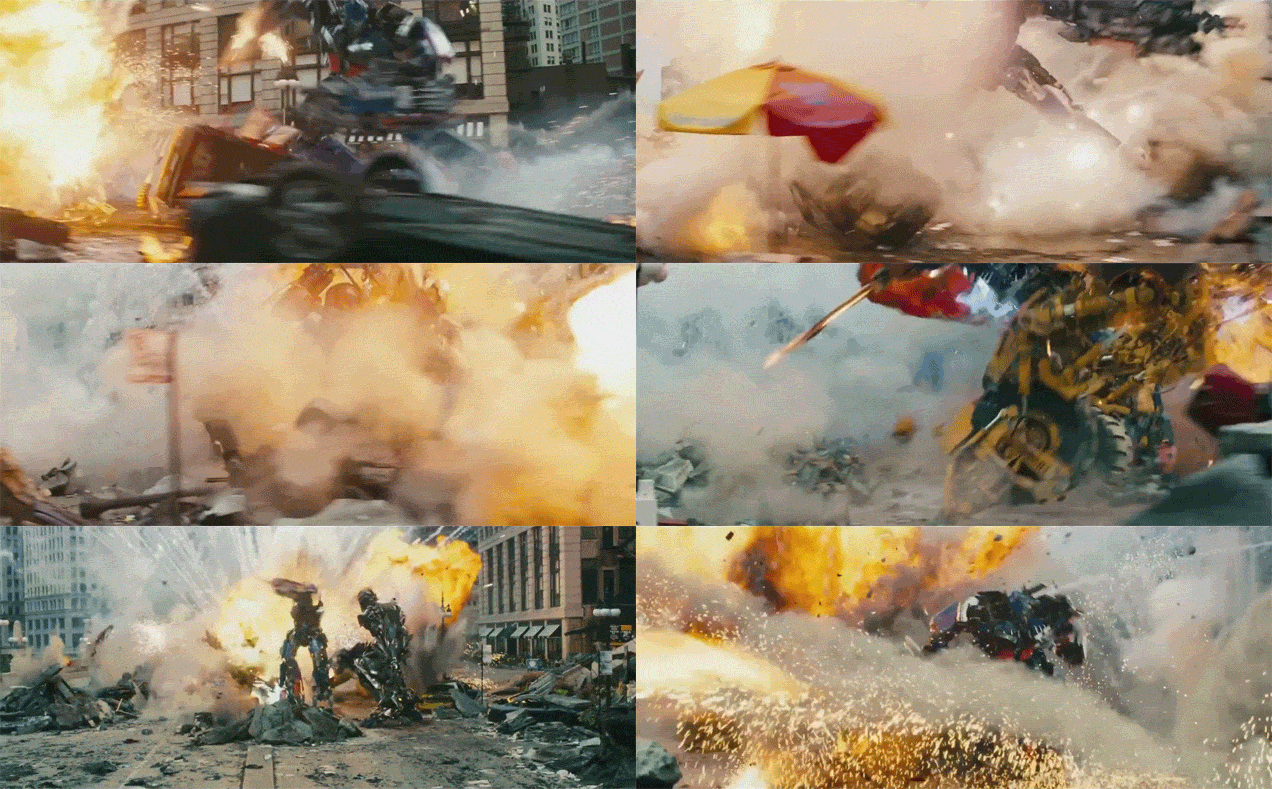 |
| Looking at you Michael Bay. |
Look at this gif to the left. Important points are kept in the center so the audience doesn't have to search for them. Shot shots, while short, are long enough that we are able to see what is occurring in each one before the next shot comes along. Also notice how while there is slight directional movement with the camera, it is still steady enough for us to be enthralled by the action but not made motion sick by the blair witch level shakiness.
While this edited works great for these action sequences, it also improves the films watching as a whole. Film being a visual medium, and actions films doubly so, it is important that you can tell your film well with minimal use of dialogue to expose what is occurring on screen. Check out this video of several action films 12 times their normal speed. As many of the other films becomes a hard to follow muddled mess, more or less you can still tell what's going on in Mad Max: Fury Road. You could easily take all the sound out of Fury Road and besides missing an awesome score by Junkie XL you would still be able to understand the story and could pretty easily explain the major plot points of the film.
2. Practical Effects
With CGI, almost anything is possible and for considerably less than it would cost to actually do it. think about it; If you were making a movie like Mad Max: Fury Road, you wouldn't spend all that time to actually build all those cars and then actually go out in the desert and film all those dangerous stunts full speed and end up destroying those cars, when you could do almost all of that with CGI right? Well George Miller did. Almost every single car in the film is a real, fully functioning vehicle.
That includes this one.
This one
This one, which you may remember having a man playing a flame-throwing guitar which was also real, on top of it.
And countless other ridiculously awesome post-apocalyptic vehicles. All of these were actually built, functioned, and for most of them, destroyed in one of the final car chase climaxes ever. Miller did use CGI, but only to enhance. This is how CGI should be used, to enhance scenes, not to completely replace what could be made practically.
Check out this great video which shows many of the CGI shots in the film before and after it was added. Notice how for the most part, things are done practically, when important. Scenes where shooting inside a moving vehicle would not have worked are done on green screen, but almost anything else is done with good old practical destruction.
Here are a few other pre and post CGI/VFX shots from Fury Road.
3. Story/Feminist Action
Perhaps one of the most interesting parts of Mad Max is that Max is not the protagonist of the film, in fact, the story of Fury Road is not Max's. That honor goes to Furiosa.
 |
| Hands down biggest badass of 2015. |
In Conclusion
Mad Max: Fury Road excels in almost every aspect. It's beautiful to look at, has great characters who you wanna root for, and is fun as hell. The film is clearly made by someone who dearly loves film. One can even see multiple subtle references to the older Mad Max films, but we won't go into that now. Filmmaking is a craft, and the craft that went to making Mad Max is truly remarkable. Each aspect is equally important to the film working out. If it failed, the whole film would have too. From the editing to the script, to the practical effects, the utmost care was put into every detail of the movie. This is not to say that the other nominees are not deserving they are, and in Spotlight's case, they will succeed. None of the films however, accomplish what Mad Max: Fury Road did. For that Fury Road shall ride enteral, shiny and chrome.
Wednesday, February 3, 2016
The Sound Of "The Revenant "
There is no doubt about it, in my opinion, The Revenant is visually the best film that has come out in the past decade. Director Alejandro Gonzalez Inarritu, along with director of photography Emmanuel Lubezky, created a visually stunning masterpiece. And most importantly told the true story of a lost culture, and a mans journey with survival in nature. But not only does this movie visually blow your mind, but the sound is incredible as well. Sound designer Martin Hernandez and Randy Thom really captured how oblivious the sound of nature really is, and how it is so much bigger than any character despite his journey. As a sound designer, I know how difficult it is to take a 5 minute scene with no dialogue and manipulate certain sounds to make the audience fall into that story. The Revenant is a 2 hour and 36 minute movie with little to no dialogue. This film deserves more than an oscar, it deserves to be historically one of the best films of all time.
http://soundworkscollection.com/videos/the-sound-of-the-revenant
http://soundworkscollection.com/videos/the-sound-of-the-revenant
Tuesday, February 2, 2016
For all you BMS (Blue Mountain State) Football Lovers! This show is a
hilarious Spike Series that premiered January 11, 2010 and ended
February 4, 2013. Even though the show was only on for 3 years it gained
a big following and was a series that everyone watched on Netflix. If
you haven't seen it you need to. The Director was Lev L. Spiro and the
writers were Eric Falconer, Alan Ritchson, Chris Romano.The Show
revolves around American Football, sex, drinking, drugs and partying.
Hits all your basics for a typical college show. Here is the trailer for the show.
The Show got so much buzz after it went off air and didn't return for a forth season, they decided they needed to make a movie. On April 8, the BMS movie was announced and a Kickstarter launched on April 15, 2014. The Kickstarter campaign reached its goal of $1.5 Million. Usually you can't follow up a hilarious show like this BMS with a movie but I honestly think that it might top the whole series. Take a look at the trailer yourself and you be the judge.
The Show got so much buzz after it went off air and didn't return for a forth season, they decided they needed to make a movie. On April 8, the BMS movie was announced and a Kickstarter launched on April 15, 2014. The Kickstarter campaign reached its goal of $1.5 Million. Usually you can't follow up a hilarious show like this BMS with a movie but I honestly think that it might top the whole series. Take a look at the trailer yourself and you be the judge.
Thursday, January 28, 2016
Michael Moore and ego-driven documentary
Bowling for Columbine. Sicko. Fahrenheit 9/11. Capitalism: A Love Story. The documentaries of Michael Moore have a lot of things going for them; big-name issues at the head of public debate, brutal honesty of style, and at times a humorous tone. However, the key aspect of a Michael Moore film, which often disrupts his general appeal to a more critical audience, is ego.
As a documentarian, Moore strives to create an education, yet entertaining film, often turning what what can be serious material into a laughable idiocy. However, he does this not through subtlety, but through his own personal appearance in his films. Michael Moore himself acts as the "everyday man" in his films; appearing as a normal person rather than an uppity director. His portrayal of this everyman helped to give his work an air of groundedness and relatability.
While this trend worked in his early films, the repetition of his own involvement has grinded many of his viewers nerves. His films became more about himself and his opinions than the issues and logic behind them. His films reach a point where he becomes not only this everyman, but he becomes highly-successful filmmaker Michael Moore. As his films became more topical, many critics claim that his success had lead him to become snobby and arrogant, and it becomes truly visible in the parody on his famed "Roger and Me", known as "Michael Moore Hates America". The film, by Mike Wilson, attempts to emulate Moore's earlier film where he attempts to get an interview with CEO of General Motors Roger Bonham Smith. Wilson attempts to interview Moore, while also exposing some of the discrepancies of Moore's earlier work, from manipulation of data and information, to staging of events and processes, in order to fit Moore's ideology and thesis of Moore's films.
The egotistical character that Moore has become, being a prominent left-wing political activist, has turned many of his films sour. His personal appearance and brashness, while entertaining from time to time, has spoiled the ideological approach his films take towards difficult issues. The brashness comes off as arrogance, and this turns the viewer off to his perspective.
As a documentarian, Moore strives to create an education, yet entertaining film, often turning what what can be serious material into a laughable idiocy. However, he does this not through subtlety, but through his own personal appearance in his films. Michael Moore himself acts as the "everyday man" in his films; appearing as a normal person rather than an uppity director. His portrayal of this everyman helped to give his work an air of groundedness and relatability.
While this trend worked in his early films, the repetition of his own involvement has grinded many of his viewers nerves. His films became more about himself and his opinions than the issues and logic behind them. His films reach a point where he becomes not only this everyman, but he becomes highly-successful filmmaker Michael Moore. As his films became more topical, many critics claim that his success had lead him to become snobby and arrogant, and it becomes truly visible in the parody on his famed "Roger and Me", known as "Michael Moore Hates America". The film, by Mike Wilson, attempts to emulate Moore's earlier film where he attempts to get an interview with CEO of General Motors Roger Bonham Smith. Wilson attempts to interview Moore, while also exposing some of the discrepancies of Moore's earlier work, from manipulation of data and information, to staging of events and processes, in order to fit Moore's ideology and thesis of Moore's films.
The egotistical character that Moore has become, being a prominent left-wing political activist, has turned many of his films sour. His personal appearance and brashness, while entertaining from time to time, has spoiled the ideological approach his films take towards difficult issues. The brashness comes off as arrogance, and this turns the viewer off to his perspective.
Adult World: Quirky, Funny, and Incredibly Relateable
Surfing through Netflix's recent releases section I stumbled upon "Adult World", and boy am I glad I did! This quirky, coming-of-age comedy hits a little too close to home for me, as I'm sure it does for many soon to be or post-college graduates. The story follows Amy, a naive Syracuse graduate who believes she is destined to be a great poet. Things don't work out initially and she eventually accepts a job at a local sex shop while she pursues a mentorship with her idol writer, Rat Billings. The dialogue is quirky and off beat, reminiscent of works by Diablo Cody (Juno, Young Adult), but somehow in that off beat oddness there is the raw truth of finding oneself during an awkward time.

The cast includes Emma Roberts, Evan Peters, and John Cusack. Adult World was filmed in 22 days in Syracuse, NY.
The cast includes Emma Roberts, Evan Peters, and John Cusack. Adult World was filmed in 22 days in Syracuse, NY.
Buster Keaton and Physical Comedy
As many of you know, my thesis film, Mime and Punishment is inspired by the works of Buster Keaton and his influence on visual and physical humor. On the off chance you are not aware of who Buster Keaton is, he's this guy.
This bit, from his film Steamboat Bill Jr. is perhaps Keaton's most famous stunt and has been continually referenced throughout pop culture.

 |
| Steamboat Bill Jr. |
Gags, like the one above, are what Keaton was known for. His films were chock full of and heavily reliant on physical humor. Keaton's characters, would often find himself in zany and often dangerous situations. What's even more remarkable was all of his stunts, were done by himself. With all these zany stunts came a fantastic visual storytelling. Silent films of the time, Buster Keaton's included, had to rely on title cards in lieu of dialogue for exposition. Most films of the period had an average of 240 title cards.
Imagine 240 of these being needed to tell your story. Keaton said that he never used over 65. That's almost 1/4th of what every other film used. Instead, Keaton relied on the kinetic and often slapstick energy to tell story in non-verbal manners. Keaton was always entering and leaving frame in interesting ways. His mannerisms and framing have had a lasting legacy. This fantastic video from Every Frame a Painting shows the lasting legacy of Keaton as well as better explaining the points I made in this post.
Anomalisa is a Movie that is Playing in a Theater Somewhere
So I saw this movie the other day. It's called Anomalisa. If you haven't heard of it, check it out. It was written and directed by Charlie Kaufman. If you haven't heard of him, check him out. Because he and his work... well, it's definitely out there.
Anomalisa is a stop motion animated film that follows protagonist Michael Stone as he travels to Cincinnati to his latest book at a hotel service convention. The story is extraordinarily simple. Michael checks into his hotel. He meets a girl. And he falls in love with her. It's basically a 90 minute movie about a one night stand.
But, if you know anything about Kaufman, you'll know that things are never that simple. Every character that Michael perceives in the movie has the same voice and the same face (whether they are male or female, they are voiced by Tom Noonan). This is an extremely original and clever way of showing Michael's inability to connect to anyone.
But when he meets Lisa, he's immediately attracted. Why? Because Lisa doesn't sound like everybody else (voiced by Jennifer Jason Leigh). She doesn't look like everybody else. She's her own person.
Finally, somebody different. Somebody unique. Somebody to make a connection with. Right?
I don't want to give anything away, so I will say no more. But I highly recommend this film. I don't remember a film that made me feel so many different feelings all at once like this film did. So go out and see Anonalisa.
Anomalisa is a stop motion animated film that follows protagonist Michael Stone as he travels to Cincinnati to his latest book at a hotel service convention. The story is extraordinarily simple. Michael checks into his hotel. He meets a girl. And he falls in love with her. It's basically a 90 minute movie about a one night stand.
But, if you know anything about Kaufman, you'll know that things are never that simple. Every character that Michael perceives in the movie has the same voice and the same face (whether they are male or female, they are voiced by Tom Noonan). This is an extremely original and clever way of showing Michael's inability to connect to anyone.
But when he meets Lisa, he's immediately attracted. Why? Because Lisa doesn't sound like everybody else (voiced by Jennifer Jason Leigh). She doesn't look like everybody else. She's her own person.
Finally, somebody different. Somebody unique. Somebody to make a connection with. Right?
I don't want to give anything away, so I will say no more. But I highly recommend this film. I don't remember a film that made me feel so many different feelings all at once like this film did. So go out and see Anonalisa.
Documentary for Social Change
Most people that I've encountered that hope to make it in the documentary world have some form of passion for social justice. Of the many news outlets and organizations I've encountered, the most effective at producing social change has been Witness. With tag of "See It, Film It, Change It", the organization works to train citizens to be active in social movements through the power of film and photography. Citizen journalism that is collected is often turned into larger films that are used as evidence in international cases. I find their series on Gender Based Violence to be highly effective. The cover issues from sex worker safety to feminicide to equal pay in a range of countries. The series is worth watching not only because they are great short films, but also because they are giving agency back to the people of these areas. Oftentimes documentaries for social change take a distant gaze and a bias based on the filmmaker's history. Instead these films bring you into the minds of the women, making them the agents of social change. This story is interesting about the differences in women's work.
Style in a Doc
My favorite nonfiction work is that which displays some finessed styling, whether it be premeditated or conceived in the editing room. Short of framing the shot, it is difficult to style, both visually and aurally, what is supposed to appear as "real life." A short and recent example of nonfiction work I believe to be successful in maintaining visual interest comes in an episode of Refinery29's "Sound Off" series, below:
Introducing viewers to Brazilian female rapper Karol Conka, this video oozes style. What I find most appealing are its:
-capturing of natural light (0:03 is a staged shot but does not detract from the documentary feel)
-humorous matching of sound to picture (0:46 and 1:43 obviously came along in the editing room)
and
-occasional POV as a "follower" (4:12 and more)
These aspects combine to make an interesting video--visually, aurally, and story-wise. Should I decide to pursue my doc idea of following around certain women of Ithaca, I would aim to conjure up a similar sense of intimacy and interest (i.e. follow the subject(s) around, use positioning to make what occurs naturally as beautiful as possible, play with sound and speed when editing) as is achieved by this episode of "Sound Off."
Introducing viewers to Brazilian female rapper Karol Conka, this video oozes style. What I find most appealing are its:
-capturing of natural light (0:03 is a staged shot but does not detract from the documentary feel)
-humorous matching of sound to picture (0:46 and 1:43 obviously came along in the editing room)
and
-occasional POV as a "follower" (4:12 and more)
These aspects combine to make an interesting video--visually, aurally, and story-wise. Should I decide to pursue my doc idea of following around certain women of Ithaca, I would aim to conjure up a similar sense of intimacy and interest (i.e. follow the subject(s) around, use positioning to make what occurs naturally as beautiful as possible, play with sound and speed when editing) as is achieved by this episode of "Sound Off."
The Graduate
I've been watching a lot of dramatic comedies lately to get into the mindset of what I want my movie to 'feel' like. The Graduate might be the most famous dramatic comedy, or dark comedy, of all time. So I rewatched it to try to get a quick master class of funny/sad that Mike Nichols seemed to do so well.


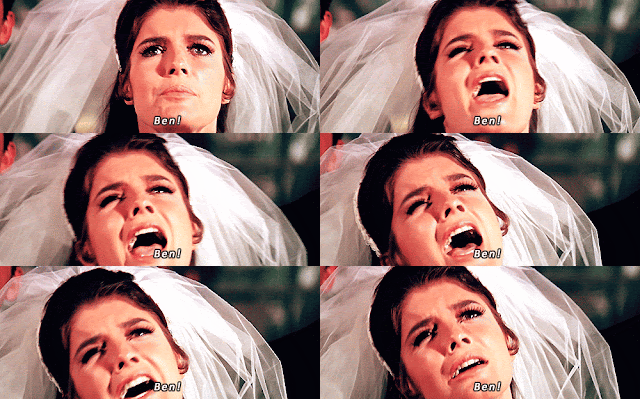


The Graduate is a movie that seems to defy explanation. Even Roger Ebert was greatly divided on the film. When he first saw it he called the movie "the funniest American comedy of the year". When he reviewed it again for the 30th anniversary special he called it "a movie about a tiresome bore and his well meaning parents."

What I think divides the younger and older Roger Ebert, and people in general, is that Dustin Hoffman's character, Ben Braddock, doesn't really change. The beginning of the film tells a lot thematically. Ben is on a moving walkway in an airport and while he is "moving forward" he is not walking or moving himself anywhere. People pass him and he watches them go by. Ben is also facing towards the left, which in traditional American film means going backwards or against the grain.

Throughout the course of the movie Ben doesn't do much. He sits in his pool and ignores his family friends. The main conflict of the film, Ben's affair with Mrs. Robinson, is started not by Ben but by Mrs. Robinson. The argument can be made that Ben changes when he falls in love with Elaine and follows her to Berkley and then again follows her to her wedding.

But Ben's reasons are still completely selfish. He is in love with Elaine because she is in the same "not moving" position he is. There are several moments where this is implied in the cinematography, most famously the runnning scene.
This begs the question that is asked every god damn semester in every film class. In film, does the main character have to change? I'd argue no. Ben doesn't change much in The Graduate. But what does have to happen is that audience has to see that the character has the ability to change but, for whatever reason, does not. Nichols shows this inability to change as a tragedy as Ben and Elaine pull away. What we thought was a happy tale of romance is just the characters realizing they haven't changed.

My goal for this semester is to make a movie where a character is given multiple opportunities to change but ultimately fails to do so. I think it's a powerful form of story telling that encourages introspection. While it is easy to say this, and showcase a movie in which this happens, it will be difficult to pull off. It will require constant rewriting and meticulous shot planning. I never thought I would say this but I disagree with Roger Ebert. The Graduate is a film that stands the test of time. Not as a comedy, but as a complex movie about depression and the selfishness in passiveness.

WORLD STARRRR
World star hip hop is a video blogging site that averages a total of 1.1 millions views per day. Although some of the content is kind of sketchy the website Alexa 983rd for worldwide traffic. It all started as a hip hop site in queens to appeal to hip hop fans world wide. But ten years later it became "The CNN of ghetto." The website posts fights, brawls, robberies, twerk videos. You name it world star has it. But despite all the fucked up content it has to offer, World Star can display the truth behind underprivileged living, and the struggles that come with that culture. At the end of the day, World Star Hip Hop is going to keep blowing up, and until the world will become less shitty, shitty content will exist on the internet
Binaural Audio
Sound is extremely interesting when you sit down and think about it. From the volatility of its nature to the seemingly endless uses and applications for it, sound is all around us on a day to day basis. However, very little thought goes into how that sound is received in various situations. Since the inception of speakers and headphones, sound has been received more or less as it was given, head on. That was until the inception of Binaural Audio; audio recorded on microphones designed to mimic human ears. I could attempt to explain this more in detail, but I figured the guys who are pioneering this technology, 3Dio, could do a better job...
Binaural recording is the process of capturing audio using two microphones that are shaped like human ears. When audio is recorded using a conventional microphone, sound is typically captured without any physical obstructions blocking incoming audio waves, other than the body of the microphone itself. Binaural microphones capture audio the same way your real ears hear sounds. The ears (pinnae) dramatically alter the incoming sound waves, but our brains understand these alterations as directional cues. In addition, the time delay between the ears gives us proper left/right directional cues. When you listen to binaural recordings using headphones, the result is natural "human" three-dimensional sound that gives the listener the sensation of being in the space where the audio was recorded.
Binaural recording is the process of capturing audio using two microphones that are shaped like human ears. When audio is recorded using a conventional microphone, sound is typically captured without any physical obstructions blocking incoming audio waves, other than the body of the microphone itself. Binaural microphones capture audio the same way your real ears hear sounds. The ears (pinnae) dramatically alter the incoming sound waves, but our brains understand these alterations as directional cues. In addition, the time delay between the ears gives us proper left/right directional cues. When you listen to binaural recordings using headphones, the result is natural "human" three-dimensional sound that gives the listener the sensation of being in the space where the audio was recorded.
What is a documentary?
The other day my professor asked our class to define the word "documentary." The whole class sat there stumbling over words and trying to find the correct answer. As a documentary studies major, I came into Ithaca College thinking that I knew the answer. As my time at IC has passed however, I am now more unsure than ever; is there a firm definition that explains documentary?
I typed "documentary definition" into a Google search and the response was,"a movie or a television or radio program that provides a factual record or report." Thinking back, that probably would have been my definition when I first started college, but I now realize there is one major flaw in that definition... the word "factual."
After taking several different documentary courses, attempting to understand what makes something factual sends me into a mild existential crisis. Due to human nature, everyone sees facts and truths differently. As humans, we are inherently subjective rather than objective, therefore can a documentary ever be completely objective and factual? What may be the truth for the producer, may not be the truth for other people.
Let's say, for example, I produce an entire documentary about the positive impacts of refugee communities in the United States. Then, after the film is finished, someone (Donald Trump?) states that my portrayal is completely inaccurate and refugee communities actually have a negative impact on U.S. society. Since someone disagrees with what I have portrayed, does that mean my film is not factual and therefore not a documentary? I would argue no, but other people may disagree.
The word "documentary" may seem pretty straightforward at first glance, but it is really quite complex when people take the time to think about it.
How would you define documentary?
I typed "documentary definition" into a Google search and the response was,"a movie or a television or radio program that provides a factual record or report." Thinking back, that probably would have been my definition when I first started college, but I now realize there is one major flaw in that definition... the word "factual."
After taking several different documentary courses, attempting to understand what makes something factual sends me into a mild existential crisis. Due to human nature, everyone sees facts and truths differently. As humans, we are inherently subjective rather than objective, therefore can a documentary ever be completely objective and factual? What may be the truth for the producer, may not be the truth for other people.
Let's say, for example, I produce an entire documentary about the positive impacts of refugee communities in the United States. Then, after the film is finished, someone (Donald Trump?) states that my portrayal is completely inaccurate and refugee communities actually have a negative impact on U.S. society. Since someone disagrees with what I have portrayed, does that mean my film is not factual and therefore not a documentary? I would argue no, but other people may disagree.
The word "documentary" may seem pretty straightforward at first glance, but it is really quite complex when people take the time to think about it.
How would you define documentary?
Wednesday, January 27, 2016
Birdwatching in Film
Birdwatchers, or as they call themselves, "birders", have never been properly depicted in film. To common folk, past movies about birdwatchers have been accurate enough, but to hardcore "birders", Hollywood is laughing stock because when it comes to accurate portrayal of birds in their movies, they miss the mark every time, apparently.
Nicholas Lund of Slate Magazine points out that after many big Hollywood blockbusters about specific subjects (such as Karate Kid with karate, or Top Gun with airplane flying) there is often a national excitement about the subject but that has yet to occur with "birding".
Two movies came out in 2014 about "birding":
Nicholas Lund of Slate Magazine points out that after many big Hollywood blockbusters about specific subjects (such as Karate Kid with karate, or Top Gun with airplane flying) there is often a national excitement about the subject but that has yet to occur with "birding".
Two movies came out in 2014 about "birding":
A Birder's Guide to Everything (2014)
The Birder (2014)
But by far the biggest movie about "birders" was the 2011 blockbuster starring Jack Black, Steve Martin, and Owen Wilson, The Big Year (2011):
The Big Year (2011)
The issue is that none of these movies have brought "birding" to the attention of the masses and none of them have done an adequate job of presenting "birding" in an accurate fashion.
The burden is on the young ambitious filmmakers of the world to make a captivating and accurate movie about "birding" that will make it the next worldwide craze.
Subscribe to:
Posts (Atom)