Showing posts with label oscar. Show all posts

Wednesday, March 2, 2016

Amy: An Uneasy Review

Since "Amy" won best documentary feature this past weekend, I decided it was time to watch it. As I sat and watched the film, I couldn't help but viscerally react to what I was seeing. At the time, I figured that was the point: we were supposed to be uncomfortable. As Manohla Dargis put it in a New York Times review of the film, "This discomfort is crucial to the movie’s complexity and is why it works as somewhat of an ethical and intellectual provocation. With “Amy,” Mr. Kapadia isn’t simply revisiting Ms. Winehouse’s life and death, but also — by pulling you in close to her, first pleasantly and then unpleasantly — telling the story of contemporary celebrity and, crucially, fandom’s cost." So I finished the doc and went to sleep, still feeling a bit unsettled, but figuring it would pass in the morning. 


But then I woke up this morning and I suddenly realized why I felt so uncomfortable. In a way, the film is everything it is criticizing. The film claims to present the Amy that the public did not get to see, but they can only achieve this through archival footage and by having the people close to her describe her. We don't actually get to see the real Amy Winehouse, the person she was when no one was around, we only really get to see the person she was when she was around other people and in front of cameras. Sure, it's a more intimate look at her life than we had previously seen because it is told by a more private sphere than the media, but I can't help but feel like it's still not authentically her. It can't be. 


Furthermore, as Dargis points out, the film tells the story of contemporary celebrity and its cost. The film does not hesitate to show their distaste for the paparazzi, yet a solid chunk of their footage is taken by paparazzi. How can you criticize and utilize something at the same time? Let's face it, the latter half of the documentary would not have been as powerful if the paparazzi footage wasn't present, so Kapadia is benefiting from the same thing he is criticizing. 



"Amy" did really well in the Box Office as far a documentaries are concerned, which makes me feel even more uncomfortable. The documentary can be seen as a scathing view of how we treat celebrities, but it's been capitalizing off of the life and terrible death of Amy. Is the documentary really much better than the people and industry that it is critiquing? While it may be a critique, it still turns her into a spectacle. After watching the film I can't help but think that Amy would be disgusted if she knew it existed. 
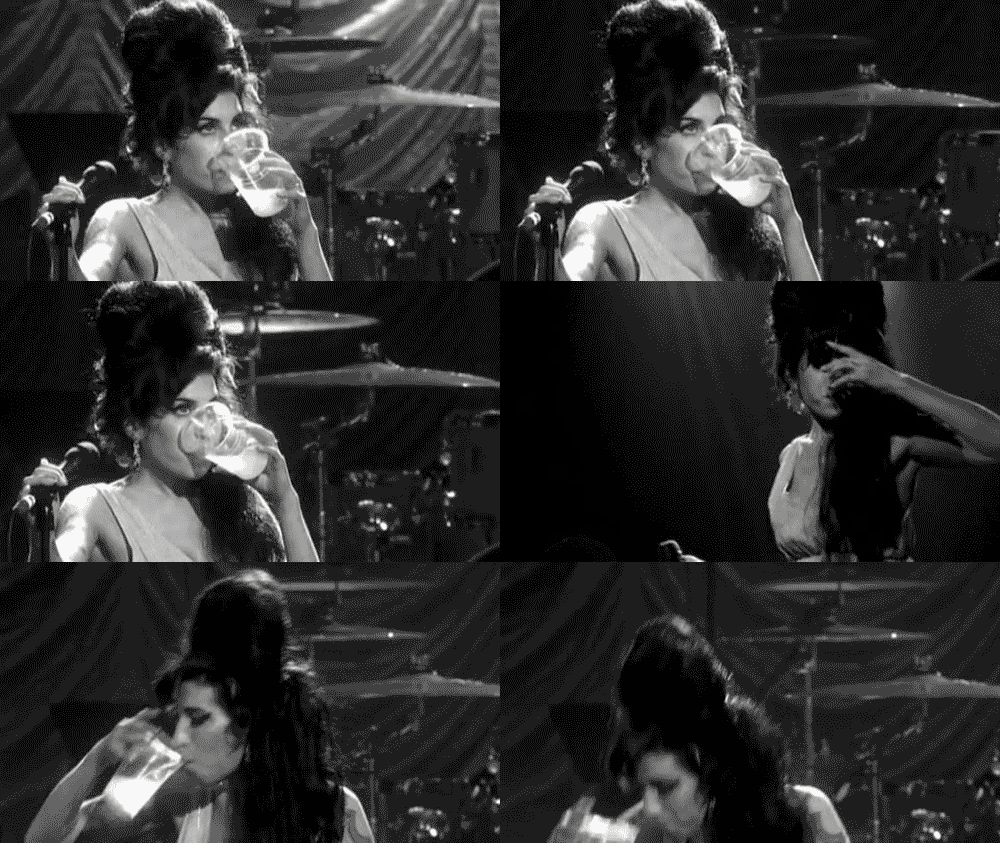


Considering the film won an Oscar, I'm sure I am one of the only people who feel this way, but I had to get it off my chest. 

Thursday, February 11, 2016

Diversity at the Oscars

Although in my last blog post I touched briefly upon Leo and his outstanding performance in The Revenant, this post is about how unfair it will be if he wins. For many years, the academy has lacked a sense of diversity, therefore most of the winner, in fact 74% of them are white. This is a huge problem with film, and in the world in general. Truly, this world is run by the "white man" and because of that most of the lead roles in hollywood are of white people, but interestingly enough, those roles that are of minorities are usually supporting roles. This year was a little different, we saw Will Smith in Concussion,

As we all know the Oscars are films biggest award shows highlighting the best pictures, and performances of the year:

But did you take the time to notice, that none of those people are not of the white race? In fact last year the academy had a similar issue:
Those people are all white too! Basically the academy is saying if you are not white, your not in! But this truly is not just a problem with Hollywood, its a problem with the entire world.  

Scene Reenactments

Shooting scene recreations

Scene recreations are a common form of documentary technique that is often used when there is a lack of archival footage or the archival footage is not adequate quality. There are many issues that arise with the use of reenactment. Some people consider it to be untruthful, but others argue that if the truth is already known, re-enactments can deliver it cinematically.
In 1988, documentary filmmaker, Errol Morris released a documentary that proved the innocence of a death row inmate and resulted in his release. The New York Film Critics Circle named A Thin Blue Line the best documentary feature of that year. On top of that it received numerous awards and recognition. Despite this film’s praise when the Oscar nominations of the year came around, this film was nowhere to be found. Roger Ebert, a top film critic, was outraged. He called it “the worst non-nomination of the year,” and blamed it on the academy’s “inability of academy voters to appreciate innovative filmmaking.”
This film was made in 1988 about a crime that took place in 1976. Morris’ signature style of filmmaking is his use of dramatic reenactments. A Thin Blue Line was one of his earlier films, but today he is known for these reenactments. Morris attributes this technique as to why A Thin Blue Line was overlooked, “Critics don’t like re-enactments in documentary films – perhaps because they think that documentary images should come from the present, that the director should be hands-off.” Although the crime occurred in the past, Morris was not given a pass for his use of reenactments. He even had one confused Dallas Morning News reporter ask him, “So, how is it that you managed to be on the roadway (the crime scene) that night?”
Morris disagrees with the academy’s decision to not acknowledge his film as a true documentary because of the techniques chosen. Re-enactments, like any other type of film, photography, or communication, can be used to search for the truth or subvert it. It is not the use of re-enactments itself that is wrong, but how they are used. Morris and the Texas Court of Appeals believe they were used to uncover the truth.

Morris disagrees with the academy’s decision to not acknowledge his film as a true documentary because of the techniques chosen. Re-enactments, like any other type of film, photography, or communication, can be used to search for the truth or subvert it. It is not the use of re-enactments itself that is wrong, but how they are used.