Showing posts with label critique. Show all posts

Wednesday, March 2, 2016

Amy: An Uneasy Review

Since "Amy" won best documentary feature this past weekend, I decided it was time to watch it. As I sat and watched the film, I couldn't help but viscerally react to what I was seeing. At the time, I figured that was the point: we were supposed to be uncomfortable. As Manohla Dargis put it in a New York Times review of the film, "This discomfort is crucial to the movie’s complexity and is why it works as somewhat of an ethical and intellectual provocation. With “Amy,” Mr. Kapadia isn’t simply revisiting Ms. Winehouse’s life and death, but also — by pulling you in close to her, first pleasantly and then unpleasantly — telling the story of contemporary celebrity and, crucially, fandom’s cost." So I finished the doc and went to sleep, still feeling a bit unsettled, but figuring it would pass in the morning. 


But then I woke up this morning and I suddenly realized why I felt so uncomfortable. In a way, the film is everything it is criticizing. The film claims to present the Amy that the public did not get to see, but they can only achieve this through archival footage and by having the people close to her describe her. We don't actually get to see the real Amy Winehouse, the person she was when no one was around, we only really get to see the person she was when she was around other people and in front of cameras. Sure, it's a more intimate look at her life than we had previously seen because it is told by a more private sphere than the media, but I can't help but feel like it's still not authentically her. It can't be. 


Furthermore, as Dargis points out, the film tells the story of contemporary celebrity and its cost. The film does not hesitate to show their distaste for the paparazzi, yet a solid chunk of their footage is taken by paparazzi. How can you criticize and utilize something at the same time? Let's face it, the latter half of the documentary would not have been as powerful if the paparazzi footage wasn't present, so Kapadia is benefiting from the same thing he is criticizing. 



"Amy" did really well in the Box Office as far a documentaries are concerned, which makes me feel even more uncomfortable. The documentary can be seen as a scathing view of how we treat celebrities, but it's been capitalizing off of the life and terrible death of Amy. Is the documentary really much better than the people and industry that it is critiquing? While it may be a critique, it still turns her into a spectacle. After watching the film I can't help but think that Amy would be disgusted if she knew it existed. 
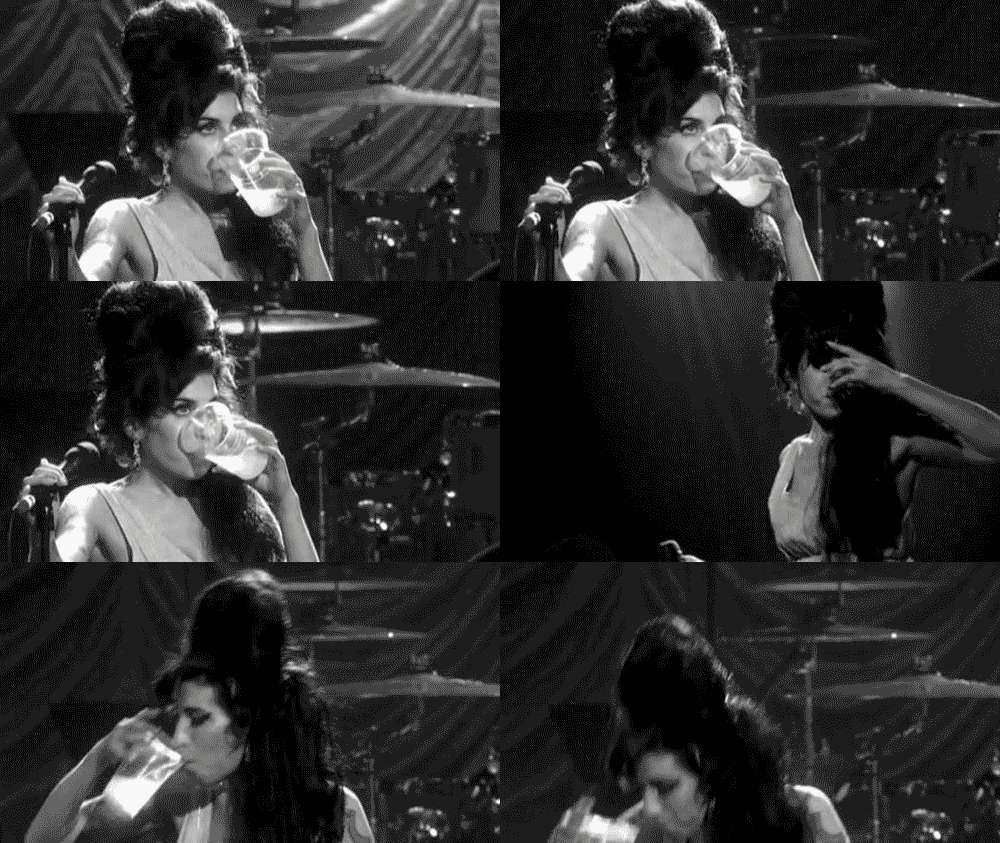


Considering the film won an Oscar, I'm sure I am one of the only people who feel this way, but I had to get it off my chest. 

Friday, February 8, 2013

Another Les Mis Post

Yes, I know we just had a Les Mis post.  And I just want to say that I agree with everything that was said.  I loved the film, it was a great adaptation of the musical, and the acting and singing was incredible.  In fact, I can almost say that Les Mis was my favorite movie of the year (there were so many good ones!).  That said, I liked it so much that I can afford to be nit-picky.  There were a few technical aspects that I thought suffered because of the uniqueness of the film.

Despite the great performance, the framing and eyeline do not match
In a way, this goes back to a lot of the discussion we had in class regarding acting for film and acting for theatre.  Much of the film was shot in such a way to let the actors act as they saw fit.  Because the musical performances set the pacing of the film, the cinematography suffered because the pacing was not as tight as it would be under normal conditions.  For instance, there were framing issues throughout, as the steadicam operators struggled to keep up with the actors moving around so freely.  There were also some weird eyeline issues.  It is obvious that from a directorial standpoint, the performance was placed above the cinematography in terms of choosing which take to put in the final cut.  That said, I am glad they made that choice because it led to the great performances that we saw.

Like I said, this was a great movie that I enjoyed very much, and it was innovative in a lot of respects.  But because of these innovations, it led to some neglect of the traditional approach.

Also, in no way do I mean to knock the steadicam operators.  They did some awesome work as seen in the behind the scenes video below.