With the technology that we have in todays society there is a lot of cool things people can do to make their vision come to life. I never really noticed how many shows were shot in a green screen. Not only you can create a virtual set but It also can be an easier way to get the shot you desire. Green screen is also a budget saver because if you are shooting something that is "on the moon" you don't actually have to go there or try to mimic it by creating it. All you have to do is have an image or a video to put it behind the subject, and they are there! Badabing badaboom.
Technology is truly amazing and the capabilities that we have achieved in the film industry has created a whole different playing field with films then the past. We went from silent films to what we have now.
Films and Tv shows need to be visually pleasing and sometimes getting permission to shoot in a specific area is impossible so the next best thing or even the better thing is doing it in green screen. After watching this video (http://www.rightthisminute.com/video/bet-you-never-knew-these-scenes-were-filmed-green-screen) It amazed me how many shows and films used a green screen for things you wouldn't even think of having, Just a single scene was shot in green screen from Ugly Betty and it just made me realize that everything is shot in green screen. It is just crazy how you would think that it is just on the street of NYC but in reality, they are not outside, not in NYC and in a green screen studio.
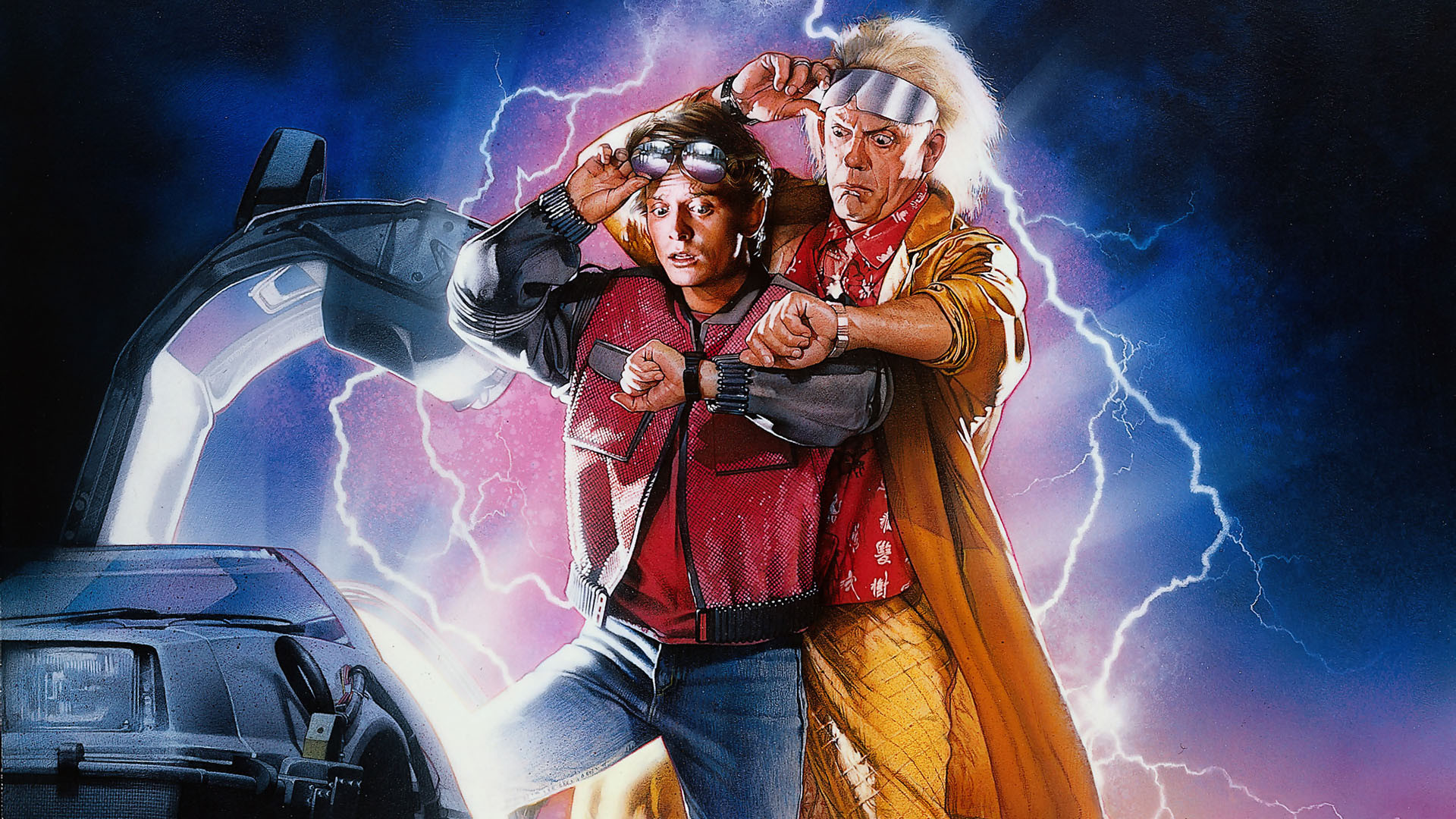
Most of us have seen the Back to the Future movies, but it may have been a while since you've seen Back to the Future Part II, where Marty McFly (Michael J. Fox) & The "Doc" (Christopher Lloyd) travel 30 years to the future!
They travel to October 2015 to prevent Marty's future son from getting arrested and sentenced to jail.
I enjoyed seeing what they thought the year 2015 would have been like technoolgy wise, and unfortunately we are still years away from some of their "future" predictions.
Some of my favorite things they predicted for the year 2015:
Perfectly accurate weather, down to the second. It would be very nice to know exactly when the rain would stop/end. They showed that it was possible to put a mini dehydrated pizza in a "Black & Decker Hydrator" and have a full size pizza in seconds! I wonder if this technology of hydrating food will ever be invented.
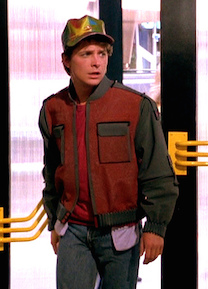
I also liked how they thought clothes would be in the year 2015. They showed Marty wearing a self adjusting jacket, that could also dry itself automatically when wet.
I love the Nikes with "Power laces" that Marty wore. I am surprised we haven't seen anything like these yet, hopefully Nike will actually make these in the near future.
One thing I can't see catching on is "Kids" wearing their pants inside out, that is one fashion trend I hope never happens.
One thing I feel that this movie did predict really well for how the future would be, is how much we are engulfed in media. There are deleted scenes I watched from this movie that I wish they kept because it may have been their best predictions. The scenes are of the future Marty coming home from work and going to talk to his son. His son is not just watching TV, but watching multiple programs at once. Marty wants his son at the dinner table, and the only way his son agrees is when Marty gives him these glasses you put on and can watch two shows at once. I feel like we are getting close to a world like this where people use media 24/7.
^Here are the scenes I wish they kept in the Movie^
Tonight, my macbook died; something with the logic board or CPU completely stopped working out of no where. They tell me there going to try and have it fixed by the end of next weekend, but I am a bit skeptical. I like to think of myself as a person who can live without technology. Sure, you can usually find me with the latest gizmos and gadgets but I feel that I could survive without them if I had to. Well now I have to. Sure, I have an iPhone and I'll be borrowing my parents iPad. I also will be taking one of my dads crappy IBM computers so I can write papers if I have to. But, I am out of commission with my creativity. All of my video editing, audio recordings and so much more lie in that computer. So much of my creativity and soul lie in its wires and connections and I thought for the first time how much I truly do rely on my computer for so much of what I do and theres no really going back at this point. This isn't my main blog post, I'll be posting a treatment I wrote for a web series type show that I wanted to get feedback on but I thought that it was interesting how much my mindset changed when I lost the ability to use my computer. It will be interesting going through an entire week of school without it.
Over the last week, we have spoken a lot about acting in class. This art has a special place in my heart, and my pursuit of this career has already taken six years of my life. Through workshops with casting directors, like Paul Weber from Weber Casting, and working with an acting coach out in L.A., I have learned much in those six years. Yet, I have found there is always some new tip or rule to the art. It is a constant learning process that is mostly acquired through experience, especially since theatre acting truly is a completely different concept than film acting.
So what happens when technology changes and the way films can be made reaches a new climax? Do actor's have to reshape how they perform their craft? Answer: Not at all.
When motion capture was first starting to be used, I remember hearing how worried professional actors had become. Would this new technology replace "the actor" in film, losing the face as well as the performance? Would this technology make acting even harder than it can already be? Again, I think everyone was amazed with the answer, especially when it went beyond motion capture and into performance capture. This new, amazing technology has been seen in so many recent films including The Lord of the Rings, King Kong,Avatar, Rise of the Planet of the Apes.
It started out very new in The Lord of the Rings through Andy Serkis' performance of Gollum. This was an amazing development in film: allowing actors to even become the most different of creatures without all of the make-up and prosthetics that can sometimes come across as very fake. What a freeing experience!
The technology itself is astounding as well. Through the use of a body suit, dots and many, many cameras, an actor's performance can be converted over into a completed CGI character. This character then embodies the soul of the actor that performs the role, even down to facial characteristics.
At the time of Lord of the Rings, I was so entranced with this concept of motion capture/performance capture that I didn't think it could get any better. I was really wrong. Andy Serkis then appeared in both King Kong and Rise of the Planet of the Apes, using this similar technology. His performances were stunning, and the characters truly took on a life of their own. Something about motion capture/performance capture brings a real life to these characters that creates an emotional draw as an audience member. I truly believe it has to do with the fact that there is a real person behind the CGI, a mind that can understand and convey the depth of the character it portrays.
I can't imagine the amount of time Andy Serkis had to spend studying ape behavior to get the facial and body movements to the point where they are so believable. This is another aspect of performance capture that is so exciting. It takes a lot of work to learn the behaviors and movements of other creatures. Sometimes actors even have to take months of "classes" just learning how to perform their characters for performance capture. Take it from the cast of Avatar directed by James Cameron.
I absolutely love this movie. I still remember sitting in the theatre, completely drawn into the film in awestruck wonder at how "real" the Na'vi of Pandora seemed. I know Avatar creates a mix of emotions regarding plot, but one thing no one can argue about is how revolutionizing this film truly is in just how a movie can be filmed. Not only did they use performance capture for the acting, but they literally created the world of Pandora as they went along. This extended even to the point where they made a special camera for James Cameron to use that allowed him to see a rough outline of the CGI world even though it was just an actor in a motion capture suit and a set of boxes around him. When I watched the behind the scenes sections for avatar, I couldn't help but be both amazed and excited about all the possibilities that performance capture offers. After seeing all of Andy Serkis' performances, and now all of the actors on Avatar, this technology have the ability to allow a greater opportunity to both actors and filmmakers in the future. Having minimal, but acting experience nonetheless, I can have nothing but a great admiration and excitement for actors who have been able to be a part of this new style of filming.
~Amber Capogrossi
The last several years I have heard the benefits of blogging. I understand it allows everyone to be a ‘journalist.’ Blogs allow people to tell stories and disperse information with just a few stokes of the keys and a few clicks. The problem with this is there are no ethical guidelines nor a system in place to check facts. There have been some guidelines proposed, but you can’t get the entire world on the Web into agreement and compliance. As someone who has written for traditional media and a Webzine, I strongly value the journalism system of writers and editors.
Through the years I have been given various reasons why I should start blogging. That everyone was doing it now never was enough for me to start blogging. When I believed it might be beneficial professionally, I strongly considered it. The idea that there are lots of people who actually care what I write seems a little arrogant to me since there are billions of other people in the world. There are some positive aspects of blogging that I recognize. The use of a blog as a way to interactively exchange information (much like a forum) is definitely a positive of a blog. The use of a blog as a place to gather your opinions and thoughts is an good enough idea. Although, I still don’t understand why a person doesn’t use a private journal to express their thoughts. I’m starting to blog for my graduate visualization class.
Even though, I am apprehensive about blogging I am interested to see how it works as a informal/semi-formal means of class discussion. Now, back to the idea of visualization. We live in a world filled with visuals, which we assess in order to get a sense of scale, size, number, and amount as stated in this week’s reading. It is interesting how we use frames of reference for making judgements on quantity.
This is interesting article I found about a projector that can make visuals interactive on a variety of surfaces: Interactive Projector
That is a tall order, but it is related as with most everything to the power of numbers. Or if you wish to the empowerment of the user at either end of the link.
This is a very interesting "social network" concept that might have a big real life influence in a very positive way:
As we have discussed the challenges of finding balance between the real world and virtual worlds, I thought this was an interesting op/ed from Michael Gilbert, a senior fellow at the Annenberg Center for the Digital Future at the University of Southern California and author of "The Disposable Male." I think he sums it up pretty well... that while "ominous clouds loom," he also says, "there's hope, because families are wondrously varied and resilient. Over the years they have managed to survive many technological innovations and potential intrusions." He also gives several excellent examples of the "good side"... perhaps, we can think of it more as "the Force" vs. "the Dark Side". May the Force be with you...
I think that this and other examples illustrate quite well a quote I read recently by Richard Purcell (former chief privacy officer at Microsoft) stating that "Technology is way ahead of our ability as a society to think about the consequences"
On a related note (everything is related, I know) an article in the Washington Post about the recent annual Toy Fair in NY, dated February 20, 2008; p.C01 says:
Fact: Kids create more than 100,000 avatars each day in virtual communities such as Habbo and Club Penguin. That startling statistic has broad implications for how kids play and what the $22 billion toy industry wants to sell them to play with.
...For the (toy) industry, which uses this four-day play date to hawk its current and upcoming products, here's the best-case scenario: Kids won't want to stop playing in their online worlds. With the ever-expanding child obesity problem, that also is the worst-case scenario.
Of course, worst-case scenarios make for some of the best business opportunities (e.g. 9/11). That is why you see and will see more and more, a strong linkage from RL to VR as you already have with toys such as Build-a-Bear which uses the virtual world, where children play a controlled fantasy using an avatar of their toy bear, to model their consumer behavior (and their parent's) therefore bouncing back to RL where the child now sees his/her bear as lacking those things which they so easily get online.
More worrying to me is the fact that those kids forfeit their imaginary role and fantasy playing by succumbing to a pre-canned experience. This might have implications for the development of true free-form creativity in the child. And no matter how emphatically the toy companies insist their "privacy policy" protects your children, the fact is that kids activities online are closely monitored by those same companies, so that while individual privacy might be moderately protected (very weakly I would argue) their group as a whole becomes a very vulnerable and exploited target.

 With the technology that we have in todays society there is a lot of cool things people can do to make their vision come to life. I never really noticed how many shows were shot in a green screen. Not only you can create a virtual set but It also can be an easier way to get the shot you desire. Green screen is also a budget saver because if you are shooting something that is "on the moon" you don't actually have to go there or try to mimic it by creating it. All you have to do is have an image or a video to put it behind the subject, and they are there! Badabing badaboom.