Showing posts with label illusion. Show all posts

Friday, April 29, 2016

Color Correction

A few weeks ago I took a course on color correction, and I don't think my eyes will ever be the same again.

I learned a lot during the course, but it didn't really effect me until I started doing the color correction for my documentary. Now I just can't see colors the same way I used to. I'm hyper aware of color changes in T.V shows now, and I completely don't trust my own eyes.

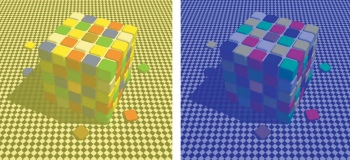
Our brain does a lot to try to make sense of the world around us, and color is no exception. Take this illusion for example:


The two gray squares with the yellow dots are actually the same color, but our brain tricks us into thinking otherwise. It's super trippy, and this type of realization can really make you question the way you see things. Now that I'm beginning to understand color more, I'm not sure I can ever return to seeing it the same way.

Friday, April 5, 2013

Color Correction and "Memory Colors"

Your brain is lying to you.  On the left, the top blue tiles are the  exact same color as the top yellow tiles on the right.  Throw this into Photoshop if you don't believe me.  It's trippy.  Source

Since we discussed color correction in class on Wednesday, it brought to mind this article by Stu Maschwitz over at prolost.com.  It's been around for a few years now, but if you haven't read it before, I would encourage you to take a look.  It is a very good look at color correction and color grading, and how the two interact to create beautiful films.  It also dives into some of the details of why being a colorist is so hard.

The main point that Stu brings up is the idea of "memory colors".  What are memory colors?  I'm glad you asked.  To quote:
 Memory colors are colors that are, in the minds of your audience, inseparable from certain common objects or events. For example, the sky is so associated with blue that you might feel that you see those two words together as often as you see them individually. The same goes for green and grass.
The article goes on to explain how to use those memory colors.  Usually, they are so ingrained in our brains that  even if they are not accurate, our brain compensates.  But they look even better when they are actually accurate, which is where color correction comes in.  It is the colorist's job to make sure that any memory colors are faithfully reproduced, both in the color correction process, and in the color grading process.  Even if there needs to be a distinct color "look" in order to set a certain mood or tone, the memory colors need to remain accurate.  Check out the article for more detail, and lots of good examples from various films.  Actually, just check out his entire site.  He's got lots of other good posts on color correction, as well as camera reviews, filmmaking tips, and general all around interesting stuff.

Source: Prolost.com

Tuesday, February 9, 2010

Anamorphosis


István Orosz Anamorphic Column with Mirror

to see the anamorphic skull embedded in this painting click on it to enlarge it and then view the image from an extreme low angle from the left corner

This type of painting know as Anamorphosis (from the Greek "Formed Again") comes from a long tradition going back to the early Renaissance (15th Century) and even earlier, since the technique was actually invented in China before migrating to Italy. There are many famous examples, from Leonardo to Hans Holbein the Younger, from Andrea Pozzo to Marcel Duchamp and Salvador Dali, on to some of the street painters shown in the previous and this post.

This technique is also widely used in film to record a compressed image in a small frame (35mm for example) and expand

Here are some examples by Kurt Wenner and Julian Beever, contemporary masters of street art.

Tuesday, January 26, 2010

Simulating illusary self motion

Some scientist experimented with floor projection in a virtual immersive environment, tried to study illusion of vection- self motion.

For people who do not know, vection refers to the perception of self-motion induced by some visual stimuli. The most familiar example of this sensation is that if one is seated in a train parked at the station while the train next to it pulls out from the station, one may have a sustained sensation that one is moving in the opposite direction.

So anyways, coming back to them scientists and their floor projection.This kind of projection helped them manifest linear vection, but not circular vection- the "real" illusion in our known world :)

So they tried a new thing- curvilinear forward vection which turned out to be more convincing experience. If you want to read further: CMU Research Paper

Here's what it looked like:


and,

Friday, January 22, 2010

Illusions in virtual reality

While reading Tufte I remembered a documentary I saw sometime back on brain research using virtual reality. Posting two links:


http://scienceblogs.com/notrocketscience/2009/07/virtual_reality_illusions_produce_out-of-body_experiences_in.php


http://news.bbc.co.uk/2/hi/health/6960612.stm


It is really interesting how a person was fooled in believing that his body was located somewhere else. How we feel that our "self" is located "behind" the eyes- like a first person shooter mode in a computer game :)

Change the camera position and the brain can be fooled about the location of the body. I would surely like to play a computer game where I am really "in" the game!

Tuesday, January 12, 2010

M.C. Escher

Earlier today when we were talking about perspective upside down on the table and in the readings, especially with Roy Lichtenstein and the artist on the ladder, I naturally thought of Escher. He is, undoubtedly, the first artist I ever took note of. Waterfall was the first drawing I ever saw and it still holds the same "awesomeness" as it did when I was 11 and I didn't understand a whole lot about perspective and illusion.

If you are not familiar with his work and the other works that were inspired by his, I highly recommend taking a look. Here are some videos and pics I think are worth taking a look at.

Shigeo Fukuda has an interesting collection of sculptures recreating Escher's works, such as Waterfall. There are also several Lego sculptures (these, too) dealing with the same ideas of it.

What's even more exciting is how with all the advancement in technology, we are able to experience Escher's works through new mediums, for example, digital design and animation.

That's what is so great about design...you don't have to "recreate the wheel." Just slap some new rims on it.