Showing posts with label books. Show all posts

Thursday, March 26, 2015

Game of Thrones TV Series Set To Spoil Books

The showrunners for Game of Thrones made an announcement this weekend, and readers of the books are outraged. 

Fans of author George R.R. Martin’s series “A Song of Ice and Fire” are some of the most dedicated fans to any current literature, and an announcement from Game of Thrones show runners D.B. Weiss and David Benioff this weekend confirmed that the show will catch up to the books in season 5, pass the books in seasons 6 and 7, and spoil the ending in season 7. George R.R. Martin has been working on “A Song of Ice And Fire” since 1991, with the first book in the series being published in 1996. To date, the first 5 books in the series have been released, and the sixth book is soon to come. Fans of the books hoped that Martin would be able to release the sixth book before the television series caught up and began spoiling elements of the plot, but that is looking less and less likely as Martin’s writing continues to move at a glacial pace. Season 5 of Game of Thrones begins to air on HBO starting on April 12, and will cover the ending of books 4 and 5. Unless Martin can seriously expedite the rest of the sixth book, the show will begin its sixth season next year and begin spoiling the plot.
There has already been some deviation between the books and the television series. There have been characters added and removed, deaths changed, and plot elements added and skipped. This deviation from the book series is likely to increase drastically in season 6, as Martin has shared with the show’s creators relatively few details about what is to come. In a quote from showrunner David Benioff this weekend, fans now know that “[the television series will] meet up at pretty much the same place where George is going; there might be a few deviations along the route, but [the show is] heading towards the same destination”. Even if Martin does manage to finish the sixth book in the series before the sixth season of the show airs, there really is no hope left for the ending of the story. Martin is taking, on average, about 4 years per book, and the makers of the show are not going to wait that long to produce their final season. Therefore the show and books will have (basically) the same ending, but the show will spoil it for the dedicated readers of the books.


Friday, September 12, 2014

Movie adaptations of books: What works and what doesn't?


It seems like almost all movies these days are based on something else. In an earlier post I talked about comic book movies, but they aren't the only source material for Hollywood these days. Lots of Hollywood blockbusters are based on popular novels, especially those of the children and young adult genres. But undoubtedly some of these adaptations are better than others. So what works and what doesn't?

Let's start by looking at perhaps the most famous book series adaptation of all time, and what one could argue was the kickstart of the now extremely popular childrens/young adult book adaptation genre.


Harry Potter by J.K. Rowling
Over 400 Million Copies Sold (7 Books)
 $7,723,431,572 Box Office Gross (8 Films)

Harry Potter is without a doubt a cultural phenomena. Harry Potter is one of the most successful book series of all time, has been sold in over 200 countries, translated in 68 languages and sold over 400 copies. The film adaptations are the highest grossing film series of all time. There are few people who haven't seen a Harry Potter film, and even fewer who have never heard of the character at all. There is even a Harry Potter theme park in Universal Studios, Orlando.   

The films are mostly well reviewed, especially the final installment, Harry Potter and the Deathly Hallows: Part 2, which has a 96% positive review rating on Rotten Tomatoes. (And is personally one of my favorite films of all time, but that's besides the point)

So what works about the Harry Potter films? Well for starters there is an extreme respect and seriousness for the source material. It would be easy to make these movies all flash, or even hokey, but there is a great respect for the characters and the world of the books. Yet Harry Potter is easy to respect. It may be a children's series about a boy wizard, but the core of the story is about the casualties of war and dealing with death and loss. 

Not all books are as profound as Harry Potter. When you don't have good source material, it's hard to make a good adaptation. Which brings me unfortunately to my next example. 


Twilight by Stephenie Meyer
Over 100 Million Copies Sold (4 Books)
 $3,345,177,904 Box Office Gross (5 Films) 

Oh god, oh god why. Why did this franchise make so much money? Okay. Alright. I have a confession to make. I have read the Twilight books. Oh god, there I said it. (I was in 7th grade don't judge me.) However, and don't shoot me here, while they are in no way good books they are still 1,000 times better than their movie counterparts. 

The first Twilight movie is literally awful, it's honestly painful to sit through. The script is awful, the acting is awful, the special effects are awful, EVERYTHING about it is awful. To give the filmmakers some credit here, they didn't have much to work with. Unlike Harry Potter, the themes of Twilight involve enteral love on a scarily codependent psychological level. 

Yet still these films were extremely successful. So if quality doesn't matter, what is it that makes people flock to see novel based films? Well, what is it that the Harry Potter and Twilight films have in common?  Not much, but one of the few things both films do is closely follow their source material. Which brings me to my next point.


Percy Jackson and the Olympians by Rick Riordan
Over 20 Million Copies Sold (5 Books)
$430 million Box Office Gross (2 Movies)

Now I personally have not read the Percy Jackson and Olympians series, nor seen the films. I do know however, that fans of the series were widely disappointed with the film adaptations of the novels. The reason for the largely negative reaction from fans being that so much of the plot and events of the books are changed in the films. As a result, while the movies weren't box office disasters they also weren't nearly as successful as the Harry Potter or Twilight films, as they might have had the potential to be.

However, one must note that critics gave the films largely negative reviews as well. The first film currently holds a 49% positivity rating on Rotten Tomatoes, while the second an even lower 41%. So perhaps there is more going on here than simply disappointed fans. 

To continue this point, there are other films that differ from their books source material that still manage to be successful. 


The Hunger Games by Suzanne Collins
Over 65 Million Copies Sold in US (3 Books)
$832,678,739 million Box Office Gross (2 Movies)

The Hunger Games is one of the most successful ongoing film franchises. The series was well received by fans and critics alike, especially the second film Catching Fire which currently holds a 89% positivity rating on Rotten Tomatoes. 

There are certain things about the books that were altered for the films. Yet, unlike Percy Jackson, the fans of the Hunger Games don't seem to mind the changes. Perhaps that is because the elements of the story that were changed were changed because they simply could not work in a two hour film version, and not because of laziness or lack of respect for the source material. 

The Hunger Games films are honestly well made films, and can stand alone from their source material as just good films in general. It remains to be seen if the last two films of the franchise will be as successful as the first two, seeing as they will be based on the final book of the series which was largely the most negatively reviewed of the trilogy. 

So what do you think? What is it that makes a film adaptation of a book successful? Is it more important for the film to be good on it's own, or should it follow it's source material as closely as possible? Or does none of this matter, as there will already be a built in audience who will go to see the film regardless of quality? 

Friday, March 28, 2014

Where the Wild Things Went: The Art of Adaptation

"There is no such thing as a new idea." Mark Twain knew it, and Hollywood knows it too. The best you can do is put your own spin on an old tale. Or, you can just realize that you'll never be good enough to think of anything on your own and adapt a piece for the screen.

In all seriousness, there is a true art to adaptation. Taking someone else's work and turning it into a visual and auditory experience is extremely difficult to do successfully. For time's sake, let's talk about books and short stories specifically. There are just as many challenges as there are benefits to adapting a written work into a screenplay. Here are some of the biggest ones:

Challenges:

Condensing/Expanding - So you have a 1000 page novel and somehow you have to turn it into a 120 page screenplay. Or on the contrary, like Spike Jonze, you have a ten sentence children's book and need to pull out a feature length film.
Bye, bye Max...
Where the Wild Things Are, a classic story written and illustrated by Maurice Sendak, is a perfect example of expanding a written work into a film. Jonze had to give each of his character's their own depth, and lengthen the plot to keep the audience's interest for a longer period of time. Almost the entire first act of the film wasn't even in the book, but it was well done and implicitly supplied us with information of Max's home life, and the motivation for the rest of the film.

Externalizing the Internal -  Screenplays consist only of action, whereas novels include the interior thoughts of its characters. The job of the screenwriter is to take the emotions and internal motivations of the characters and translate them into something visual. A great example of this is Lawrence Hauben and Bo Goldman's take of another classic, Ken Kesey's One Flew Over the Cuckoo's Nest. The entire novel is told in the first person from the perspective of one the patients, Chief Bromden. Instead of having Bromden narrate the movie, the screenwriters decided to tell it in the third person so that we can see all of the characters' experiences.
It's a third person party!

Benefits:

Insta-Plot - Most of the work is done for you. The plot, the characters, a lot of research and even some of the dialogue. Although the plot and many of the characters may have to be tweaked due to length and elements added to the story, the main concepts are there. Harry Potter and the Sorcerer's Stone, the first installment of the Harry Potter film franchise, is known for its loyalty to the novel. 
The Boy Who Adapted
Although there is some criticism that it stuck too closely to the book and didn't offer anything new, it is a good example of staying true to the novel's plot and characters.

Built-In Audience -  Okay, I know I said to stick to novels, but let's consider comic books for a second (that's a book, right?). We've all seen superhero movies. Superman, Batman, Spiderman, the list goes on forever. But these were all adapted from comic books at one point or another. The great thing about producing these films is that you already have a guaranteed number of viewers. Avid comic book readers will pay money to see their favorite heroes come to life on the big screen. This applies to regular books as well. For example, The Hunger Games was extremely successful because of the giant success and following of the novel it was adapted from.
"Shout out to all my fans."
So go out there, find yourself a popular book, and adapt it into a screenplay before anyone else discovers it. Then get yourself to Hollywood and sell it for as much as you can get your hands on. It can't be that hard, right?

Friday, October 26, 2012

Novels vs. Screenplays


I love reading books. All kinds of books. I have had this passion for since I was probably 9 or 10, but it wasn't until tenth grade that I discovered a passion for creative writing. One of my closest friends in High School did a lot of fan fiction and wrote her own short stories, and because I love to read, I was her captivated audience whenever she wrote something new. It was during this time that I thought, "Hey! I should try to do this!" And so I did... only I wasn't as successful at first. I think I have around five or six stories that I started writing or have notes on that I just never finished. I guess I just never realized how much went in to telling a story: Characters have to be discovered and developed, the plot should twist and turn in ways that are both unexpected, yet make sense, research has to be done in period pieces, etc. This is true for novels, non-fiction, screenplays, and theatrical pieces. 

I tried to write my first mini-script for the stage just before my sophomore year in high school. Let's just say it wasn't the best piece of writing I have ever done, and I didn't really enjoy it. I have taken several creative writing classes in both high school and college that I have absolutely loved. Right now I am even working on a novel that I started in a class that I took last fall. It will probably be a long time until it is finished, because the more I write the more I find out that I need to still do more research. Since I was so unsuccessful in playwriting, and I loved creative writing for novels, I thought that was the only writing I would or could ever do. Hence why I was so nervous for the course Developing Story Narratives that I took last semester. 


It seemed a little rocky in the beginning of the semester. The first couple practice scripts seemed to be going okay; they weren't great, but at least they were ten times better than the "play" I tried to write when I was a part of the Hanger Theatre summer camp. For the course we had three major scripts to write: a story based around an important event in our own lives, a story based on a character that we create, and a story centered around a theme. The first one was okay. I based it on the events that took place during and after my grandfather's death. The second one, I fell in love with. It is a story based on an orphan named Henry who is, in many ways, searching for a place where he belongs. I won't go into too many details, but this piece turned out fairly well, to the point where I would LOVE to film this here at Ithaca College. I want to do it right though, and the first step is making sure the script makes sense. Currently, I'm in the process of changing around a couple of scenes because the events that occur don't quite fit. The interesting thing about writing a script versus a novel is that you have to keep in mind that you are writing for a visual medium. Every emotion or internal dilemma has to be able to be seen in some way. It would be easier for a writer if subtext could scroll across the bottom of the screen, but then it wouldn't be much fun for the audience. Besides, sometimes there aren't words for certain emotions. On top of all this, the character has to move or flow from one point to another in a way that makes common sense. This means looking internally into the character to decide what is exactly going on there, so that the actions don't seem forced. 

Details, details, details. They are so important in creative writing for novels. Not so much, or at least not in the same way, for screenwriting. My professor said that you have to imagine each line as a shot in the film. That is a lot harder than it sounds. Well, I will keep plugging away at it and hopefully I will find the best way to tell Henry's story. 

~Amber Capogrossi


Friday, September 21, 2012

The Hidden Magic: Music


Over the last week, my health has gotten worse. I hate to say it, but I think I am one of the lucky ones who caught the viral infection that is sneaking its way across campus. The wonderful thing about being sick though, is that my time for watching movies and TV shows has almost doubled. Inevitably, during my many viewings I would start to dose off. I may have been half conscious, but I could always tell what was going on in the films and shows, not based on what I could see, but on what I could hear.
I don't only mean the dialogue or the recorded sound effects, although those are obviously very important. No, I'm talking about the power of music. Think about your favorite movie, or your favorite scene. Now try to imagine that scene without the background music. Isn't that a strange thought? It is something that is almost always overlooked, yet without it, the context of the movie doesn't seem quite complete. 

Now, I danced for about nine years and I played piano for about five years. I love music. I think everyone does, but what I loved about music was how, when I was dancing or even playing piano, I was able to feel the music inside me and move me in a way that let me express the heart of the song. Something about music hits us in our core and allows us to feel emotions. Who would have thought that combining sounds, raising or lowering the levels, and tempo would allow us to feel so much? With music, we are giving almost a sixth sense, or a 4D quality to our visual or movie experience. I believe it is because we can relate to what is happening through the notes. We all have some kind of device that we use to listen to music. When do you listen to music? In the car? In the morning as you are getting ready? Walking to class? When you are doing homework? Music has become such a part of our lives that it is easily overlooked. Sometimes we even hear soundtracks to our own lives. So, if music is such a huge part of our everyday life, it only makes sense that it should also be present in the movies and shows we watch. 
Last week I wrote about Lord of the Rings, and I will use it as an example again. The music in that film is astounding. It was written in such a way that it literally brings you into Middle Earth and traps you there with its interweaving melodies and harmonies. Other movies like AvatarNarniaHarry Potter, and The Hunger Games have similar qualities. Movies and shows that take place in our world and our times have more modern music performed by modern artists that fits the film genre. This extends even to books. I have read several commentaries from modern authors about the music that inspired their stories. When I sit down to write my own story I'm always playing some kind of celtic or other instrumental music that helps me to see or create the story that I am writing. 

Music is a part of the world, from the birds in the trees to the notes playing through your headphones. The next time you watch a movie or show, listen for the underlying music or film score. Sometimes that music can tell a story all on its own. 


~ Amber Capogrossi

Friday, September 14, 2012

A Return to Middle Earth


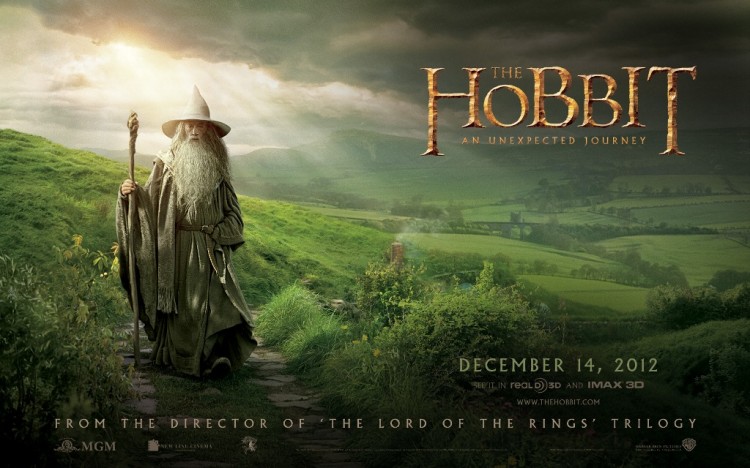
3 months, or 13 weeks, or 91 days. However you want to look at it, December is fast approaching. No, I'm not counting down to what many believe will be the end of the world. Lord of the Rings fans will know exactly what I'm counting down to... the release date of The Hobbit (Part 1)! Exactly three months from today, there will be huge lines in the theaters, with popcorn exploding from the seams and soda slurped up huge, plastic straws. All will be waiting impatiently for the movie to start.

December 14, 2012. A young Bilbo Baggins will be begin his own journey down a dangerous and exciting road. A road that will eventually send fate hurling his own nephew, Frodo, into a perilous journey as well. This is a story that is very near and dear to my heart. The Hobbit by Tolkien was the first fantasy book I ever read. My dad, the source from which I draw my love of everything fantasy and sci-fi, handed Tolkien's book to me when I was eleven and told me that it was a story worth reading over and over again. So I read it, and I loved it. I continued the story by following up with the Lord of the Rings Trilogy. I was an avid reader since then. I read books that ranged from the Shannara Series by Terry Brooks to Harry Potter by J.K. Rowling. At this point in my short life, my refrain had commonly become, "The book is always better than the movie." When I saw The Lord of the Rings directed by Peter Jackson, my whole world was shaken.

Not only was the story preserved in the films, but it was done in such a way that the beloved characters I saw in my mind were there before my very eyes. It is hard to find another movie that can actually sit so close to their paper and ink counterpart. I am still an avid reader and believe me when I say that the only other movie that I have seen is The Hunger Games directed by Gary Ross. In The Lord of the Rings, the whole of Middle Earth was there; it was almost tangible to my imagination. This was such an amazing feat that required so much talent on the part of both the cast and the crew. The acting was so superb, the visuals were perfect, the story was intriguing, character development was fantastic, this movie was and is truly a classic.

I was so drawn into this film, that at the age of fourteen, I watched all of the Behind the Scenes footage that came with the extended versions of the films. Again, my life was utterly changed. I fell in love with everything that is FILM. From learning about the make-up to the intricate creation of the miniatures, to the development of the different cultures through costumes, to the creation of all the magical creatures, to how they actually built the sets, to location scouting, the list can go on and on with how much I absorbed. It opened my eyes to a way to make the worlds I read about in books "come alive" in our reality in some way. It was at this point that I found a dream that resides so strong in my heart that it feels as if my entire being is going to explode. This is how I became so passionate about acting, and from there, about what happens behind the camera too. For the discovery of my passion, I have to thank all who were involved in the making of these fabulous films.

Peter Jackson is and forever will be one of my favorite directors. So many of his films, including King Kong, have kept me sitting on the edge of my seat and allowed me to escape into worlds and times that I can only do through reading books most of the time. Such is the depth with which his films are created. Every detail must be and is as perfect as can be. My favorite book series is the Green Rider series written by Kristen Britain. If anyone ever tries to make these fabulous books into movies, I would  hope that it would be Peter Jackson, because they deserve the best.


I encourage any who have not seen The Lord of the Rings to borrow the film from someone. It is an experience that shouldn't be missed. I can't wait for The Hobbit! Someone said to me the other day, "Yes, but they have a lot to live up to after Lord of the Rings." I agree, but I trust that both the cast and crew will be able to pull it off. If you haven't seen the trailer yet, it is below:
~ posted by Amber Capogrossi


Sunday, December 4, 2011

Books vs movie scripts

Who has ever mentioned a movie and had a bystander reply: "The book was better." ?  Annoying right? On Thanksgiving my brothers and I were discussing books that were turned into movies and the pros and cons of the outcome.  One book I read and watched the movie of was "1984." This was my example of a movie that followed the book almost line for line, and the outcome was...TERRIBLE! (The book was GREAT) One of my brothers read the "Watchmen" graphic novel series and said a similar thing; the movie was so similar to the graphic novel frame-for-frame that you didn't even need to see it if you've read the book.
This is the distinct difference between books and movies... size. Books can be as long as they need to be in order to tell a story, but movies have to be condensed into 2hours or less.  This shows the format difference between the two mediums, and is why movie scripts have to be adjusted for the "big screen."  What works for one type of media doesn't directly transfer to another.  Drama and action have to be much more controlled and formulated to grab an audience's attention in film.  I feel this is an important point to tell book snobs. On that note, I'd really like to see a remake of "1984" with an actual movie script and today's technology!

Monday, April 7, 2008

[book] Platform Second Life

Whether Second Life will be the platform of the future or not is not the issue here. It is that people are starting to see the role that virtual environments can play in providing real life applications by being the delivery platform.

Monday, February 25, 2008

Literature factory

You should probably take some time to check out the literature factory in SL. It is a factory full of robots that are building works of literature! The factory is totally automated. Even the receptionist is a robot named Rosie. They even give you name tags and a hard hat to wear on the factory tour. Theres a tour robot that can tell you about all the different robots in the factory, and even robots who serve tea and biscuits in the waiting area.

Not sure if the literature fits my taste though.

Sunday, January 13, 2008

The primitives I am working with

I've enjoyed reading everyone's posts, so after a week of diving in (and flying around) SL here are a few things that I've found interesting, academically and otherwise. I have enjoyed chatting with a few class members already in-world - this should be fun. (Or, Deckard Jameson has chatted and enjoyed it? Argh.)

I took the class because it was interdisciplinary and interesting - I really had no idea how it would relate to my research, if at all. That's good because in the last week of using SL I've found a whole bunch of things about it that I love that have very little to do with my research, like:
  • "travel writing" -- I collected a few lists of "places to visit" and spent way too much time visiting different sights and writing notes on them. I would think doing some travel writing on different SL sights would be a blast.
  • "the book experience" -- I'm kind of a book nerd, in the sense that I like the 'experience' of a book (that can't be found on the Web) so I was interested to see if/how the good ol' book would adapt to the SL world. I went to visit the SL Library and several book publishers. And, I visited a bunch of "bookstores" to see if anyone had managed to create that great "third place" feel of a good coffee house or old bookstore. (Or, err ... would that be "fourth place"? I get confused easily.)
  • "snapshot aesthetics" -- I started taking snapshots early on and they were so bad I had to spend time learning the camera controls. Then I started wondering what qualifies as a good snapshot in SL.
  • avatar creation -- To do some posed snapshots I started creating different avatar "roles/skins/???" to use as "models." Fooling with the sliders in different ways brought back lots of lessons on anatomy from art classes that I thought were lost forever. If I were a (professional) actor I think I would be thrilled at my ability to throw off physical constraints in the creation of a role.
So ... I'm not sure exactly how SL relates to my current research directions, though it certainly does. Thus far in my research I have been looking closely at the rise of online social networks (ie MySpace or Facebook) and how people use them to connect and relate to each other. (Example: when I say you are my "friend" online, what are the obligations/expectations I have about our relationship?) So, like Narasi and others I'm interested in the "quality" of SL relationships.

Beyond the metaphysical questions I'm interested in SL as a technology of social connection, too. There are pieces of the "social network toolbox" built in to SL (ie profiles) - but how will this aspect of SL evolve, if at all? Could a future version of SL provide residents with the same sort of "uses and gratifications" that, say, MySpace does today for those who use it? If not, what about the experience of both is different?

So many questions, not enough avatars to find out the answers ...