Showing posts with label themes. Show all posts

Friday, March 7, 2014

The Women of Wall Street

Everyone's seen The Wolf of Wall Street. And if you haven't, you need to get on that. Seriously, watch it. It's a miracle you've been able to hold any sort of conversation with people since its release. Just kidding, I saw it about a week ago. But I mean, look at this face:

Leonardo DiCaprio in "The Wolf of Wall Street"


Anyway, if you have heard of it, you're aware of the certain misogynistic themes that run rampant throughout the entire 180 minutes of the film. But Meghan, it's a biographical film! It's supposed to be funny! They have to stay true to the characters! And yes, I do admit that there's something outrageous and alluring that sets The Wolf of Wall Street apart from the other hundreds of thousands of "Men-Are-Powerful, Women-Are-Sex-Objects" films, but it's interesting to think about how the movie would've actually went if the roles were reversed.

And that's where Los Angeles writer, Nicole Donadio, comes in. A couple of weeks ago, she released a video called "The Women of Wall Street", a parody of the original The Wolf of Wall Street trailer. Line for line, and almost exactly shot for shot, she recreated the trailer, but with a twist. All of the roles switched genders. The concept is more impressive than the actual production of the video, but in my opinion, it was very well executed and edited. First, here's the original trailer:


And here's Donadio's version:


At it's worst, it's a silly parody of a blockbuster film. At it's best, it's a nod to the inequality of women in not only the film industry, but the corporate world as well. What I found extremely interesting were the surprisingly negative comments on the Youtube page. Commenters treated the word and the concept of "feminism" in a very critical light. Although "feminism" has always been viewed as a dirty word (known to many as "the F-word"), I found it alarming how many people took the time to express their hatred for not just the video, but the feminist ideals behind it. Regardless, I'm all for these kinds of videos starting discussions and bringing to the surface some of the issues of gender that are mostly shoved under the rug. Props to Donadio, and I'm excited to see if this sparks any more critical parodies.

And in case any of you are interested, here's a link to a well-written critique on The Wolf of Wall Street from a feminist stand point. Because you know, feminism.

Tuesday, November 6, 2012

The Road: Theme

       This past weekend I watched a film that had a new take on a post-apocolypic world.  "The Road" by John Hillcoat, tell the tale of a father and son trying to survive in a very cold and dark world.  The film seems to make a statement on human nature  when looking at how civilization was so quick to fall to pieces.
      We are never given a reason why civilization ended, we simply come into its aftermath.  There are no animals left aside from humans and no form of law/government.  Gangs run the land raping, killing, and cannibalizing as they go.  Our main characters, a father and son, are confronted as they go by gangs and murderers.  Through all the hardships they face they try to "be the good guys" as the son says and avoid falling into the chaos and lawlessness that surrounds them.  This desire to stay pure and good is a metaphor for the boys innocence.  The little boy tries to help people, while his father strives to protect him.  In a way the father starts to become corrupted when he steals the cloths of a man in the snow and leaves him to die, but is pulled back and saved by his son who convinces him to try and make up for what he has done by giving them back.
    This theme of trying to maintain ones innocence and remain morality is seen throughout the film.  This themes also directly dictates character interactions and how the two main characters view each other.  The reason I chose to talk about this movie is because it has an interesting theme to the viewer, but this theme simultaneously drives the plot.  I felt that this film had an excellent plot but also did exceptional job of choosing a theme that than motivated the characters actions while at the same time allowing them to become more multi-dimesional and realistic.

Friday, November 2, 2012

Period/Cultural Films and Their Importance


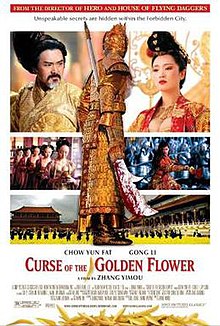
After watching the videos from behind the scenes of The Curse of the Golden Flower, I was very curious to figure out if the lead actress (Li Gong) had been in Memoirs of a Geisha directed by Rob Marshall, which is one of my favorite movies. I was delighted to discover that she was in fact in that movie as Hatsumomo. I have to admit just from the behind the scenes look and the fact that Li Gong is in The Curse of the Golden Flower, makes me desperate to see this movie. I'm intrigued by how Professor Sinclair described director Yimou Zhang's filming style, so I have also added some of his other movies, such as The Road Home and Not One Less to my list as well. So, hopefully more on that in a later post soon.


Anyways, I think I've come to the realization that I love period pieces. In high school, I was the nerd in history class who would research period clothing for a class project, (I actually made a dress in the Ancient Greek style my sophomore year). I think they are not only important for historical perspectives and understandings, but sometimes they even help with cultural perspectives. Even movies that tell of specific events, such as civil wars, have a lot to tell.


 Last weekend, I saw Hotel Rwanda directed by Terry George. I had seen it once before, but the impact of that movie still hit me hard. The way it was filmed not only tells a horrific and inspiring story, but also instills a desire to go out and help people who are in such positions. I watched the movie in a group of twenty people or so, and the tension and sorrow that filled the room was almost palpable. I can't tell you how many people went online trying to find ways to help those who are in similar situations around the world and even maybe in our own country.

This made me think about the role of filmmakers and the media in general. We tell stories, yes. Some stories are just meant to make someone smile. Some are meant to scare the audience. Some are very tense. Yet, something that they all share (at least most of the time) is that they all give some kind of message. I think it is so important to have films like Hotel Rwanda and Memoirs of a Geisha. Yes, they are events that happened in the past, and yes, they are not always pleasant to see, but without these reminders, who's to say history won't repeat itself?

~Amber Capogrossi