Showing posts with label Shakespeare. Show all posts

Friday, September 20, 2013

Unoriginal Creativity

I like to consider myself a creative person. I find the ability to create and destroy universes under a shady tree on a late afternoon an extremely gratifying and therapeutic process. The stories I manufacture are an expression of who I am and how I'm feeling.  The thing is, these stories I create aren't mine; they've been told thousands and thousands of times before. As a self-proclaimed writer, I find it extremely disheartening to find that something I put so much stock in, something I identify with, is merely an emulation of something someone else created. The question the becomes: If every story that can be told already has been, what can I offer to the pool of creativity?

The answer: a lot. The same rule that has applies to my stories has applied to literally every story that has ever been told throughout time, save perhaps for the first story that was ever told. Arguably some of the greatest works of literature throughout history have merely been adaptions of something that came before. Virtually none of Shakespeare's content was original. His works had all been previously told, he just added his own personal spin to each story. For example, The Tragedy of Othello, The Moor of Venice, was based upon two books, "Hecatommithi" by Cinthio and "A Geographical History of Africa" by Leo Africanus.


His content wasn't his own, but we still laud him for his mastery of the written and spoken word over 400 years later. Inversely, Othello has lead to an innumerable number of modern adaptions. There have been many theatre adaptions, such as "Desdemona, a play about a handkerchief" by Paula Vogel. This modern adaption tells the same story, but this time from Desdemona's point of view. All the events of the "original" still occur, but you get the "meanwhile" action. Is it the same story? Yes. Does it still have merits for the way the story is spun? Absolutely. Othello has led  to other liberal adaptions, such as 2001's movie "O", where it's practically the same story, only in a high school setting. In the original, Iago may warn Othello "O, beware, my lord, of jealousy! That is the green eyed monster which doth mock the meat it feeds on". In "O" the Iago character says " Watch your girl, bro".

"Watcheth your wench, bretheren"

Perhaps that is the beauty of it all. True creativity stems from taking an existing piece of work an morphing into something fresh and your own. As seen in the "Everything is a Remix" video by Kirby Ferguson, some of the best movies of the 20th and 21st centuries have literally taken and copied scenes shot for shot and adapted them into their movies. Films such as "Star Wars" and "Kill Bill" all have adapted scenes from previous movies. Their stories too are adaptions on previous ones. Still, we still give them credit for being great movies.

Today, arguably some of the best creative pieces are adaptions. One of my favorite films of all time is called "Ikuru" (1952), co-written and directed by Akira Kurosawa. It follows a minor Tokyo bureaucrat, who is dying of stomach cancer and struggling to find meaning in his life.  "Ikiru" although arguably one of Kurosawa's lesser-known pieces, has influenced arguably the hottest show on television right now, "Breaking Bad".


Recently, Vince Gilligan, the creator of "Breaking Bad" was on NPR's Fresh Air, had a few things to say about Wantanbe-San, the main character of "Ikiru", and Walter White.

There’s a wonderful Kurosawa movie from the 50s in which a man, a mid-level, very much a Walter White-type, or rather, Walter White, I suppose, inspired by this man. This man is very much a mid-level corporate guy who finds out he’s dying of cancer. And in the last months of his life what he chooses to do is a very good thing, it’s to build is playground, a small playground in Tokyo for the children in his neighborhood.
And this haunting ending of this movie is this man swinging on a swing set in this playground that he’s managed to build after a surprisingly hard go of it. And the snow is coming down and he singing a Japanese children’s song, and it’s just haunting and beautiful. And, of course, Breaking Bad is anything but that. It’s the flip side of that. It’s a man doing terrible things once he is freed by this knowledge that he does not have long for this world.
But I think what the two stories to share in a sense is the idea that if we found out the exact expiration date on our lives if we found out when we were going to be checking out, would that free us up to do bold and courageous things, either good or bad things, hopefully good things, then I think there’s a lot of that involved in Breaking Bad.”
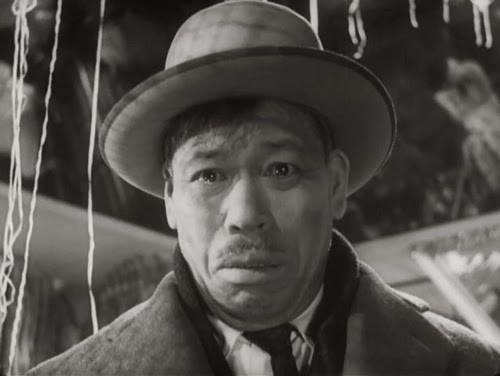

If you had to boil each of these pieces of media into a log line, they would both be extremely similar. "Dying man struggles to make something of himself in his last days". It's the same story, just taken in two beautifully different directions. One focuses on a man trying to build a playground, and the other focuses on a man cooking meth. Both great. The story is only one part of the overall piece, and ultimately the sum is greater than it's parts.


To push an argument further, "Ikiru" was in fact inspired by a Leo Tolstoy short-story titled "The Death of Ivan Ilyich".

Everything is built off of something else. Once I realized, I became confident in my "unoriginality" and now can take little bits of things and fashion them into a "script collage" all of my own.

Friday, February 8, 2013

House of Cards Kills

After listening to Arturo's such positive comments about the brand new Netflix series "House of Cards", I decided I'd give the first episode a try and see if they held true. 12 episodes later... I concurred that Arturo was right.

House of Cards proved to be a very intelligently written political drama that kept you on the edge of your seat throughout. It was extremely difficult to stop watching once I got started, with the ending of each episode leaving you on even more of a cliffhanger than the last. In addition to the excellent storytelling, the acting was absolutely superb. Kevin Spacey delivers an immaculate performance as Francis Underwood, the ruthless Majority Whip whose hellbent on scheming his way to the Presidency, and not letting anyone get in his way. However he still doesn't outshine his co-stars, with Robin Wright, Kate Mara, and Corey Stoll bringing their A game as well.


This is the second original series Netflix has put out, and this one really knocked it out of the park. Whether or not the show is a success hinges on how many of Netflix's subscribers decided to watch the show and keep watching once they got started. Netflix hasn't released any numbers yet, but the hope is that releasing an entire season all at once will keep viewers hooked given the accessibility of the next episode, as opposed to releasing each one weekly. Essentially, Netflix hopes their original series inspires the "binge watching" in which many customers end up using the service for (especially college students). After my experience, I have no doubt that it will.

Friday, December 14, 2012

My Guilty Pleasure Film

Everyone has a guilty pleasure movie: a film that either has a horrible story or tons of technical errors, yet you can't peel your eyes away from the screen.

After giving it much thought, I'm a huge fan of the early 00's teen classic "Get Over It."

But this isn't just another poorly made movie. It had an all star teen cast at the time that included Shane West, star of such tear jerkers as "A Walk to Remember" and "Whatever It Takes", Kirsten Dunst, who was typed-cast as a high school upper classman for the better part of four years, Ben Foster, fresh off a breakthrough role in "Freaks and Geeks", and Mila Kunis, then-star of "That 70s show." Let's not forget Martin Short, a comedic staple in many 80s films.

Despite the star-studded cast and a director who previously created several critically acclaimed short films, the film was so bad it was good. Where do I begin?

The story of the film is loosely based on Shakespeare's A Midsummer Night's Dream, much like many other teen films at the time. Foster plays a high school basketball jok who get's dumped by his questionably attractive girlfriend for Shane West, who is sporting a horribly fake British/Australian accent, so bad that the producer decided to change his physical appearance so it was less transparent.

Kirsten Dunst plays a theater geek who has a thing for Foster, who continues to ignore her obvious advances in his comedic attempts to win back his girlfriend.

It was really hard for me to understand why a film with such a great slew of actors could be so horrible. Then it hit me: everyone is anti-cast.

Shane West is obviously not British. Ben Foster was too meek and quiet compared to his usual roles. Kirsten Dunst, who usually plays the popular-type girl with all the friends, unsuccessfully attempted to play someone enamored with the arts. Sisqo is a singer, I really don't know why he was in this movie. The worst had to be Mila Kunis. At the time, she was known as the pushy, bitchy girlfriend of Michael Kelso on that 70s show. In this movie, she actually came off as kind and compassionate, which was off-putting to say the least.

Overall, all of these failures make the movie so stupid, it's worth watching again and again. I highly recommend it.

Thursday, September 20, 2012

Intertextuality in Adventure Time


I’m very fond of the show Adventure Time on Cartoon Network. While it would seem the cartoon is aired at children, the show has a large following among teens and college students due to it’s quirky, offbeat and occasionally absurd humor. The most recent episode, “Ignition Point,” aired on Monday, and the episode supported numerous intertextual references, which reminded me of a previous class in which we discussed how films often borrow from other films.


The episode draws inspiration from Shakespeare’s Hamlet, and a small portion of the “To be or not to be” soliloquy can even be heard during a short scene. Much like how Hamlet’s father was murdered by having poison poured into his ear, the climax of the episode features Finn and Jake foiling an assassin’s attempt to pour ice cubes in the Flame King’s ear. The Flame King’s nephews are also directly based on Hamlet himself, as they seek to avenge their father.


Additionally, a reference to the game Dungeons & Dragons is made when the characters discuss alignment, which describes how a player character makes ethical and moral decisions. The chaotic neutral alignment is specifically mentioned by Finn when he asks if the Flame Princess is truly evil; chaotic neutral characters are neither good nor evil, and are typically free-spirited or unpredictable.


Overall, I thought the episode was very entertaining and did a good job of making Hamlet approachable for its younger viewers. I plan on watching some previous episodes of Adventure Time to see if I can catch any intertextual references I missed on the first viewing!

For added fun, you can take this online alignment quiz, answering the questions as your player character would: http://www.wizards.com/default.asp?x=dnd/dnd/20001222b