While watching the three hour long
Transformers: Age of Extinction this summer, I was given ample time to reflect on the theme of the film.
Throughout the film there are many references to beings referred to as “our creators.” Lockdown, a Transformer, is sent down from another planet to bring Optimus Prime and the other Autobots back to these creators. When Prime decides to defend the humans, Lockdown continually suggests that Optimus Prime should not side with them. Lockdown claims that humans believe that they are the most important beings in the universe even though they are aware of the other beings that exist. Lockdown does not care if the humans destroy themselves, for he believes that they are selfish, greedy, destructive, and geocentric. He points out that there is war, disease, poverty, and violence on earth. If humans were removed from the earth, hate and destruction would cease and the earth would prosper again. Through Lockdown’s hatred of the human race, the filmmakers are trying to convey the message that humans need to be less geocentric, more understanding of other cultures, and less harmful to the environment.
Although the filmmakers attempt to impose this moral on the audience, the characterization of the Transformers proves that we are farther away from changing than we think. The Autobots and Decepticons transform into bodies that look inherently human. All of the Transformers have two arms, two legs, and a face with eyes, a nose, a mouth, and projections coming from their heads that appear to be ears. Not only do these aliens have physical human characteristics, but they also act like humans. Hound, the Autobot voiced by John Goodman, has a round belly that jiggles when he walks. He has a beard as well as a mustache and smokes a cigar. This is completely based off of human appearance as well as culture. As far as we know, smoking cigars is something that only humans do. No animal, machine, or other being smokes cigars.
 |
| Hound | |
Another Autobot, Drift, transforms from a Bugatti into a samurai. Samurais are unique to Japanese culture. Again, the filmmakers portray a part of human culture that could not be mistaken or interchanged with any other culture.
 |
| Drift | |
Although the message of this film implies that humans need to become more welcoming towards outsiders in order to save the earth, the filmmakers directly oppose that idea by using human characteristics and culture to create the images of the Transformers. The filmmakers model these alien characters after humans, not giving them their own culture, but imposing ours upon them, proving that we are in fact geocentric. This directly contradicts the moral that the movie is trying to convey.
Human characterization is given to extra-terrestrial characters in many other alien films as well. For example, the beloved E.T. has eyebrows, two eyes, a nose, a mouth that melds into a loving smile, and even an affinity for the Coors Light he finds in the fridge. The movie, Signs, portrays an alien that looks almost entirely human, only more skeletal. The model used for this figure could easily have been the skeletal remains of one of our early ancestors.
 |
| E.T. (Even dressed as a human) |
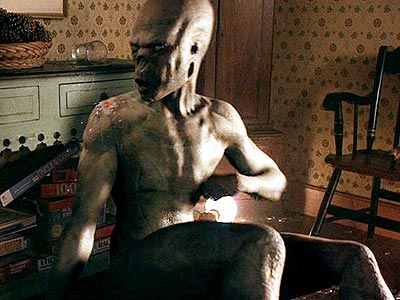 |
| The Neanderthal-looking alien from Signs. |
|
|
|
By portraying aliens in films with human characteristics and culture, filmmakers prove that we are, in fact, geocentric and find difficulty in imagining a world too different from our own.


