Showing posts with label storyboard. Show all posts

Friday, April 18, 2014

5 Phases of Making a Fiction Field Production I Film

Well my friends, it's that time of the year. Picture Lock season. Each and everyone of us has worked hard, suffered greatly, and felt like we've gotten nothing accomplished. But as we near the end of our filmmaking journey, I want to reflect on the steps we've taken (or at least I've taken) to get to this point.

5 Phases of Making a Fiction Field Production I Film

1. Pick Your Group
Though this seems like an easy task, the cooperation of your team members can either make or break your film and/or mental state. A group that works well together and has members with different strengths makes the difficult process of making a film a little bit easier. They become your family. Either you love them or you hate them, but you're attached to them no matter what. Thankfully, I got lucky and have a really strong group with some great people, and they have become not only my coworkers, but my friends.


2. Pre-Production
You're all so excited. "We're going to make a movie!" You assign jobs, then start planning how the rest of the semester is going to go. You have to write the script, find sponsors, start a fundraising campaign, get actors, get additional crew members, get locations, storyboard, start production design, the list goes on... forever. But you're bright-eyed and bushy tailed, ready to take on this film and make your family proud. So how do you get started? You don't... for weeks. Because you think you have time. You have all semester! Why bother?
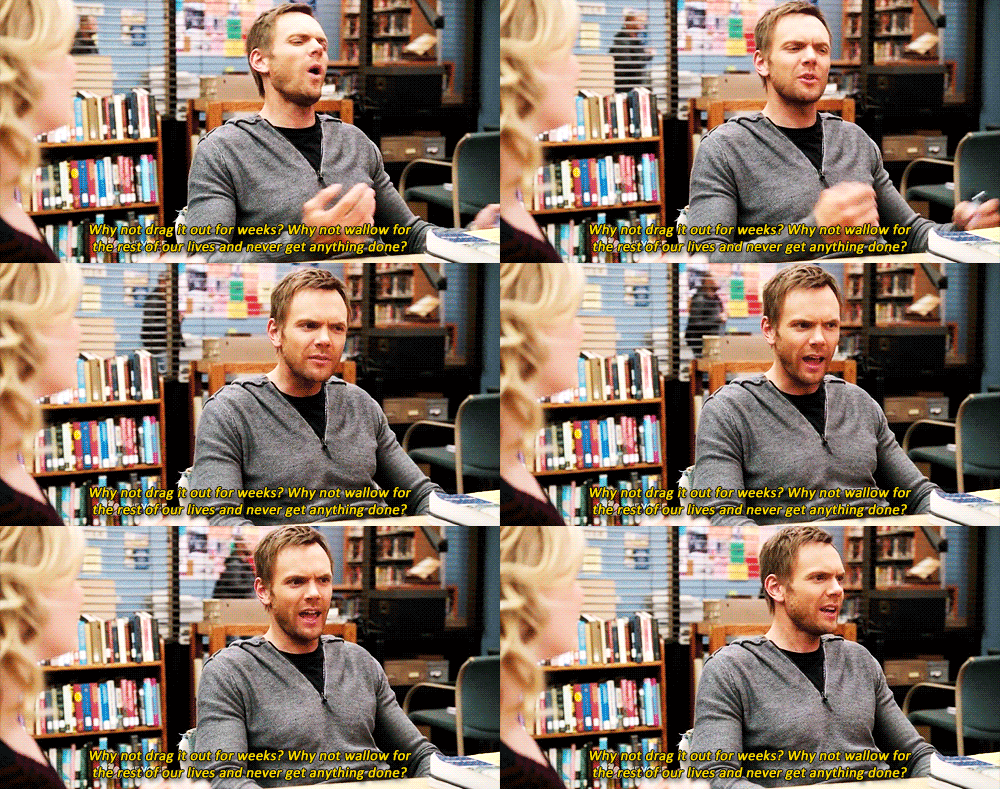

Don't worry, it'll all get done. Right?

3. Beginning Production
Nope. You were wrong. You were so, so wrong. By now you've wasted at least three weeks, spring break has come and gone and you haven't even casted. The script may or may not be done (sorry guys, my bad), and you have to start filming in a week. As of right now, your blood pressure is shot through the roof. You have to distribute flyers and still make a blog post. Coffee is your new best friend. But you get together with your group and you muddle through it, dealing with one crisis after another to start on time. You are now familiar with panic attacks, but feel like you have gained superhuman powers at the same time. This is what adulthood feels like, and although you're unsure of the future, you go into the next phase head on.


4. Production
You're in the heart of your production phase. Check your pulse. Yes, you're still alive, but barely. You haven't slept in what feels like years. Your friends and family are worried because they haven't heard from you and don't know where you are. You forget that you have other classes, and your grades suffer from it. Coffee is not your friend, but has become a part of your bloodstream.


Schedules are no longer set in stone. Film shoots are temperamental, either convincing you that you will be the next Steven Spielberg or making you rethink your entire career and future. Arturo laughs as your health deteriorates, slowly but surely. Someone, if not every single person in your group has had some sort of a mental breakdown. But post production is so close, so you torture yourself a little bit longer, hoping and praying that something, ANYTHING good will come of this hell known as filmmaking.

5. Post-Production
You think you'd be relieved, but the work has really just begun. This is the part where you save your film from every little and big mistake that you've made during pre-production and production. And it all falls on the one or two people you call your editors. Thankfully, this is not me, but I have a feeling my work is not done. As we approach this stage of our voyage, I can only hope that it's smooth sailing. But like all of my hopes and dreams this semester, I'm fully aware that this will not be the case. Until then, I'll live my life day by day and hopefully come out of this with at least one lesson: Making films is hard. If anyone ever says anything different, this semester has shown me that it is completely appropriate to react with physical violence.


So to everyone in my class, and all future Fiction Field members, I wish you luck as we come to the close of the longest (yet shortest) semester of my life, and I look forward to all of our hard work to translate into something we're not embarrassed to show even our parents.

(Bonus) Wrap Party


Friday, March 15, 2013

Project Update

The Purple Cobras are currently in pre-production for the project. Matt has finished writing the script and we have found our lead actor and are waiting to here back from a couple others. Craig has emailed Nicky Wood and we are waiting to hear back from him. I hope we are able to use him as an actor because he seems exactly like the character Artie in the script. We are still looking for locations to shoot but the plan is to shoot later next week and edit the project the following weekend. We will have our storyboards completed by the time we are ready to shoot. It is expected to snow some time next week but that could actually work to our advantage. The original story did take place during an ice storm in Indianapolis so if it is snowing when we shoot, our project would be even more accurate to the original news story than it already is.


Thursday, February 24, 2011

Story-boarding: Is It Art?

Since we've been talking about storyboard drawing and all the different ways one could it (simple stick figures, second-life, et cetera) I thought I would introduce everyone to a pretty cool sample of storyboards. Japanese director Akira Kurosawa's first career was as a painter, so when he began making films we would paint his own storyboards. Some of them have actually become well-received especially the storyboard for his film Throne of Blood because of its similarity to the actual film. I know that it would be really time consuming to storyboard this way for this class, but here is an example anyway.

Saturday, February 12, 2011

Storyboarding and storytelling


Time to really dig in and read the section on storyboarding on our class ebook:
Directing the Story; Professional Storytelling and Storyboarding Techniques, by Francis Glebas.

Check out Chapter 4 page 90 for some useful tips. Remember no one expects a masterpiece of art, but rather a clear simple depiction of your key shots. If you cannot visualize them you can't shoot them!
It is from the storyboard/script combination that you will have a successful and useful breakdown so you can have a smooth shoot, so make an effort to put your visual ideas on paper.
As I believe I mentioned, you can also "colllage" your storyboard using clip-art, cutouts from magazines, comic books etc. I like to use grpahic novels sometimes because they have such great angles and scene depictions that really give you a sense of athmosphere, character and place.
This is from DMZ by Brian Wood and Riccardo Burchielli

Tuesday, January 23, 2007

From concept to creation

See how closely the production has followed the storyboard. It makes a lot of sense if you think about it. All the time spent in planning the shot to tell the story pays off when you are doing the extremely time consuming work of animating, whether in clay or in CG. You won't have much time to change characters, situations and action, so try to get it to your liking at this stage. And have fun!

Storyboard and end result


Click the images to see a full size version.
The pictures are taken from the book Creating 3-D animation about the Aardman animations. I highly recommend this book if you are serious about animation. It will give you not only great ideas and behind the scene looks at some of the most memorable animations of our time but will also give you a sense of what it takes to do such work.