Showing posts with label Truth. Show all posts

Thursday, April 7, 2016

Documentary: Real Life or Half-Truth

In nonfiction media education, every student always gets asked the question of whether or not staging a scene from real life is still nonfiction. If you haven't asked that question - try it. Robert Fenton is the historical example of this question in action through his photography of the Crimean War.
One photo is the photograph right after a battle, while the other is a photograph right after Fenton placed a few canon balls in the road to make the scene more intense. The question is - which is true? 

In documentary film, this question of half-truths becomes even more prevalent. A filmmaker could stage a subject in his room with a poster of half-naked women behind him or the filmmaker could stage him at his church for an interview. Which is true? 

In my opinion, documentary film is a series of half-truths. At the beginning of my exploration into documentary film, my goal was always to bring the truth to life, to be an advocate of accuracy, a sultan of specifics. However, one quickly realizes that life is full of half-truths. Unfortunately, the human psyche does not exist on a binary of real and fake. Instead, our beings are made up of half-truths. Subjects in documentaries reveal, but they cannot reveal everything. But if what I see in every documentary is a half-truth, what's the other half? I don't believe its a half-lie. I don't believe it's half-fake. Documentary film can just only capture what the time and place allows. So rather than being half this or half that, a documentary is a product of circumstance. 

Keeping It Real

Generally, in documentaries, the audience relies on the filmmaker to portray the truth and reality of an event. But sometimes, as a filmmaker, it is easy to want to manipulate and direct what is happening in front of the camera. Whether or not this is okay is up for debate. Some people think that you can manipulate events slightly as long as you're not changing the overall truth of the film. However, this turns a fine line into a very blurry line. How much manipulation is too much? How much can a filmmaker direct without effecting the integrity of the documentary?

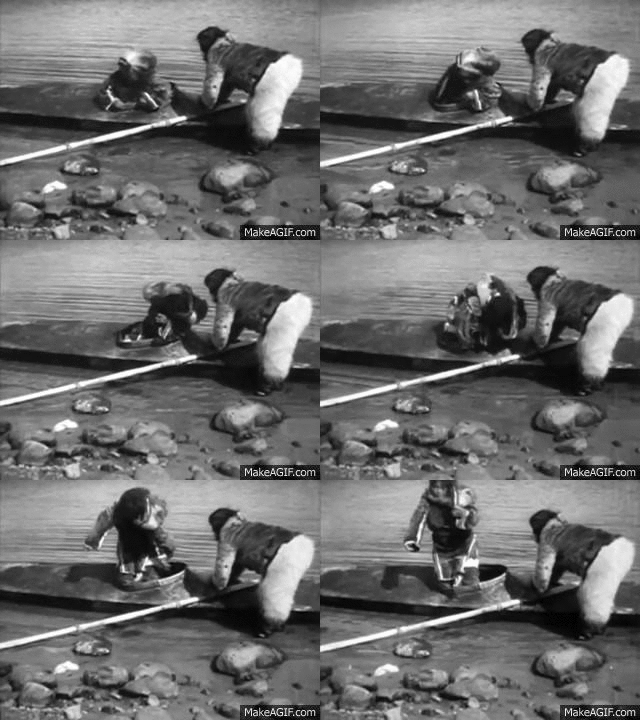
Nanook of the North, by Robert Flaherty, is typically considered the first documentary film. At the time, people were fascinated by the inside look Flaherty provided on a culture that was foreign to them. However, it was later discovered that Flaherty lost all of his original film for the documentary in a fire, and went back and tried to recreate it all. In other words, he was telling Nanook what to do the entire time. Can we even consider this a documentary then?


This week, Evin and I went back to Buffalo to film with one of our subjects, Rubens Mukunzi. Rubens is the creator and editor of Karibu News, a multilingual newspaper in Buffalo. He used to be a media star when he was still living in Rwanda, so he is extremely comfortable in front of the camera. So much so that, while we were following him on his paper delivery, he started directing his customers and telling them what to do on camera. At one point, he staged an entire scene for us. So what do we do? The footage is great and gives solid insight on the paper, but does it ruin the integrity of the doc since it is directed?

We essentially have three options: use the directed scene, scrap the directed scene, or include the scene along with his directions. I would argue that it is okay to use the directed scene because using the footage does not discredit the doc; it does not change the overall truth of the documentary like Flaherty did. However, using the scene along with his directions could be interesting since it really shows his personality. We'll decide as we continue with the editing process, but I think that this provides and important lesson for documentary filmmakers. It can be tempting, and much easier, to direct your subjects, but it's extremely important to make sure that doing so does not ruin the integrity of the film.

Thursday, October 11, 2012

How Not to Market


The ICTV show I'm on, Game Over, is currently at Comic Con. The first day was press and limited passes, so the floor was as empty as we're ever going to see it, and it was a good way to get a handle on the different companies who are going to be there over the next few days, and the different products each company offers.

The day started off kind of slow, and resulted in a few hours hanging out in the press room. While we were there, one of the companies, Truth, gave out folders packed with information about an anti-tobacco campaign they've been working on: "Flavor Monsters." The idea for "Flavor Monsters" came from the fact, "Big tobacco isn't allowed to sell flavored cigarettes; yet, they offer over 45 candy flavors in the other tobacco products they sell. Sugary sweet flavor monsters."  The campaign has merch and a highly developed app, which all focuses around the different types of flavored tobacco in the industry. The Flavor Monsters are all designed as monstrous fruit that no one would ever want to cross.

When I finally got to visit the company's booth on the exhibition floor, I was sceptical as to how well Truth would present "Flavor Monsters," on account of even the promotional material they gave press was hard to disect, and was disappointed to see the result. The set-up itself was kind of cool. They had this covered booth that housed different characters from the game. They had a green screen set up that you could run in front of to make yourself part of a movie where you're being chased by the monsters, and several stations set up where you could play the game. However, not once in the entire process was it ever made clear that all of this had a point.
It wasn't until the end when they gave you your free promo t-shit with the fact that spawned the whole campaign that your realized the game was actually a campaign against tobacco use.

What is the point of creating an entire campaign against one of the largest industries in America, if you aren't even going to mention it in one of your largest marketing platforms?