Showing posts with label Directing. Show all posts

Thursday, April 7, 2016

Keeping It Real

Generally, in documentaries, the audience relies on the filmmaker to portray the truth and reality of an event. But sometimes, as a filmmaker, it is easy to want to manipulate and direct what is happening in front of the camera. Whether or not this is okay is up for debate. Some people think that you can manipulate events slightly as long as you're not changing the overall truth of the film. However, this turns a fine line into a very blurry line. How much manipulation is too much? How much can a filmmaker direct without effecting the integrity of the documentary?

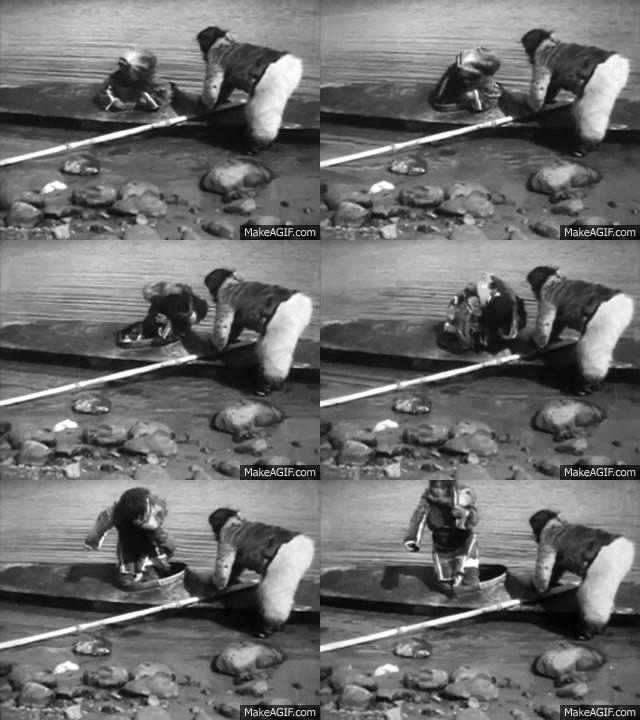
Nanook of the North, by Robert Flaherty, is typically considered the first documentary film. At the time, people were fascinated by the inside look Flaherty provided on a culture that was foreign to them. However, it was later discovered that Flaherty lost all of his original film for the documentary in a fire, and went back and tried to recreate it all. In other words, he was telling Nanook what to do the entire time. Can we even consider this a documentary then?

This week, Evin and I went back to Buffalo to film with one of our subjects, Rubens Mukunzi. Rubens is the creator and editor of Karibu News, a multilingual newspaper in Buffalo. He used to be a media star when he was still living in Rwanda, so he is extremely comfortable in front of the camera. So much so that, while we were following him on his paper delivery, he started directing his customers and telling them what to do on camera. At one point, he staged an entire scene for us. So what do we do? The footage is great and gives solid insight on the paper, but does it ruin the integrity of the doc since it is directed?

We essentially have three options: use the directed scene, scrap the directed scene, or include the scene along with his directions. I would argue that it is okay to use the directed scene because using the footage does not discredit the doc; it does not change the overall truth of the documentary like Flaherty did. However, using the scene along with his directions could be interesting since it really shows his personality. We'll decide as we continue with the editing process, but I think that this provides and important lesson for documentary filmmakers. It can be tempting, and much easier, to direct your subjects, but it's extremely important to make sure that doing so does not ruin the integrity of the film.

Thursday, March 31, 2016

Directing is not easy

So, coming into this class, my main goal was to make something that I would find funny. Throughout my time here at Ithaca, and being a screenwriting concentration, I've written a lot of stupid short scripts. But I've never had the opportunity to make the stupidity come to life. That's why I decided to take thesis. I wanted to make something - 100% of the way - directing, filming, editing, maybe acting - instead of just writing the story and being done with it.

But, as I started to shoot, I soon realized that I totally underestimated the of challenges of actually making a film. And considering I haven't taken any production classes prior to thesis, it was either sink or swim.

Writing the script has always been easy for me (well, relatively speaking...). But actually taking the finished script to the locations, with a camera, and audio equipment, and actors, and unforeseen problems, and then filming it - well, that's fucking hard.

The biggest thing I worry about is making everything look good. So, I decided to re-watch some of my favorite shows and look at how they're directed and what makes them look so good. First, I watched Louie - probably my favorite show ever in the entire world of television. Since I want my film to have a very Louie-esque feel to it, I took close note to the camera work, the shot angles, what is in focus and what is out of focus, etc. Louie has a lot of hand held camera work. It gives a very "real" feel which is something I want to accomplish in my film. Another element that gives it the "real" feel is the use of natural lighting - street lights, lamps, sunlight, etc. There are also a lot of close ups on characters when they say or do something important, with the background out of focus.

A lot of what I'm saying is pretty self explanatory and obvious, but when it comes to actually implementing these elements in your own film, it becomes challenging. Not only did I watch Louie, but I watched specific scenes from other movies and television shows. For example, I have a scene where my main character gets mugged. So I researched all of the best mugging scenes in cinema to see how they did it. And the more I watched, the more I was able to take and use these techniques.

If I learned anything, it's that you have to steal. You have to steal from the best and make it your own. That's the only way you can make something of quality.

Friday, October 24, 2014

4 Tips for Writing Directing and Producing a Short Film

Writing a great script for a short film is hard. Most people feel like you have to lengthen the script to create an in depth story, which isn't true. To make the most of your limited pages and minutes use these ideas:

1. Create complex characters. 
Before or during writing, ask yourself some questions about your characters. Asking questions like "What was the worst moment in your characters life?" might seem silly, but it could lead you to some very interesting conflicts and plot points in your story. If anything questions like this will help you to make a world around your character it makes sense for them to exist in.  Here are some character questionnaires to start with.

2. Don't neglect your set. 
Though most of us are just happy to get a location to shoot in, remember that the location of your film can be a goldmine for planting character information and foreshadowing. Avoid exposition through dialogue by leaving a characters room a mess with clothes and make up before a date, or show the room as immaculate if your character is very controlling.

3. Make dialogue that sounds real. 
People in the real world don't talk in full sentences, they sometimes stutter, pause, misspeak, use contractions. Read your dialogue out loud while writing. Do you believe someone would actually say it? Don't waste time with lengthy dialogue when you could convey the same idea visually.

4. Be confident.
Throughout this process realize that this is your vision and you are going to have to work hard to bring it out to the world. Be your own best advocate. Be confident that your idea is great and that it can impact something, and people will be willing to help. No one wants to work on a film that even the creator isn't excited about.

Friday, February 1, 2013

The Brilliance of Nolan

Last night seemed to be a quiet evening, so what better way to spend it than enjoying a film with my closest friends.  We settled on The Dark Knight Rises, the epic third part of Christopher Nolan's Batman trilogy.  The movie, which came out this past summer, smashed its way into the box office and immediately became a huge success in the eyes of movie goers, and super hero fans.  Christopher Nolan's brilliance was really proven with the release of the 2nd movie from the trilogy The Dark Knight.  


Personally I see such creative, and impressive filmmaking and I can't help but wonder why this movie was snubbed at the Academy Awards as well as the Golden Globes.  The race for the Oscars this year is obviously a very close one however I can't see how such visual storytelling did not emerge it's self into the race.  The Dark Knight was nominated for 8 Academy Awards, winning two: sound editing, and best supporting actor.  In such an impressive movie trilogy, I don't understand how this one falls so short for the critics.  Nolan has produced a series of incredible movies, only receiving 3 nominations total even if he receives praise everywhere else you look.  His 3 nominations were for original screenplay for Memento and Inception, also scoring a best picture nom for Inception.  


I find Nola's work to be incredibly deep, and ascetically imaginative with his directing.  I can never quite understand why the Academy always seems to not recognize Nolan's directing after his phenomenal work in all of his movies.  I think he reinvented the comic book character, and brought an entirely new spin on such a classic story, really bringing it into the modern day world and not a fantasy land of Gotham City.  I can't wait to see what he does with the new Superman flick Man of Steel.  I hope that Man of Steel, much like The Dark Knight Trilogy, and even this years hit Bond flick Skyfall, brings a new generation of movie goers into the stories that are simply outdated, and reinvents them in the way that keep the characters and plots updated with the times, and relevant in today's society.  

Friday, November 2, 2012

Cinema Verite Project Reflection

Yes I know that the project has come and gone but I figured, better late than never. Now before I start this, I would like to say that I did understand the point of the project. That in the real film world, if there had to be a re-shoot then it would be very important to try to mimic the same motions again as closely as possible and that just in general, if somebody can direct a person's subtle movements than they probably know what they are doing directing wise. However, if I'm going to be completely honest, I was not a fan of this project.

The main thing that I had a problem with was that there wasn't any fiction involved, there was no creativity. Yes I suppose that recreating something could be considered creative but I felt like just spying on a group of people and then recreating their motions wasn't creative to me. It didn't satisfy my creative itch. I think it would have been fun if we had a choice of a movie scene and we would do our best to recreate that. Because then we would have the choice of our scene and we would be able to put our own creative twist on it while still recreating it. I think that that would have been a directorial exercise that would have been both fun and informative.

Another thing that I wasn't a huge fan of was the actual video. I'll explain what I mean by that. In the beginning of the semester you said that you wanted us to make videos that we would want to put in our reel, videos that we were proud to show off and brag about. Now I only speak for myself when I say this, and not for anybody else in my group, but in all honestly I'm not that proud of the video. It's not something that I would ever show somebody mainly because I don't think it's very interesting or entertaining in any way. It doesn't tell a story and if I was to just show it to somebody, I honestly feel as though they wouldn't care at all about it. The one shot project on the other hand I am very proud of and I have showed it to my friends and family and I think that it came out very well. I liked the story I told and I'm very happy with how it turned out. This cinema verite project however, I can't say that I feel the same way.

Like I said at the beginning of the post, I do understand the point of the project and I do understand where this exercise came from and in all honesty I think it's a good idea to do. However, I really wasn't a fan of making this a full blown project. We spent over a month on this and I personally think that this is something that we should have done over the weekend as a quick exercise and then just left it at that. Making this a full project was something that I didn't really like. I really didn't feel like I put any effort into this and that's probably because I didn't. Personally I just wanted to get it out of the way so I could move on to whatever was next. If I was going to spend over a month on something, I would have liked it to be for something that I would end up feeling proud about, and as I have already mentioned, I really wasn't proud of this project.

Which takes me to our next project. This is the one that I'm looking forward to the most and probably for a fairly obvious reason, I have a lot of creative freedom for this one. Yes it needs to be based off of a news story but I mean, the news is more than interesting enough for a fictional story to come out of it. This is the kind of project that I would like people to see. After watching this final project, then people could form an opinion of my directing and storytelling abilities.

Friday, September 7, 2012

My Kevin Costner Obsession


My dad doesn't always watch movies... But when he does, he watches Kevin Costner movies.


As a kid growing up, I didn't have the attention span to make it through a single one. I have recently made it my mission to watch all the movies he has ever produced, directed, and/or starred in, though. This may take me a while, as his movies all seem to be approximately 4 hours long. 

If you looked at ratings by Rotten Tomatoes, Kevin Costner has definitely had some big hits, and some even bigger misses. However, I find that some of the movies with the lowest ratings seem to be some of my favorites. For example, The Postman. Rotten Tomatoes critics gave it a whopping 9%, but I prefer to call it a masterpiece. Costner both directs and stars in this movie, where a makeshift postman reunites a post-apocalyptic America by delivering mail. Maybe an odd concept to wrap one's head around, but I dont want to spoil the movie for those who may actually read this post and have the intrest of watching it. 


Kevin Costner's typical style defies Hollywood norms. He makes movies as long as they need to be, rather than editing them down to a more appealing length for the general public. In some cases, his movies turn out twice the length of a typical feature film. Another rule he seems to break is to choose factual details rather than bending the truth to make more drama and/or action, shown best in his movie entitled "Wyatt Earp" that shows the life of the horse thief turned lawman of the Wild West. This is a risky style to follow, but I like how different he is and I havent come across a Costner movie that I wholeheartedly disliked. His differing style that leads to spectacular movies (in my opinion) is my inspiration for breaking the rules, and finding something outside of normal that is still appealing to at least a small portion of viewers. 

I encourage you all to IMDb Kevin Costner and watch at least one of his films. 

-Scott Walle

Friday, August 31, 2012

Musical Adaptations

As a drummer, I find myself listening and tapping along to music on a constant basis. There is never a time when a there is a song (or multiple songs) stuck in my head. I like a wide range of music, but mainly stuff I can drum along to. I was a band geek in high school, and lead drummer when I was a junior and senior; this meant that I had to help out with our biannual musicals. At first I was very bitter and disinclined to participate, but I quickly found a soft spot for musical theater, and medleys from musicals and movies that we played in concert.  My favorite was the percussive score from the Pirates of the Caribbean films.

Because of this, I began watching film adaptations of famous musicals, as well as attending many shows. I am very interested in taking part in film adaptations in the future, as well as possibly producing, directing and/or editing music videos.

Here's a short list of my favorite musical films:
Grease (only the first one, the sequel was garbage)
Most Disney animated musicals (Lion King, Aristocats, Jungle Book, Beauty and the Beast, etc.)
Little Shop of Horrors (I recommend this to anyone who has not yet seen it)
Sweeney Todd (a great Johnny Depp/Tim Burton film, yet a little graphic for the weak stomached)
Wizard of Oz (such a classic)
Rocky Horror Picture Show (it's even weirder than the title would suggest)

I could go on, but I'll keep my list for now to the ones more people have probably heard of.
More to come in later posts if others share my strange infatuation :)


Thursday, September 22, 2011

My favorite Director

I think M. Night Shyamalan is a wonderful director. You can all take a moment to laugh at me now....Ok now stop laughing. I'm serious! I think he really puts his heart into what he does and I've always seen that through his artistic view of things. He may not be THE best director in the world but I really appreciate his point of view. When he looks at a story weather he wrote it or not, he really highlights and saturates every beautifully artistic movement and sound. I've always tried to do this in my films as well. I've always noticed his use of fallow shots, and hey I agree its a movie things should move.  We use fallow shots to see where the character is going, we go too, what the character sees, we see too. It's a beautiful thing. He's been known to put a twist on things and every one criticizes him for it. Well, if they stopped being such cranky ex-girl friends and look at why or how or just began to appreciate what's really going on, then they'd understand it. Oh yeah and critics, hey its hard to make a film, you should try it some time.

Recently He has been writing and honestly as big of a fan as I am for him as a director, I can comfortably say I enjoy his writing more. The director of Devil (John Eric Dowdle) interoperated M. Night Shyamalan's writing perfectly and it was very pleasing. I hope that they'll continue calibrating  so I can enjoy more of what they produce. It's actually a really good movie; ranked number 37 in my favorite movies list.