Showing posts with label Media. Show all posts

Thursday, March 10, 2016

Vito: Calling Out Hollywood's Portrayals of Gays and Lesbians


This week I watched HBO's documentary film "Vito", which tells the story of Vito Russo, a gay man from NYC who found his voices as an gay advocate in the aftermath of Stonewall. He was an active critic of LGBT portrayals in the media. In the 80s he published his book called "The Celluloid Closet", the first major book to critique these portrayals in Hollywood. When the AIDS epidemic shook the gay community, Vito formed ACT UP, an advocacy group for justice, before his death from the disease in the 90s.

The film is a classic-style documentary: a blend of historical images, clips, and interviews by those who new the subject best, but what makes it so captivating is it's relevance almost 50 years later. I was left wondering at the end of the film what Vito would think of the amount of progress we have made for LGBT individuals since, but also the amount of work we still have left to do--particularly when it comes to visibility and representation in the media.


Thursday, April 2, 2015

Genna Davis at IC

Genna Davis an Academy Award Winning Actor and Founder of the Genna Davis Institute on Gender in the Media. She recently visited the beautiful Ithaca College on Tuesday, March 31, where she addressed Gender Equality in the Media.

Genna Davis Institute for Gender in Media is a non-profit program which engages film and television creators to dramatically increase the percentage of female characters---and reduce danger stereotyping --in the media made for children 11 and under.


In her speech she addressed that in almost all her roles she plays is a strong women.  This is true through her part of the first female President on ABCs hit show Commander in Chief.  Currently, Davis plays Dr.Nicole Herman on Grey's Anatomy.

Some of her other films included Toostsie, The Fly, Beetlejuice, Earth Girls Are Easy, Angie, The Long Kiss Goodnight, Stuart Little and A League of Their Own. <----- My TWO FAVS!


Some very interesting points that I feel were valid in her speech are:

  • Males outnumber females 3 to 1 in family films. In contrast, females comprise just over 50% of the population in the United States. Even more staggering is the fact that this ratio, as seen in family films, is the same as it was in 1946.
  • Females are almost four times as likely as males to be shown in sexy attire. Further, females are nearly twice as likely as males to be shown with a diminutive waistline. Generally unrealistic figures are more likely to be seen on females than males.
  • Females are also underrepresented behind the camera. Across 1,565 content creators, only 7% of directors, 13% of writers, and 20% of producers are female. This translates to 4.8 males working behind-the-scenes to every one female.
  • From 2006 to 2009, not one female character was depicted in G-rated family films in the field of medical science, as a business leader, in law, or politics. In these films, 80.5% of all working characters are male and 19.5% are female, which is a contrast to real world statistics, where women comprise 50% of the workforce.
(http://seejane.org/research-informs-empowers)

Wednesday, February 18, 2015

What ARE We All About?

We currently live in a period of time where feminism is a strong theme in everyday life, body shaming is no where near okay, and self love is very important among everyone. I'm not sure how these trends started, but I'm so glad they did. But, as happy as I am that I can't go to any social media site without seeing something about one of these themes, I'm also a bit off put by some of the media surrounding these subjects. One of the bigger portions of media that has stirred up controversy among these subjects is pop singer Meghan Trainor's song, "All About That Bass."
The song has become an anthem for many women who are said to be more "curvy" than others, which I honestly find great. Being bigger shouldn't be a shameful thing, and I'm really glad that that's out there. However, as much as the song has it's high points, it's also got a lot of lows. As much as I love to hear that every inch of me is perfect from the bottom to the top, I'm not so sure that I like to hear that the reason I should be okay with having a little more "booty" is because that's the way guys like it. This idea comes from the line "my mama, she told me, don't worry about your size. She said that boys like a little more booty to hold at night." I don't think that in a world where feminism is rising that girls should love their bodies because boys do. 
I'm not the only one who thinks so, either, This Instagram video by the user "mobrienorwhatever," was posted on the subject, The new lyrics say "fuck what boys think, it's your body so do as you like." And, however crude or funny you might find this short video to be, it's very true. No girl should ever feel empowered by her body just because a guy likes her that way. It's 2015, and we've got to start loving ourselves because IT'S WHO WE ARE, IT'S HOW WE WERE BORN, AND IT ISN'T GOING TO CHANGE, and that should be okay.  
This isn't the only problem encountering the song and it's video. While the song promotes women who have curves, it very much shames people who do not. It refers to girls without curves as "skinny bitches" and "stick figure silicone barbie dolls." The smaller girls in the video seemed more ditzy, more rude and just overall not nice people. This is the WRONG message to be sending out. Smaller girls should love their bodies too, they don't need to spend their time figuring out how to gain weight so they can "shake it like they're supposed to do," just as much as curvy girls shouldn't be worrying about losing weight to be like smaller girls.  There's no reason to be shaming girls who are smaller, don't hate them for their metabolisms, they can't help it. This is also something that I think many people can agree on, and YouTube user Natty Valencia expanded on it and made her own rendition of the song, that includes all woman, skinny, curvy, black white, and encourages them to forget about guys who don't accept them the way they are. 


I think this is a really great way to approach the matter, because the tune is catchy, and it's something people catch onto. I hope all women get to see this version of the song, because it's really important that we stop body shaming, and we start loving ourselves for who we are. 

Thursday, February 5, 2015

Time traveling to the year 2015 'Back to the Future Part II'

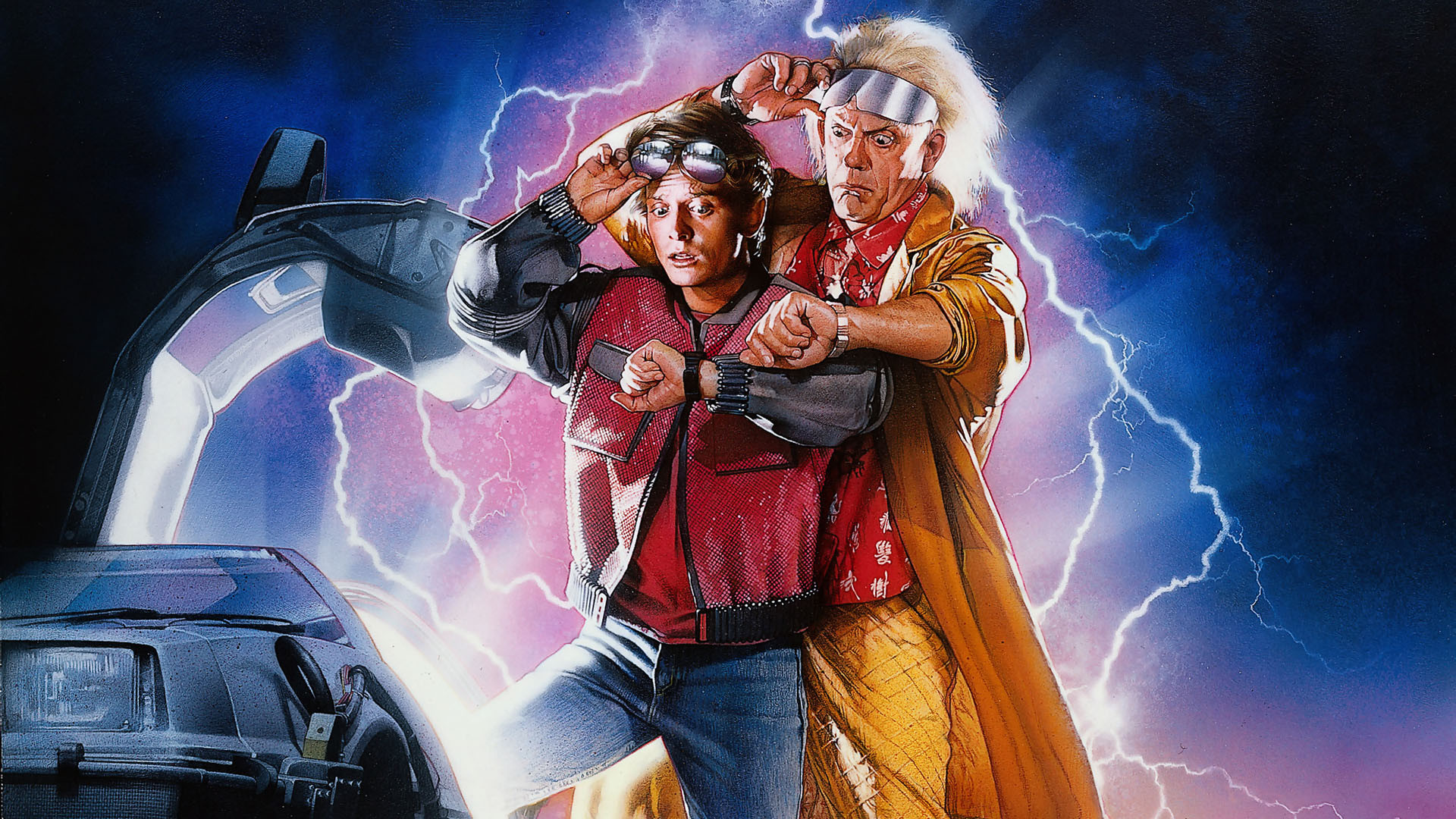
Most of us have seen the Back to the Future movies, but it may have been a while since you've seen Back to the Future Part II, where Marty McFly (Michael J. Fox) & The "Doc" (Christopher Lloyd) travel 30 years to the future!
They travel to October 2015 to prevent Marty's future son from getting arrested and sentenced to jail.  

I enjoyed seeing what they thought the year 2015 would have been like technoolgy wise, and unfortunately we are still years away from some of their "future" predictions.

Some of my favorite things they predicted for the year 2015:

Perfectly accurate weather, down to the second. It would be very nice to know exactly when the rain would stop/end. They showed that it was possible to put a mini dehydrated pizza in a "Black & Decker Hydrator" and have a full size pizza in seconds! I wonder if this technology of hydrating food will ever be invented.
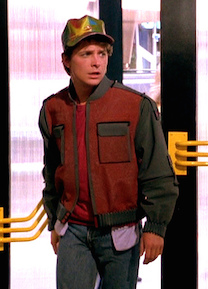
I also liked how they thought clothes would be in the year 2015. They showed Marty wearing a self adjusting jacket, that could also dry itself automatically when wet. 
I love the Nikes with "Power laces" that Marty wore. I am surprised we haven't seen anything like these yet, hopefully Nike will actually make these in the near future. 
One thing I can't see catching on is "Kids" wearing their pants inside out, that is one fashion trend I hope never happens. 
One thing I feel that this movie did predict really well for how the future would be, is how much we are engulfed in media. There are deleted scenes I watched from this movie that I wish they kept because it may have been their best predictions. The scenes are of the future Marty coming home from work and going to talk to his son. His son is not just watching TV, but watching multiple programs at once. Marty wants his son at the dinner table, and the only way his son agrees is when Marty gives him these glasses you put on and can watch two shows at once.  I feel like we are getting close to a world like this where people use media 24/7. 

^Here are the scenes I wish they kept in the Movie^

Thursday, January 22, 2015

Ellen Degeneres' response to online critic, Larry Tomczak

Ellen Degeneres, who has her own popular talk show, responded to a pastor, Larry Tomczak, on accusing her of promoting a gay agenda along with the rest of the media.

Larry stated, "Ellen DeGeneres celebrates her lesbianism and "marriage" in between appearances of guests like Taylor Swift to attract young girls."

As a longtime outspoken leader in the conservative community, Tomczak encouraged parents to fight the "indoctrination and propaganda coming from those advocating a gay lifestyle," offering advice for keeping children out of the influence of stars like DeGeneres, Jillian Michaels, Anderson Cooper, and Michael Sam.

Ellen usually does not answer to online critic's, but as she said on her show, she decided to make an exception to being on this list, and responded perfectly on her talk show.


Christian writer Larry Tomczak, who regularly writes for the Christian Post, is outraged at the gay agenda in Hollywood.  He recently addressed the "tsunami" of gay acceptance, claiming it is an "abomination."  Ellen responds in a witty and respectful way.  Ellen states that she is married, not quote on quote "married".  She then goes on to say that she does not even know what "celebrating her lesbianism" means, and continues to make fun of the ignorant fact.  Ellen accuses Larry of watching a lot of gay TV!  As he criticized many other TV shows that feature gay couples.

To conclude, she said: "The only way I’m trying to influence people is to be more kind and compassionate with one another.  That is the message I’m sending out. I don’t have an agenda. I’m not here to brainwash anyone." 
Then an assistant handed her a black and white hypnosis wheel which she began twirling at the camera, and spoke her closing statement.
"Attention youth of the world: I want you to live your lives being exactly who you are. Be true to yourself — the most important thing is to be true to yourself.
The second most important thing is that you wear Ellen underwear and only Ellen underwear."

I applaud Ellen for being so cool, calm, and collected about her response.  The fact that she can turn anything into a humorous joke makes her the beloved talk show host that everyone loves.  I do believe Larry was out of line to attack TV shows and celebrities, and I believe that Ellen handled it very maturely.  


Larry Tomczak's article:  http://www.charismanews.com/opinion/heres-the-deal/47834-avalanche-of-immoral-propaganda-targets-our-youth

Ellen's response:  http://www.charismanews.com/opinion/heres-the-deal/47834-avalanche-of-immoral-propaganda-targets-our-youth


Tuesday, October 30, 2012

Misinterpreting the Media

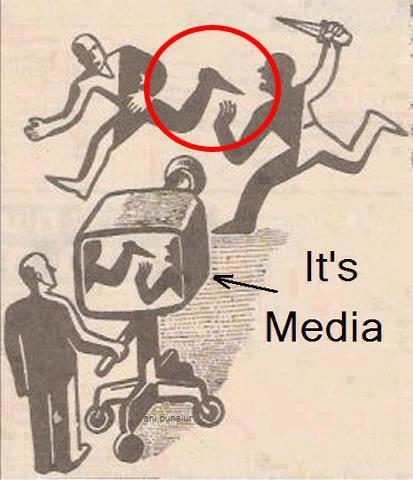
While surfing the web recently, I cam across this image.  Now, normally I don't find myself incredibly provoked by cartoons of this sort, but this was something entirely different; this picture actually said the thousand words to me that it's supposed to be worth.  In short, it asked me, "What are you doing about this?  Or are you doing anything at all?"

"It's Media"
I see this picture as representing what just about everyone within the media industry's been guilty of at some point: framing a shot just so, tweaking words in the proper way, only giving half the story.  As a means of communication between different areas of the world and society, this shouldn't be such a twisted message that we send; rather, we should be relaying an honest series of events and ideas, which has potential to make moves in turning the media into a perpetually reliable source.  Yes, the content is still truthful, more often than not, but it's displayed out of context.  For example, in the image here, the man seen running away in reality is caught in a shot that entirely switches his action, and does the same for his aggressor.  Because of the way the shot is framed, however, it can still be considered an honest representation of what's going on...just with a bit of the story missing.  It's like when a child is caught by his parents having done something wrong.  "Did you make this mess?" they ask him, and he replies "No, Johnny did."  What he neglects to mention is the fact that he aided Johnny in this action, and by doing so entirely changes the way that events proceed from that point.  Still, he hasn't told an outright lie; Johnny did do this, but not alone.

So, what am I doing about this kind of misinterpretation in the media, about this backhanded way of skewing ideas to make or break something else?  Sure, I'm in Park and learning all that I can to accurately work with the media, but how am I actually going to apply these skills to the real world to make a difference?  The fact of the matter is, I'm not going to do it alone, but that's what makes the media so wonderful opposite its negatives; everything connects, and there are infinite ways of getting this thought across.   It's a touchy situation, considering how quick people are to jump to arms over any slight infringement of rights, but with enough influence behind the movement, it has potential to make serious progress in the way of accurate media coverage.

Friday, October 26, 2012

Ithaca College's Park School...

and it's lack of classes devoted to how the industry and business works.

I first thought of this when we watched that video in class on Wednesday.  Now, I know Arturo has told us certain things about the industry and how production is the best way to get into the business but it was interesting to watch the video and see the vast number of positions available in just one department on set.  I was really amazed that I had never really thought about that kind of stuff because knowing the business and its positions are extremely important as well as how the hierarchy works on a set.  A lot of times, we only learn production type things in park and I think because of this, we forget that learning about the industry we get into and how many of the different things work is extremely important.  I really wish the school would create a class or two other than the intro media industries class that students could take to learn in depth about how the industry works in different aspects.  Some things they could talk about would be how to get investors for films, going through all the production jobs on set of a movie or television show (field, live, sports, scripted, ect.), all about the different studios and how to get in contact with them, and even the different areas in the country and around the world that are hidden hotbeds for video other than LA and NYC.   I think this would be extremely beneficial for students to really fully understand the business other than only knowing how to produce things.


-Tyler Chadwick

Tuesday, September 11, 2012

It's Amazing how much the World Changes in Eleven Years

     Well that day has come again. Eleven years ago a few moments shook our nation and dramatically altered the coarse of many American lives. For some generations this was the second major attack on home soil by a foreign enemy, others it was the first. For some it was all too confusing at the time to make anything of it and for some children, aged ten and under, it means they grew up their whole life while our country was at war.
     This tragic event has received a lot of coverage ever since that day. The news was the fastest way to spread the message of what happened that day as that was probably the most watched thing for the following days across America. The next thing I remembered seeing was the music industry, so many bands had been releasing songs or even albums dedicated to what happened that day. Bon Jovi came out with the song "Undivided" on his album Bounce in 2002, about how the nation came together that day. In 2003 Yellowcard's song "Believe" was dedicated to heroic acts that occurred that day. Also in 2003 Darryl Worley came out with the song "Have You Forgotten", whose imagery brings back vivid memories of what happened that day. Documentaries have since emerged. Inside the Twin Towers, 102 Minutes that Changed America, Ten Years On: Remembering 9/11 to name a few. The documentaries while not having the largest audience, definitely have the biggest impact because they tend to have true stories in them, not hypothetical or cliche stories in them. Recently Extremely Loud and Incredibly Close directed by Stephen Daldry came out. Eleven year old Oskar Schell, afflicted with Aspergers, tries to solve the last puzzle his father left him before his father, Tom Hanks, passed in the attack. It is a touching movie that has a few cliches and some disturbing videos from 2001. It created a powerful movie. The movie takes place over the span around one or two years.
     As mentioned above for some people they were too young to properly make sense of what happened that day. To this day they might not know what to make of it, I know I still don't know entirely what to think of it. Since a lot of people tend to look at the world through their own eyes, people in a different generation might not understand that. To them it might be seen as a horrible event with horrible outcomes that they understand and the though might not come across to them that its fuzzy to others.
     One of the amazing things that media can do is show new points of view on topics or even bringing topics to light. Things like the coverage of the Egyptian Revolution last year, or the Kony movement that briefly swept across the internet. While it's not the biggest thing in the world, I want to use my voice to show that story. The story of someone who to this date is affected by September 11th, 2001. With Extremely Loud and Incredibly Close it takes place soon after the attacks, but with what I want to do is make it more current. So the character could fit with someone within two years of my age. I feel like it will be a powerful piece and hope this will be one of my best pieces of work while in college.
     Never Forget 9/11/01. May all those effected find peace.

Tuesday, April 19, 2011

The Academy


Sometimes we think of the Academy as something remote that we connect with every year during the Oscars. But of course it is a lot more than that. As students of entertainment media there is much to learn and benefit from the numerous activities that you can have access to if you are in LA for your internship. So make sure to check their calendar of events.

At the very least be informed by the innumerable articles, research in the science and technology of movies, and of the numerous grants, internships and fellowships that the Academy grants every year to educational institutions across the country.

As a student of Ithaca College you are part of a select community of individuals who are expected to make their mark in the industry of communications and storytelling. Variety, which is the premier source of entertainment news in the world of show business, lists IC as one of the top media programs in the nation. It is up to you to use this platform to further your career opportunities. It takes work, and passion. Your call.

Thursday, March 10, 2011

Movies on Education

I'm planning on visiting my old high school over the break to help out with some stuff and when I went to their front page, they were advertising two movie screenings at the school for students (which I've never heard of at my high school before). Although they screen on days I won't be there I was wondering if anyone has heard of these titles: Race to Nowhere / 2 Million Minutes. The first is a documentary about the pressures of the school system on students, teachers, and parents, while the latter is about how students spend their time in school. At least, that is what their descriptions say.
What is creepy is that it seems we just had a discussion along these lines in class today. You don't have any connections in Vermont, do you Arturo?

Friday, January 8, 2010

ART && CODE

The 2009 Art&&Code Symposium gathered together some of the pioneers of the open source tools intended to democratize "computer programming for artists, young people, and the rest of us."

The Art&&Code symposium series as well as the social network around it was created by Golan Levin, who is a Professor of Electronic Art at Carnegie Mellon and the director of the STUDIO for Creative Inquiry. You can see some fascinating work of his and his collaborators here.

This video is the presentation of Processing, the program developed by Ben Fry and Casey Reas, which is one of the important open source visualization tools that we have at our disposal.

The presentation is a little long but make sure you get to the demos by the various artists they feature and whose work you will surely enjoy and might trigger some ideas of your own.


ART && CODE SYMPOSIUM: Processing, Ben Fry and Casey Reas from STUDIO for Creative Inquiry on Vimeo.

Saturday, February 16, 2008

Getting a little ticked...

Our reading this week struck a cord with some of the other reading I've been doing for our group. We're looking at personality, obviously, so a simple search on avatar personality led me to a book written by David Bell. Bell talks about embodiement, or lack thereof, and of some of the history of the "gender rights movement" for lack of a better term. He mentioned that in the late 90s, a movement developed to keep female gamers out of these online worlds. Women responded by creating groups of girl gamers that used terms like geekgrrls and others. They fought back much like we saw in Ada's story.

Bell also talks about the "cross dressing" aspects as well. He mentions some specific cases of female lesbians being seduced by homosexual men believing the female avatar is actually a man. He then speaks of the sterotypes of maleness and femaleness. The idea is that you must exagerate the sterotypes in order to be a believable avatar.

Up until this point in my reading, Bell had only ticked me off to a mild extent. Then he pushed me right over the edge. He began discussing race and computing. He classed individuals into 3 groups, the Information Users, the Information Used, and those that lack information. By information, he of course meant lack of access. His whole thesis apparently revolved around this point. Apparently minorities and women LACK the needed skills to effectively use the internet and VWs, and it is another ploy by those in the upper tier to keep us all in our proper places. His book was published in 2000.

I growled a few times, skimmed the rest of the work and chalked it up to the hairbrained schemes of the moronic, until I found he's actually published several works on this subject. That really made me angry. While I can see his viewpoint about access, I do not accept his idea that some people (mainly women in his opinion) lack the skills to participate flly in the digital age. To me it is akin to an article in a gaming magazine from several years ago in which the author suggested to his male readers that they should introduce thier girlfriends to gaming through things such as Spiro, or other cuddly, easy games. The author was inundated with enough letters from angry female readers that even he had to admit that perhaps he was wrong. In the year 2000, when Bell was published, I was teaching 7th grade life science at an at-risk in Virginia, where my students were far more technologically savy that I was. Even in 2000, most families had a computer in the home. Though Bell does admit that he graduated from grad school when computer took up several rooms.

I believe he is right that in some cases gender is over exagerrated to be believable, however, I found that usually this is a case of when someone is attempting to project an avatar they are uncomfortable with (ie man project female or vice versa). We won't even get into his thoughts on "furries" as he calls them, and those that would chose them.

Now let me move abruptly to my next topic of frustration for the week. Obviously, since Thursday, much ahs been discussed about violence in the media, ie violent games, movies, tv shows. Everytime some horrible tragedy occurs it's back to the theory of desensitation that causes the young (and not so young) to "lose it" and harm others. I've spent much time in conversation about this lately, and this is not my first post on the subject. But as I watch the things occuring in our world and the increase in technology being blamed for it I feel outraged. I have yet to find a single long term study that links violent media to violent behavior in the young. What I have found are studies that indicate that the "me" attitude of parenting has caused the young to feel isolated and powerless. Obviously there are many good parents in the world, many realize the committment required to parent. Others do not. When the incident at Columbine was blamed on video games and music I (as young as I was) asked why his parents weren't monitoring what they were doing? I find myself now wondering why, even at the age of 27, no one noticed that this young man had gone off his medication, or that something was wrong.

Some discussion in our class has revolved around whether meeting online is truly meeting, whether it is social. Forming friendships online can be just as vital as forming them in RL. No man is an island, why didn't anyone notice? I think again it leads back to the "me" attitude. Well, he stopped showing up to work at the prison, so he's fired, end of story. Why didn't someone go to his home and check on him? It would seem to me if the playing of violent video games is "making" children react violently, then why are parents allowing the games to be played by thier children? While it's not easy to monitor every aspect of what your children's lives, there is quite a bit that can be monitored. I knew most of what was going on in my classroom when I was teaching. I knew who thought they might be pregnant, who was taking drugs, who was living with someone other than thier guardian, who was reading what, and what games they played. I knew which girls braided hair for extra money, and I knew who was "dating" who. I was thier teacher and saw them roughly an hour a day. How can we live in a world where it is SO easy to stay connected, and yet no one knew this young man was about to snap, just like no one knew the young man at Virginia Tech was about to snap. How can no one know?

I think we're living in a time where everyone can be connected. I don't feel that there are classes. While my mother typically uses the internet for shoping, she also knows how to log onto a library system, retrieve materials, and do what she needs to do. She taught herself. Some of the greatest computer users I've met are women and minorities. These are the people that not only can do anything online, but when thier computer is broken, they know how to take it apart and repair it. Not because they had opporunity to learn as children, but because unlike those that have the resources (According to Bell), they cannot replace thier system when it breaks, they fix it. I once epoxied a telephone jack onto my computer when my modem port had broken. It worked that way for years. I've also helped one of my friends reduce her computer to parts in order to find that broken card and replace it. Remember, we are the people that Bell insists have no ability.

I know that this blog has been rambling, but of course during the course of writing it I've had three seperate conversations with my son, taken water to my husband that is recovering from Strep, and I've taken a second to feed my aged cat canned food. But hey, maybe it should be all about me? Come on folks, especially the ladies and minorities, please prove Bell wrong. And remember to take care of each other. Those of us in Grad school know what its like to be far from home, with no one to look in on you. I remember thinking that when I arrived here, 12 hours away from my family and my fiance that the only people that would miss me would be GRU and maybe Cox. Ironically, I quickly made close friends of several cohorts, and we have always taken care of each other. It's not hard. When someone is strapped for cash, take them leftovers from dinner, or invite them over. I can't count the number of meals I've taken to my friends, and how many I've gotten in return. When someone you care about is down, take them out for coffee, watch a movie together, it's just a couple of hours, and can mean the world. The night I called a friend and told her that I was miserable, she picked me up and we drove for three hours talking. Several weeks later, when her sister had an ear infection that sent her to the hospital int he middle of the night, I drove. It's not the things we watch as adults, or the games we play, it's the fact that no person is an island and we all need each other. SL gives us a chance to make connections to people, to keep in touch, and to take care of those, even when they are hours away.