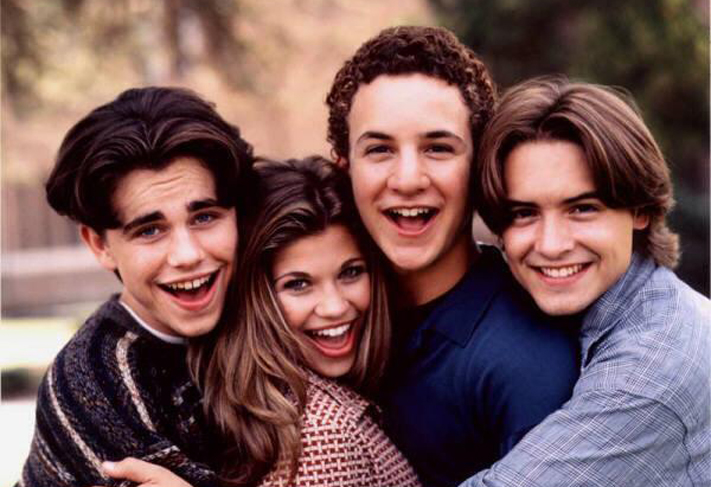
I was very cautious going into my first episode of 'Girl Meets World,' Disney's new (as of 2014) spin-off of the popular 90s ABC sitcom 'Boy Meets World.' I, probably like you, followed the life and love story of Cory Matthews and his girlfriend (later wife) Topanga, and fell deeply in love with best friend-sidekick Shaun Hunter.
'Girl Meets World' takes place more than a decade later. Cory and Topanga's daughter, Riley, is trying to navigate her tween years -- and problems that go with them -- especially in regard to bonds with family and friends. At John Quincy Adams Middle School in Manhattan, Riley finds being a student more difficult because her dad is a history teacher there, and she's in his class. Her mom, a lawyer, is involved in her social life and owns a trendy teen hangout. Among Riley's classmates are best friend Maya (who reminds us oh so much of Cory's childhood bestie Shaun), crush Lucas, and quirky Farkle (son of Cory and Topanga's classmate Stuart Minkus).
You can see why I was nervous. 'Girl Meets World' had (and still has) some big shoes to fill, with its predecessor having a seven season run. But I had to watch it. I mean, they got Ben Savage and Danielle Fischer to reprise their roles as Cory and Topanga. So I watched the pilot. Then I watched the next one. Then I binged the entire season.
Whether you're a fan of 'Boy Meets World' or not, 'Girl Meets World' is important and I'll tell you why. I haven't watched a show on Disney Channel by choice in years, but I had to watch this one. 'Boy Meets World' ran from 1993-2000 and a lot of their fans are now parents. As a generation of new parents watch characters they watched as teens become parents themselves, Disney is perfectly targeting adults and teens with this new show.
Not to mention, we're all guilty of claiming the children's programming back in our day was way better than the crap they make nowadays. Well now the youth of America is experiencing the brilliance of Mr. Feeny and his lessons. Only this time it's Cory giving the lesson, not Feeny. Just imagine how satifying that must be for those parents. 'Boy Meets World' was a genius franchise to build on. You can watch season 1 of 'Girl Meets World' on Netflix.
This past weekend I watched the film Children of Men for probably the 8th time in the past two years. My girlfriend and I have a running list of films to watch and since she has never seen this movie and I have, we decided on it.
For those of you haven't heard of or seen Children of Men, the film is set in 2027 when infertility strikes the planet and women around the world are unable to reproduce. It's been over 18 years since the last child was born, and the world has literally gone to shit. Not only has the world stopped producing children, but much of the world is either at war or has collapsed. Britain, where the film is set, is the only functioning government. The country is dealing with a massive refugee crisis, with government propaganda everywhere telling the population to be vigilant and see something and say something. Seen throughout the movie are shots of people locked in cages, treated like cattle with dozens of police making their lives even more of a hell than it already is. The main character, Theo, who is played by Clive Owen, is a drunk living in Britain. After almost dying in a bombing, he is thrust into helping a young, pregnant woman, who is being moved by the Fishes, a terrorist group. The group wants to take her to meet with the Human Project, which is a group of scientists who are working to find a fix to humanity's most pressing issue ever. His ex-wife, who is the leader of the terrorist group, recruits him to get transit papers for the girl. Because of the complexity of these documents, Theo is accidentally pushed to come on the trip. Along the way, his ex-wife, Juliann, is killed by another member of the group who wants to use the woman's baby as a tool for a coming revolution. Theo learns of this and takes her to Bexhill, a large refugee camp on the coast where he finally meets up with the Human Project.
Wow, that was a lot. Through this film are heavy themes of dystopia and despair. These two are the reasons why I love the movie. I'm fascinated by the idea of the collapse of civilization. Not for the death of people, but how the world copes with such calamity, and how nature begins to take over. This can be seen with the schools that are
abandoned because of the lack of children. As for the world coping, in Children of Men, it is barely hanging on. For example, the United States, after having nukes dropped on the country, is embroiled in a civil war. One of the most powerful nations in history is turned to nothing.
I have a decent amount of friends from home who used to skate but have recently been branching off to find thrill in a different activity. Urbex. Short for Urban Exploring which wikipedia defines as "the exploration of man-made structures, usually abandoned ruins or not seen components of the man-made environment." Basically you go explore abandoned buildings, and you often get to see really cool stuff.
Unfortunately I have not had the opportunity to go on these adventures with my friends, but they have gotten extremely good at taking photographs that allow their audience to experience the adventure from behind a computer.
They've been able to take places that people have viewed for so long as run down, useless, abandoned buildings, and turned them into beautiful works of art. They've had many encounters with police, security guards, and even the homeless. Taking these photos requires them to travel light, because to get to these locations you often have to run, jump, climb etc. This most often means one camera body, one lens, and no lights.
Something that started out as an after school past-time has turned into future careers for my friends. They started just going and exploring these old buildings because they thought it was cool. Soon they started taking pictures to document the places they go. Now they are studying photography in school and have had art shows in Philadelphia featuring their work.
The first three photos were taken by Andrew Collins. More work can be seen here: instagram.com/andrewcollinssk8
The last photo was taken by Jon Sevik. More work can be seen here: instagram.com/jonsevik and flickr.com/photos/sevik
This past Tuesday night, Stephen Colbert, formally of the "Colbert Report," made his Late Night debut on CBS. His shift from satirical news to late night was intriguing for many reasons. He's making the shift from cable to network Television and he's now got over an hour of content. But perhaps the most intriguing and publicized change for Colbert, is his character.
For the last nine years, Stephen Colbert essentially was playing a character, not being himself. When the program began in 2005 it was a perfect opportunity for Colbert to get into the public eye and display his star power. And for the nine years the show aired, his program along with Jon Stewart's "Daily Show" dominated the 11:00pm hour for Comedy Central. While Colbert's comedic intelligence and charisma shined throughout his time on the program, reports say playing the same character for nine years began to weigh down on him. Pretty much everything he said or did on the show had to go through a right wing filter to keep him in character. Essentially Colbert was performing one long sketch for nine years.
As much as people loved the "Colbert Report," it's easy to see how he could grow tired with the limitations him and his crew faced in writing for one character. So now as he steps into his new show and the vacated seat of David Letterman, Stephen Colbert has a chance to show his real self, to speak uninhibited.
Colbert's first show was interesting, to say the least. You never really know what to expect on someones first episode, but the mystery felt greater going into this program. One of things I was trying to figure out early on was the structure/format. Most late night programs eventually find their rhythm and begin to roll out shows daily that are fairly similar, with some variation here and there. But in the first episode of Colbert, it was hard to figure out the set up they'll use going forward. Some moments just felt a little awkward or different. One instance of this being when they played the title sequence about ten minutes into the show after he had already done his monologue and dialogue with the crowd. Overall, the show had very little flow and most of his gimmicks or bits went longer then expected.
As odd as the first show felt, Colbert's enthusiasm and energy was on full display. He looked recharged, like someone who had been liberated, and his energy was infectious. As a whole, the program felt more like a variety show then anything else, something to put Colbert's skills on display. The structure was secondary to Colbert's new personality. The issue for Colbert going forward will not be in replacing Letterman, it'll be in replacing the old Colbert. Pretty much he's his own toughest act to follow. With that said this program promises to be something new and different because for the first time the world will get to see the real Colbert.
Through my almost three and half years in Park, I've been told over and over again that film is a VISUAL medium, and that it should be treated as such when you're writing a script. For the most part, I would agree with this: when at all possible, you should tell a story visually instead of spelling something out with pointless, expository dialogue. Let the viewer figure stuff out for themselves instead of having characters broadcast it. I get it. That's all good.
So my question is, after watching something like the fantastic "The End of the Tour," how can movies consisting of mostly dialogue be compelling? End of the Tour follows Rolling Stone columnist David Lipsky (Jesse Eisenberg) as he goes about interviewing David Foster Wallace (Jason Segel, in an uncharacteristically good role) during the last stop of his book tour for the novel Infinite Jest.
And that's pretty much all there is to it.
Nobody dies (I mean, teeeeechnically DFW does in the intro, but it's barely part of the plot). There's no big twists or turns. At times, it can seem like there's barely any conflict. Just two dudes named David, talking about everything from sex to junk food. So where's the hook? What's the elevator pitch there? If I had tried to write something like this for my advanced screenwriting class, I probably would have been immediately shut down. It didn't help when I discovered that the writer was Donald Margulies, a guy that normally writes plays (albeit, really great, compelling plays). Then THAT got me thinking: what's the difference between a play and a film? Is a play also not a visual medium? Why is ok for a play to be talky, but not a movie?
Turns out, even though they're visual, stage plays are a different creature altogether, mainly for some obvious reasons. Plays don't have cameras, for one: they work with a single stage, and whatever you see is going to be determined by your place in the audience and your particular view of that stage. Many times, all you'll be able to work with is a couple actors and a bare bones set, so compelling dialogue is the one thing that you have to really focus on.
Sometimes, this can be translated over into film. Take Glengarry Glen Ross, for instance. It's a super talk-y movie, one of those films that I would have absolutely hated as a kid, but it's compelling, and it's adapted for the screen from what was originally a stage play. If you're able to translate the intensity and keep the dialogue tight and interest-keeping, then you're set.
And that's more or less what Margulies is able to do with End of the Tour. He takes a book about a long conversation and turns it into a movie about a long conversation. I'd like to say that framing and shots help the movie stay interesting as well, but from a technical standpoint, it's fairly average and forgettable (apart from this one shot in a parking lot that makes the physically imposing Wallace look like a child). Sure, you can go the route of David Fincher/Aaron Sorkin in the Social Network and also make it super visually appealing, but you also, surprisingly enough, don't need to. Sometimes a good script is a good script, and musings about masturbation, Alanis Morissette, and television are all you need. Which is kind of both inspiring and strangely depressing. Oh well. I guess that's David Foster Wallace for you.
While sports fans have their fantasy leagues, TV buffs are placing bets on which pilots will actually make it through a season. In a mix of comical book adaptations, spinoffs, and a few original programs, the Network's have chosen who will stay, who will get a chance to premiere more episodes, and who is already kicked to the curb. This year adds in more competition with Hulu, Netflix, and Amazon creating their own scripted programming. Out of ABC's 14 comedies that were pitched, four were chosen to continue. Surprisingly, not on the list of picked up pilots was Chevy Chases' comedy (called Chevy) about grandparents who suddenly have to raise their grandkids alone. In addition, ABC saved 7 of 12 pilots in the drama category, with an equal mix of political and social plot conflicts.
In the other neck of the woods, CBS only secured 2 out of 9 comedy projects, while 4 are still being reworked in order to see another day. CBS had 9 drama as well, and gave 5 of them a series order. FOX only had 8 comedies to show, giving half of them a chance to premiere their seasons. And with only 7 dramas, FOX decided to order seasons for 5 of them, and have yet to cancel the other two. Meanwhile, NBC came out hot with 14 comedies, 6 have ordered more episodes and 5 are stilling fighting to stay alive. With 10 dramas, NBC has decided to continue 6 of them, leaving two on the bubble.
Last but not least, the CW produced 5 drama pilots, and only 2 made the cut.
If you're looking for your next new favorite show, some to look out for include Dr. Ken(ABC comedy with Ken Jeong), Angel From Hell (CBS comedy with Jane Lynch), Minority Report(FOX drama), and The Player (NBC drama).
Click here if you want your complete guide to the 2015 pilot season.
There are two kinds of people in this world (Earth C-137):
those who absolutely love Rick and Morty, and those who I pretend exist in a
parallel universe where they love Rick and Morty, which I can do because that’s
exactly the power of the show. Because it is a sci-fi cartoon with a backbone
built around multi-verse theory, Rick and Morty is a show that can do whatever
it wants.
The adultswim show that aired on December 2, 2013 is just
over halfway into it’s second season and was renewed in August for its third. No
surprise there. After one season, the show had already become adultswims’
trinket necklace left to it by it’s late grandmother that actually turned out
to be worth way more you ever could ha
ve gotten for it on ebay. That’s because
it has the most value element in the world in it. Collaboration. (Aww)
Rick and Morty actually started as a sketch
meant only get a
shock factor reaction from the audience by one of the show’s creators, Justin
Roiland. Originally a grotesque spoof on Back To The Future, the animated
sketch called “The Real Animated Adventures of Doc and Mharti” was noticed by
Community creator, Dan Harmon. With Justin’s art and vocal stuttering’s- I mean
stylings and Dan’s unmatched wit and storytelling ability, the duo took the
sketch from over the top gross to stellar comedy.
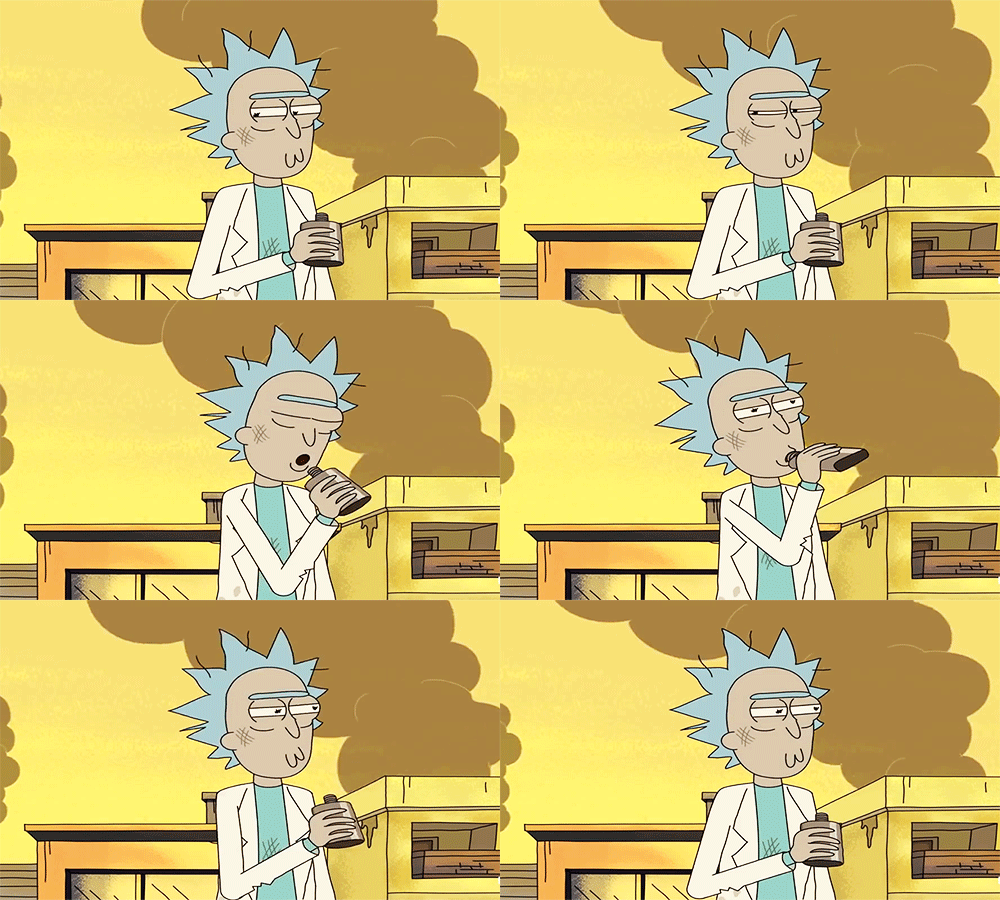
Rick and Morty follows the story of Rick Sanchez, an
alcoholic scientist who happens to be the smartest man in the universe and his
dim-witted grandson, Morty, as well as the rest of the family. As they travel
through the universe, their stories incite more than a little laughter but kick
you in the heart just as often. The power of the show is that even though it’s
jokes per minute count is off the charts, it weaves in very real issues as
well, like suicide, failing marriages, molestation, insecurity, etc. However,
all of this together means that even the fourth or fifth time you watch an
episode, you pick on new jokes and subtle plants, making it easy to introduce
and watch with friends who have never seen it, at least not in this universe.
For a dumb looking show, it’s one of the smartest sci-fi series on TV at the
moment and from the looks of it, it’s here to stay. Just like you, in that
chair as you watch the pilot for yourself right now: http://www.adultswim.com/videos/rick-and-morty/pilot/
Film making is one of the most time consuming things in the world. To do something well, A LOT of time needs to be spent working on it. It takes months of pre-production, shooting and then all of the post production work to pull it all together. This is all before you have anything to really show to the world. This could even be for a five minute video. So how do you balance this with everything else that needs to be done in life(Laundry, calling mom, paying bills, etc.)?
One of the most important things in my life, besides for film making, has been running. I have been running competitively for almost a decade. Since coming to college it has become a year round commitment. On top of classes and films, I would have practice 4-6 daily and would usually have meets on Saturdays lasting the entire day. I loved every minute of it. I've always been competitive and never minded the strain on my schedule. Even if it meant a much more limited time to make films.
Recently I had to make the decision to leave the cross country team just before the start of my senior year. It was one of the hardest decisions I've ever had to make. In these past years the team has become my family. We've spent hundreds of hours together pushing our bodies to their limits, joking, and just being together. Running has very much shaped me into the person I am today.
So why quit? If I've been balancing running and everything else since day one why stop now? What makes this year so different? I came to the realization that I wasn't able to give it everything I had. In either direction. I am a strong proprietor of the idea that "If you aren't going to do it right don't do it at all." Being in my final semester I knew it was time to put my money where my mouth was. Am I going to make a good film or do I want to make something extraordinary? To make this difference I needed time, as much as I could get. It would mean missing meets for productions. So many meets that it was pointless to stay on the team, regardless of how much it means to me.
Life is a series of choices. Some will be easy and others will be extremely difficult. I will always encourage people to make the decisions that will make them happiest in the long run. I will also encourage people to be the best at whatever they do. Sometimes those aren't the same decision. Success is not easy but you have to be willing to work for it. Even if it means making sacrifices.
My Team and I after winning the E8 conference championship
The London based film company, Realm Pictures, brought every video game/film nerd's wet dream to life. This past August, they created a first person shooter film that allowed random strangers they found on the internet to control the actions of the main character.
Yeah. You heard me. Realm Pictures specializes in fantasy-like films, photography and visual fx, so they are no stranger to creating interesting content that pushes the bounds of reality. With a camera strapped on to a helmet, and some tricky computer work, Director David Reynolds and his team were able to live stream an actor wandering through a church yard and fighting zombies.
But here comes the cool part. Reynolds was able to live stream the video to Chatroulette, a website that allows you to talk and video chat with random strangers. And those strangers got to control what the actor did, just like a real video game. With multiple locations, a handful of hidden weapons and items, a horde of zombies and a demonic final boss, players were able to choose their own paths by giving the actor commands, and hopefully make it through to the end, where the team of filmmakers was waiting for them in their control room. Here's the awesome video:
But how did they do it?!
It wasn't as easy as setting up an intricate obstacle course and flooding it with actors in zombie makeup. Reynolds orchestrated something very innovative technologically, that could really change both the gaming and film world. By strapping one of the zombies with a wireless router, they were able to live stream HDMI from the camera on the actor's helmet back to the control room, where Reynolds and his team controlled the website, and visual and sound effects. Reynolds also provided the voice of the shooter, so he would be able to react and communicate with the strangers. They created a behind-the-scenes video, which was even more interesting than the actual film.
And their accents, am I right ladies?
Currently, Realm Pictures are starting to produce their first feature film, so a sequel won't be in the immediate future. But, Reynolds stated "our fanciful conversations about what 'level 2' could bring are now becoming a reality real quick!", so don't cry yourselves to sleep just yet.
This level of audience participation is pretty groundbreaking. It takes the concept of "Choose Your Own Adventure" games and films to the next level, getting rid of the preplanned paths and allowing the "gamers" to decide whatever they wanted in a controlled environment. Though video games almost look like films nowadays, with graphics getting more realistic by the second, this is truly a new way to combine the two mediums. If developed and expanded, this kind of gameplay may catch on, and hopefully Realm Pictures will be the leading pioneer to this new frontier.
Recently I was able to make a huge investment for myself as a filmmaker. I introduced myself to a new camera, the A7s. I have had my eye on this Sony product for quite sometime now. I have been blown away by it's dynamic range and high ISO capabilities displayed online and now I finally get a chance to use this in a real world setting.
(A still from the A7s, Sigma Art 35mm 1.4)
So where to start? The Sony A7s has so many favorable traits its hard distinguish a starting point. I'll start with my three favorite features and move on throughout each blog post, addressing individual features as we move along. For myself there were a few things that I found desirable about the camera that swayed me to switch from Canon to Sony. First off, variable frame rates. I previously shot on the Canon T3i as it was my starter camera and boy did it get me through some times. However, the highest frame rate you can go is 60fps at 1280x720. This is universal through most Canon DSLRs.
(Tokina 11-16mm 2.8)
The 5DmkIII, which previously ruled the DSLR world, couldn't compete. The A7s can also be boosted to 120 fps with the downgrade to 1280x720. It can't compete with the Phantom or RED, but for a Full-Frame DSLR, this variability will get the job done. The video posted below is shot completely in 60fps. All footage is played back in realtime until brought into post to be altered.
While the variable frame rates are so much fun to play with, thats not all there is to this beast. The ISO is off the charts. Most of the footage above, besides what was indoors, was filmed at upwards of 30,000 ISO. This was my first day with the camera and I really was enjoying this party trick. Grain in the image began to increase as I went up, however it is quite clean around 20,000. Some 50,000 iso footage can even be salvageable. Once you increase upwards of this threshold you will need to use plug-ins like Neat Video to decrease grain levels.
(Sigma Art 35mm 1.4)
Many filmmakers have highlighted in reviews this outstanding feature, and I hope to learn how to take advantage of this feature and really get some outstanding footage. Once difference I noticed is that the Video ISO is much cleaner at much higher ISOs than the photos. This is due to the sensor only having 12.2mp, thus the pictures suffer loss of quality in order for the video to prevail. Although the resolution is not quite up to par with Cameras like the 5D or even the A7s older brothers the A7 and A7r, the pictures produced still look very nice when paired with the right glass.
While these two capabilities are useful and help with more advanced shooting, you can never forget the little things. The live recording punch in feature is so handy and is something I've been looking forward to for quite some time. Paranoia strikes at the strangest times, especially when conducting interviews. The everlasting battle of not being able to tell if you have something in your eye or if your shot is soft. Being able to punch in and check focus is an amazing feature especially when it comes to doc work, not only in interview settings but out in the field too. The back tilt able LCD screen paired with an amazing EVF makes this camera very diverse.
(Sigma Art 35mm 1.4)
Using the EVF paired with the punch in focus feature will be great when recording in the field and you need that extra assurance that the subject of your shot, whether that be an animal, mountain top, you name it, is in focus. There are multiple custom keys on this camera that you can arrange which ever is most comfortable for you. I prefer to have my C1 button (located on the top right corner diagonal from the shutter release) to be my short cut to this handy feature, but to each their own.
I'm very excited to start using this new investment for personal projects, thesis films, and even try my hand at time-lapses. It feels weird making the next step of your career goal and being faced with new and unique situations. While the learning curve in this industry is always changing, this factor is what drives me to be the best I can be. There will be plenty more reviews to come in regards to the time-lapse capabilities, picture profiles, and much more. Until next time.
Browsing NoFilmSchool today after not reading the site for well over a month I discovered that Panasonic released a camera called the DVX200. This camera is a successor to the DVX100, a 4:3 CCD camera released in 2002. At its time, the DVX100 was the first camera to support progressive scan video recording at an affordable price. Since then other cameras have been released, such as the HPX500, the HVX200A and the HMC150, which were released in the 2000s.
Several years ago I owned an HMC150 that I bought after saving up for over a year while working at a NAPA Autoparts store in my town. I loved that camera. At the time, I was shooting action sports videos of my friends snowboarding and riding BMX bikes. The HMC150 served a versatile tool for the type of filming I was doing. Action sports filming is a run'n'gun situation. Many times we would arrive at a location and after a few minutes of scoping out shot locations begin to film. Content was key, the more the better (as always), and we never wanted to miss a moment. The first video I have posted above is a edit from footage I shot during one year for my friend Shane. His video was being shot when I bought my camera and is the first one that I shot part of with my HMC150. The second video was made about a few years later. By this time I had become much more adept at using the camera.
The release of the DVX200 is important because it brings 4K quality video recording to the build style that favors action sports videos as well as documentaries as well. Most 4K cameras are not built for run'n'gun style shooting as they require a monitor and a complex setup that is suitable for studio work in a controlled environment. Sports and documentary filmmaking involve quick setups, the ability to zoom easily with a servo zoom motor, attachment of shotgun mics with onboard XLR ports, as well as other features, such as ND filters. All-in-all I'm excited about this camera.
As a fan of documentaries, I’ve become fairly well acquainted with the various styles found in the genre. One of the less-discussed styles that greatly intrigues me is non-narrative docs/nonfiction films - particularly those that lack any sort of narration whatsoever.
The first time I saw this sort of thing was back in middle school, when our music teacher showed us some clips from Godfrey Reggio’s Koyaanisqatsi (we watched it in music class because of its remarkable score by Philip Glass). And as a middle school kid, of course I found it to be the most boring thing I’d ever seen. After that experience I stayed away from the genre until I found Ron Fricke’s 1992 film Baraka a few years later.
Baraka opened the door for me to the world of non-verbal film. It is a movie shot in 25 different countries on 6 different continents, and it completely avoids the use of dialogue, narration, and narrative. It is comprised of footage of people, nature, vehicles, infrastructure, etc. over a beautiful score. Regarding the film, producer Mark Magidson said “[the goal] was to reach past language, nationality, religion and politics and speak to the inner viewer.”
Baraka is remarkably captivating, yet in a different way from most films. There is no story to become invested in, or characters you get to know. However the cinematography is absolutely gorgeous, and the film keeps your interest by providing vastly different aesthetics as locations change. Here is an example, in a particularly depressing scene:
The film was shot in 70mm and later scanned at a ridiculous 8k for their 2008 blu-ray remaster. Even though I (or pretty much anyone, for that matter) am not getting anywhere near that resolution on my TV, it still looks absurdly good and it's certainly one of the best blu-ray film restorations I've seen. Take a look at the original trailer vs. a re-cut trailer with the restored footage:
I highly suggest checking out the Baraka blu-ray, it's good stuff. A sequel to Baraka called Samsara was released a few years ago, and it is equally as stunning.
There’s a good chance that you have never heard about ASMR,
and if you have, you almost certainly haven’t talked about it. But almost
everyone has experienced it in some way or another, either as a tiny child, in
romantic encounter, or maybe even during a game of telephone. When somebody
whispers in your ear, it can trigger a very relaxing, somewhat paralyzing chill
that spreads in a wave over the head and sometimes in the lower back. This is
caused by a relatively unknown mechanism in the body called the autonomous
sensory meridian response (ASMR). Depending on the context, it can foster a
feeling of tranquility and/or sexual arousal. While the scientific reasons for
this response are still unknown, the sensation has found a significant appeal
among a growing YouTube community.
A simple search of the terms “ASMR” or “whispering” will
result in an array of videos that oddly enough comprise of many people just
whispering to the camera, most of the time for about twenty to thirty minutes.
Sometimes they just make lip sounds. Sometimes they tap and scratch random
objects. Sometimes they pretend to give the audience a fake haircut.
So what’s going on here?
It turns out that for many people, ASMR videos provide a
drug-free way to relax by tapping into a sensation in the body design for
exactly that. In order to fall asleep, people will listen to YouTubers
(sometimes known as ASMRtists) whisper and tap objects to create this sensation
in their headphones. There are all different kinds of people making these videos
but certain voices are more effective to certain people.
And as it happens, certain audio recording techniques are
more effective as well. After finding out that ASMR videos exist, I found
myself very intrigued not only by the idea of using this sensation to relax,
but also how to use 3D audio recording techniques to best recreate natural
human hearing. I developed an ASMR series of my own called “Ultimate Plane”.
The idea behind it was to create a found footage style narrative using ASMR to
tell a post-apocalyptic story. In terms of stereo recording, I used two
omnidirectional stick microphones places just outside the frame of the shot,
replicating approximately where human ears would pick up sound. When two
omnidirectional mics are recorded together and then hard panned left and right,
it creates a three dimensional listening environment, meaning that even without
visuals, a person would be able to pinpoint the direction and distance of the
source of the sound.
Only five episode were shot because I realized I had gotten
too many people and too many props involved to keep making the weekly
commitment to record episodes, but of the feedback I got, it was mostly
positive, albeit many people thought it was weird. To tell the truth, it is
weird, but it works and whiles it’s rarely talked about, a lot more people turn
to ASMR than you may think. For me, it was a test in storytelling and sound
recording and someday I’m going to go back to 3D ASMR sound recording. In the
meantime, I think I’ll just listen to it sometimes and pretend that I don’t.
Developing a story is often a work in progress. Even the most experienced writers know that story telling takes time. Myself and the creative team behind "Scout's Honor" are discovering first hand the struggles that come with creating a well rounded plot. All the ingredients are there for us, diverse characters, strong environment and a premise we're happy with. And yet, even with all these elements we're still working to get over the hump between draft 2.99 to 3.0 One of the things we've been struggling with is the tone of the piece. We're tabbing our film as a "family dramedy," key word being dramedy. This genre of storytelling combines parts of both drama and comedy, elements we're looking to include in our film. As we write and revise, we've discovered the difficulties that come from this type of storytelling.
Dramedy is tough because the author must establish a fine line between laughs and drama. A big part of a successful dramedy (or any story really) is establishing a tone and keeping it consistent throughout. Part of this is creating reliable characters. If they are, the audience will never question their emotions. Moments whether sad or happy will feel appropriate.
Even with all of these elements, it can still be hard to walk that line between comedy and drama. In "Scout's Honor" we're covering something that isn't necessarily funny: death. While our plot covers a sad part of life, we've been trying to find humor in the situational's, the aftermath. We've tried to create characters that feel real and relatable, however sometimes it can be difficult when the comedic element is added. One of our characters, the attorney, has sort of become our go to guy for comedic relief. In each draft we've tried to work on him so that his character feels multi dimensional and real, not just funny. Once again we had to go back to this character's situation and use that to justify his actions, trying to make them consistent with his predicament. As we work to complete our script we're focusing hard on finding a reliable tone.
One of the things that got me thinking more about the line between comedy and drama, is the netflix show "BoJack Horseman". I started watching this show about a week ago and have already finished the first season. I had heard good things about it, but my expectations weren't exactly through the roof. I liked the premise and most of the voice actors working on it, but otherwise I didn't think it would be much more then an easy to watch comedy. The first couple episodes were about what I expected; funny, decent plot, enjoyable enough to keep watching. As I got deeper into season 1, I was surprised to see storylines carry over episode to episode. Plot points started to get darker and the character emotions became relatable. This is when it really started to differentiate between other adult cartoons such as "Bob's Burgers" and "Family Guy." While it continued to make me laugh, the 2nd half of season 1 really pulled me in with the dramatic aspects. "BoJack Horseman" began to waver between comedy and drama. And while you can't really sell it as a drama, you can't discount the dark moments that resonate with the viewer. In one of the later episodes in season 1 there is a scene where BoJack takes too many drugs and begins to hallucinate. At coming off as funny, his hallucinations take a reflective turn as BoJack starts to visualize what his life would be like if he had a family, if he made different choices. He sees how happy he could have been before he wakes up outside a gas station collapsed in the pouring rain. As silly as the show can sometimes be, this scene really resonated with me. With graduation a year away, I'll soon have a lot of tough decisions to make as I pursue a career and a family. Each of these choices I make could have a ripple effect on the rest of my life. And while these are things everyone will think about at some point, it was this "comedy" "BoJack Horseman" that got me looking to the future.
Dramedies are awesome in that they can connect with the viewer in all kinds of ways. If done right they can connect with all kinds of emotions. Make you laugh, make you cry, and more then anything make you think.
Long takes (or oners, or long shots, or whatever you feel like calling them) have been talked about endlessly among film buffs, film students, and really anybody that gives a shit about the aesthetics of film. If you know what a long take is, chances are you've got a favorite, whether it's Goodfellas or Gravity or Children of Men or Birdman or Episode 4 of the first (and only, as far as I'm concerned) season of True Detective. I'm pretty positive I even wrote a blog post last year around the time Birdman came out, fanboying over how sexy and cool the long take is, as a shot. By this point, just pointing them out is nothing new, though. They're there, they're good, and I won't talk about them any more.
While these shots should be praised for their creativity, determination, and, sure, length, I've recently gotten more interested in when it's acceptable to use one, and for what purpose. You might have seen this video about how Spielberg uses long takes in a far more subtle way than most directors; it's part of the really great Youtube channel "Every frame a painting," and it really dissects ways you can use a long shot to your advantage without calling attention to it. In particular, I think it's fascinating how you can essentially take a long shot and break it down into three or four basic shots: the Raiders of the Lost Ark scene stands out to me the most in that regard, with a wide, mid, close, and insert shot all being incorporated into a single take. It moves the scene along, keeps things interesting, and like the guy said, almost definitely saved time on set.
What's the point of this though? Why not just do a scene four times and cover all your bases? This is just me conjecturing here, but I think every shot should elicit some kind of emotion from your audience. Don't just go about shooting everything willy-nilly: have a purpose. If a character feels isolated and alone, back that camera way up and make her look small. If someone is claustrophobic, slap that macro lens on and get in real tight. Make a powerful character more prominent in a shot than a weaker character, and switch this if their roles are reversed. All of these will, even if only subconsciously, help an audience to better understand whatever emotion you're trying to play up.
So what emotion does a long take elicit? In short, all of these things, all at once. I know I said I wouldn't bring up Birdman again, but I lied, so deal with it. Birdman is filmed to make it appear as if the entire movie was all done in one take, using really clever transitions to cover up the cuts. It's about theatre and theatre actors, and throughout the film, you can't help but feel like you're watching a stage production instead of movie, mostly due to fluidity and lack of cuts. One of the intentions of this is to (probably) just let the actors take over and control the screen. This works, but only to a certain extent: the lack of cuts can sometimes be distracting, e.g. "oh, did they cut there? I think they cut there. But wait ok maybe not."
This guy.
This brings us back to the subtlety of the Spielberg long take: it's long enough to let the actors act uninhibited from cuts and various camera angles, while still being short enough to not draw attention to itself. The "Every frame a painting" guy calls it "robust," and I think that's the perfect word for it. It's simple, gets a strong point across, and can free up time on set. Ideally, we'll find some way to incorporate it into our film this semester, and if we do it right, you might not even notice it.
Also, here's another great article about the evolution of long takes, both subtle and not-so subtle. Looking at you, Lubezki.