As many of you know, my thesis film, Mime and Punishment is inspired by the works of Buster Keaton and his influence on visual and physical humor. On the off chance you are not aware of who Buster Keaton is, he's this guy.
Steamboat Bill Jr.
This bit, from his film Steamboat Bill Jr. is perhaps Keaton's most famous stunt and has been continually referenced throughout pop culture.
Gags, like the one above, are what Keaton was known for. His films were chock full of and heavily reliant on physical humor. Keaton's characters, would often find himself in zany and often dangerous situations. What's even more remarkable was all of his stunts, were done by himself. With all these zany stunts came a fantastic visual storytelling. Silent films of the time, Buster Keaton's included, had to rely on title cards in lieu of dialogue for exposition. Most films of the period had an average of 240 title cards.
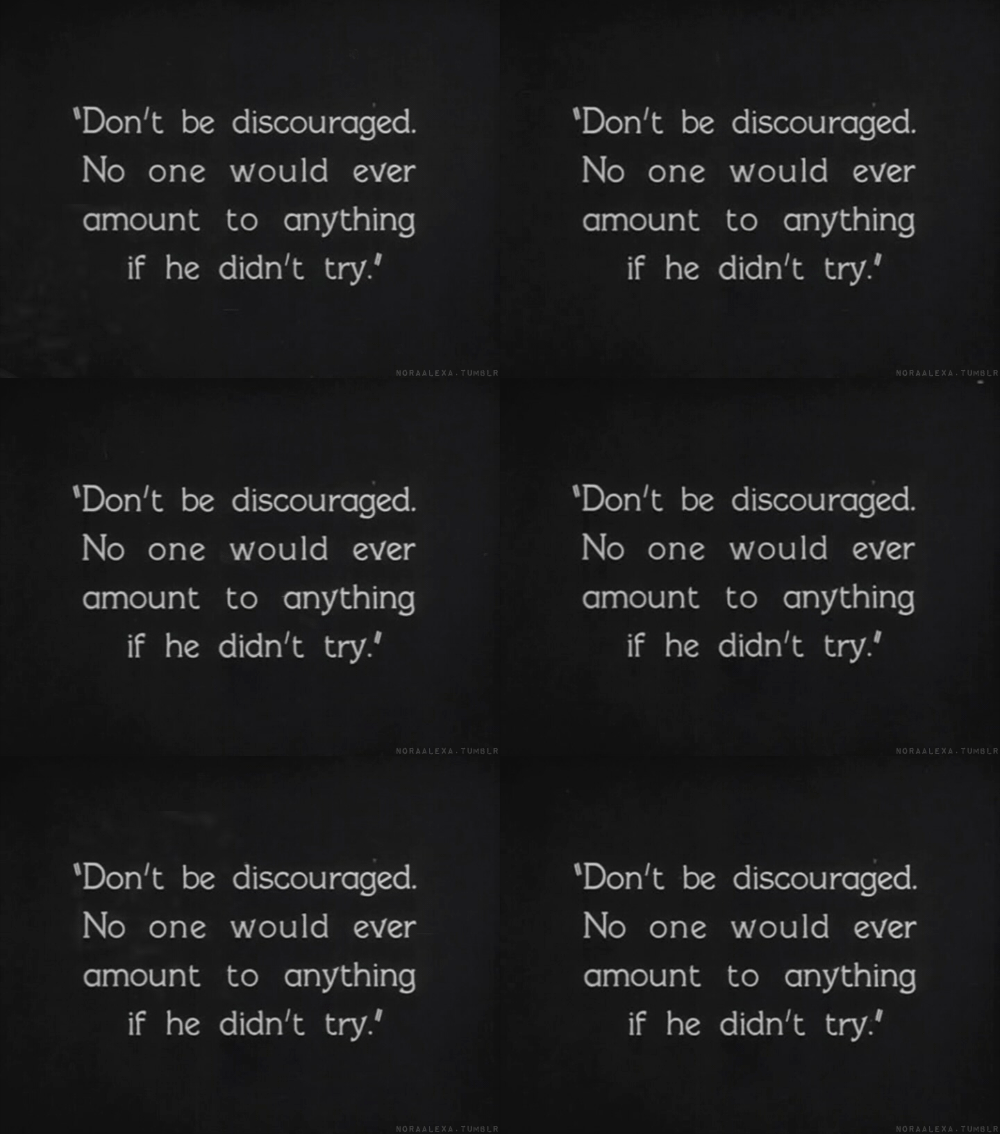
Imagine 240 of these being needed to tell your story. Keaton said that he never used over 65. That's almost 1/4th of what every other film used. Instead, Keaton relied on the kinetic and often slapstick energy to tell story in non-verbal manners. Keaton was always entering and leaving frame in interesting ways. His mannerisms and framing have had a lasting legacy. This fantastic video from Every Frame a Painting shows the lasting legacy of Keaton as well as better explaining the points I made in this post.
Long takes (or oners, or long shots, or whatever you feel like calling them) have been talked about endlessly among film buffs, film students, and really anybody that gives a shit about the aesthetics of film. If you know what a long take is, chances are you've got a favorite, whether it's Goodfellas or Gravity or Children of Men or Birdman or Episode 4 of the first (and only, as far as I'm concerned) season of True Detective. I'm pretty positive I even wrote a blog post last year around the time Birdman came out, fanboying over how sexy and cool the long take is, as a shot. By this point, just pointing them out is nothing new, though. They're there, they're good, and I won't talk about them any more.
While these shots should be praised for their creativity, determination, and, sure, length, I've recently gotten more interested in when it's acceptable to use one, and for what purpose. You might have seen this video about how Spielberg uses long takes in a far more subtle way than most directors; it's part of the really great Youtube channel "Every frame a painting," and it really dissects ways you can use a long shot to your advantage without calling attention to it. In particular, I think it's fascinating how you can essentially take a long shot and break it down into three or four basic shots: the Raiders of the Lost Ark scene stands out to me the most in that regard, with a wide, mid, close, and insert shot all being incorporated into a single take. It moves the scene along, keeps things interesting, and like the guy said, almost definitely saved time on set.
What's the point of this though? Why not just do a scene four times and cover all your bases? This is just me conjecturing here, but I think every shot should elicit some kind of emotion from your audience. Don't just go about shooting everything willy-nilly: have a purpose. If a character feels isolated and alone, back that camera way up and make her look small. If someone is claustrophobic, slap that macro lens on and get in real tight. Make a powerful character more prominent in a shot than a weaker character, and switch this if their roles are reversed. All of these will, even if only subconsciously, help an audience to better understand whatever emotion you're trying to play up.
So what emotion does a long take elicit? In short, all of these things, all at once. I know I said I wouldn't bring up Birdman again, but I lied, so deal with it. Birdman is filmed to make it appear as if the entire movie was all done in one take, using really clever transitions to cover up the cuts. It's about theatre and theatre actors, and throughout the film, you can't help but feel like you're watching a stage production instead of movie, mostly due to fluidity and lack of cuts. One of the intentions of this is to (probably) just let the actors take over and control the screen. This works, but only to a certain extent: the lack of cuts can sometimes be distracting, e.g. "oh, did they cut there? I think they cut there. But wait ok maybe not."
This guy.
This brings us back to the subtlety of the Spielberg long take: it's long enough to let the actors act uninhibited from cuts and various camera angles, while still being short enough to not draw attention to itself. The "Every frame a painting" guy calls it "robust," and I think that's the perfect word for it. It's simple, gets a strong point across, and can free up time on set. Ideally, we'll find some way to incorporate it into our film this semester, and if we do it right, you might not even notice it.
Also, here's another great article about the evolution of long takes, both subtle and not-so subtle. Looking at you, Lubezki.
Tony, the man behind the youtube channel Every Frame a Painting released a new video this week specializing in Jackie Chan. If you haven't seen any one of his other videos I can't recommend them enough, they are very well edited and Tony knows a lot about all kinds of films. But what I found interesting in his new video is how action and comedy are quite similar. In terms of how they should be filmed to get the best reaction and how showing everything is always better. Just like a joke showing the action and in the same frame showing the reaction is the best way to pull everything out of the picture. If someone is hit on screen showing the hand and then the reaction from the hit draws more effect from the audience. The video goes on to explain more about the differences in action between American and Asian films. The editing in Hollywood for action has become more about cutting from one shot right as they get hit to the next. Tony goes on to explain that in many asian action films editing has been used to alter the continuity of each hit. So as someone throws a hit the hit is quickly shown and then cut to close up and quickly see the hit again. With only a couple frames it's barely noticeable but adds an extra force behind each hit. I find it extremely interesting how editing can be used in this way and can not wait for Every Frame a Painting's next video.
Over on Vimeo and YouTube, a film educator named Tony Zhou has been creating a short web series called Every Frame a Painting, where in every episode he breaks down the visual approach of a popular director to examine what elevates that director's work. Last week, in anticipation of David Fincher's new film Gone Girl (which I'd strongly recommend), Zhou released a new video breaking down Fincher's style, from his breakout film Se7en up through his work on House of Cards and Gone Girl, with a particular interest on Fincher's use of blocking and framing. This video, particularly the bit about featuring the police station scenes from Se7en, emphasized to me just how important framing can be in creating power dynamics between characters in a scene. As evidenced by the video, great directors can bring a cinematic style to something as simple as two characters spouting exposition, which can elevate a film from good to great. The restrictions that Fincher puts on his own shot choices, which all seem to have evolved from his deep understanding of the grammer of film, allow him to tell a story in the best possible way. Another article I read this week about Fincher and Gone Girl noted that Fincher's specialty is in adapting narrative material (the origins of Facebook, a pulpy detective story, etc.) and introducing a cinematic element to these stories that heightens the drama and deepens the audience's understanding of the characters.