Showing posts with label Sundance Film Festival. Show all posts

Thursday, March 10, 2016

We're All Animals

     Animals is a new HBO animated comedy executed produced by Mark and Jay Duplass. The mumblecore duo promotes the work of Phil Matarese and Mike Luciano, two unknown comedy writers who submitted Animals as a short film to Sundance in 2015. HBO picked up Animals at the festival and streams it exclusively on HBOGo, their mobile streaming platform. 
     

     Animals is a really good idea on paper. Human problems and stories as explained by animals who act human. Plus the animated element means that really anything can happen. If you look at the cast it's a list of alternative comedies biggest names such as: Eric Andre, Aziz Ansari, Jason Mantzoukas, Nick Kroll, and Scott Aukerman. Mark and Jay Duplass are indie stars and them promoting a young comedians work it must be good for them and the comedians.

However Animals has gotten mixed reviews at best. Maureen Ryan at Variety said, "It is unfunny, its animation is unexceptional and the studied banality of its dialogue is excruciating." It has a 60% on Rotten Tomatoes and a 6.8 on Imdb. 
But why the intense hate. Even Mark Duplass is a little confused, "Animals is the first time in history that people have gotten angry with us about something we’ve made." To be fair the show is weird. Very weird for HBO. Structurally the show follows one main plot but has several vignettes. 
     These vignettes aren't even necessarily non sequiturs, often these smaller sketches are tangentially related to something that happened earlier in the episode. For example in the first episode the main characters, a pair of rats that are obsessed with making babies, watch a couple have sex. Later in the episode the woman having sex is taken out in a stretcher which starts a sketch between two police horses which cuts back to the mice. 

Duplass says it's because the show was created separate from HBO. That they did it their own way and that might be why people are not responding to this like they would a traditional HBO comedy. 


     As a comedian who hates restrictions I have to side with Duplass. While Ryan is right at points the show becomes tedious and drags, often Animals shows a unique and funny perspective on mundane things in life. I'm excited that the show is weird and with this show being streaming only it is a good example of the future of tv. Shows made by unique people for a niche audience. While Animals might not be for everyone, I enjoy Animals and hope to watch the second season HBO ordered at Sundance. 


Thursday, September 10, 2015

It's Not the Camera...

The common questions that is raised among student filmmakers is, "What camera did you use?" While each camera has it's own perk, the Phantom with amazing variable frame rates, the RED with insane resolution reaching up to 8K, or even the A7s with its outstanding low light capabilities, it all really comes down to the operator. Its proven every day on Instagram that you can produce beautiful images with an Iphone or Go Pro. But there have also been plenty of bad movies shot on high level cinema cameras as well.


Above is a video created by DigitalRev that shows filmmaker Philip Bloom create a very unique piece of work with just the camera that comes in a specialized Barbie doll. If you have the chance to watch it please do, it is quite amusing and the results will amaze you. Below is the trailer to a recent Sundance film that was shot completely on the Iphone 5s and has been one of the most talked about movies to come out of the festival.

These are just two real world examples of how the camera really doesn't matter when it comes to story. Films are about relaying a message. Even though I would love to shoot pretty Bokeh images all day long, the fact of the matter is viewership comes from how well the story is told. Only the film students in the audience will be thinking about what camera and lens the DP used, the rest of the audience will be focused on what is happening in the universe that is being created before their eyes.

Composition of shots and the technical precision of the camera work will be noticed in film only when done badly. But when done right, these factors drive the film. Blown out windows is commonly a jarring feature of a movie and the most common mistake among students is breaking the 180 degree rule. But both a RED and a Iphone can break this universal rule.

We are no longer in the age of film where every shot literally costed money. With digital media you can shoot for hours on end for no extra cost, and this has created a shift in the way filmmakers work. Any yahoo can operate a camera but doing it well is another story. 3 hours worth of bad footage will never trump the longed for 1 minute tracking shot. We are sacrificing quantity for quality and students are the number one culprit. We need to get back to focusing on how the technology we have available to us can add to the story rather than focusing on what certain cameras can and cannot do. Will 4k really make your movie better? Or is it just being used because thats what "The Hobbit" shot in? Story is the center of cinema, the camera is what relays that story, they are two separate factors that combine to make a masterpiece, but only when sculpted together with the right hands.

Friday, December 5, 2014

Where Are The Women?

     The 2015 Sundance Film Festival has officially released the lineup of films to be screened! [You can sneak a peek for yourself here.] A plethora of uniquely intriguing synapses scrolled down my screen before I caught myself exploring deeper into the depths of the Sundance website. In particular, the "Womens Initiative" caught my attention. 

Full Disclaimer:


     In essence, the Womens Initiative is a group of organizers that promote gender equality in the film industry by supporting female filmmakers in developing their stories into projects as well as assisting them sustain a career. My first reaction was pleasant. I thought, "Well that's nice. While we may have progressed significantly since the first wave of feminism we certainly are far from the cusp of equality." Shortly thereafter another monsoon of thoughts emerged. Just how much of a "banana republic" was the film world? The results of my research were surprisingly unsurprising. Surely, males make up more of the workforce than females do. But just how much men dominated wasn't clear to me... until today that is.
From Sundance Institutes press release from Womens Initiative's research 
     As if that chart isn't horrifying enough... these numbers are rapidly declining in all but one or two categories (which have increased 1% or remained stagnant) between 1998-2014.

     Why oh why?
  There are many things one can attribute to the lovely ladies that are interested in this wonderful art form closeting themselves from the industry. One in specific I'd like to focus on is how women are often written out of film history. For example, even in our hallowed halls of Ithaca College, we face male dominated tales of cinematic genius. Though, there are some pretty influential ladies who are responsible for shaping the art of filmmaking as well. 

Alice Guy Blaché 
The first female director - a key figure in the development of narrative film
(Wait, who? I've never had to study her name or achievements for a test...)
In conclusion the odds of me finding film employment after college is slim and even if I make waves with anything I create, I'll most likely be ignored historically. 
Comforting.

Yet... I haven't filled out any paperwork to transfer schools or majors. While the odds of me making it are repulsively slim... I'm going to continue creating and pushing forward. Film-making is underestimated and difficult stuff, but the outcome is one that cannot be explained into words. Maybe the film didn't turn out as grand or funny or shocking as you had hoped, but I bet something worthwhile blossomed from the experience that wouldn't have blossomed if we said, "naaah it'd never work." 
     Our deadlines are quickly approaching and I encourage everyone, both ladies and gentlemen, to stick with this. The road ahead is demanding and holds minimal time for sleeping and perhaps the road further ahead holds an eleven percent chance for employment but... keep at it? I know I will whether my budget is four million dollars or just four hundred. 

Other Helpful&Related Links:

Friday, August 29, 2014

Efficacious Filmmaking: Kevin Smith

After our first cinema "lecture" I frolicked out of the classroom buzzing head to toe with the desire to make another film. It had been too long since CP1, and I just gotten done sitting in a circle of folk similar to myself listening to a man remind us that our wildest movie-making dreams can come true (as long as we aren't chumps about it and work our tails off.) I don't know about you guys, but I'm ready to work my tail off. Which got me to thinking of fellow film-makers who rolled out of bed and did what they loved, even when every other element of the universe was pulling them towards not doing so. One in particular came into mind today, Kevin Smith.
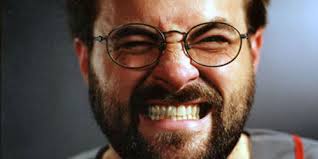
Few filmmakers tug at my heartstrings with their display of tenacity like this man does. One could riddle me biased, seeing as my heart tends to always go out to fellow passionate, creative and working class minimum wagers such as myself. Sometimes people make it seem easy - making films. Some come from families with deeper pockets and have significantly more resources at their fingertips. They attain an education and equipment with ease much like the flick of a wand. Smith had nothing but a pocketful of inspiration fueled by Richard Linklater and his film Slacker taking off from Sundance. (Smith was hoping the same would come of him and his film Clerks - spoiler alert... it did.)  Learning more about how this screenwriter, actor, film producer, speaker and director got his foot in the door was a refreshing bout of knowledge to ingest. In my opinion, he is the epitome of "all it takes to make films is the drive to make films."

So, how does a broke, inexperienced twenty four year old behind a convenient store counter manage to hash out a film that wins the highest award at Sundance Film Festival? With nothing more but a few screenplays locked away, Smith emerged from seemingly nowhere with his movie that was later picked up by Miramax! How?! 

By doing whatever he had to. 


He'd work his shift at the shop, and after closing up, it was immediately transformed into the set for his movie. For twenty one straight nights this director, producer as well as actor of this film clocked in at 6am, clocked out at 11pm and then shot until the wee hours of the morning and wrapped around 4am. (If any, Kevin would manage two hours sleep while shooting Clerks.) Nearly $30,000 was charged to various credit cards Kevin had fenangled throughout the years, adding up to the entire films budget. His shoestring allowance was displayed on black and white film due to various lighting types and shot on one location. His cast consisted of friends and even his mother to try and reduce cost of production. Since his boss would exclusively let Smith film off of business hours, explanation towards closed shutters were sprinkled into the plot. In the opening scene, the locked security gates are surpassed by the protagonist (Dante) hanging a sign that reads I ASSURE YOU, WE'RE OPEN due to them being "jammed by gum." Smith admitted himself the film appeared to be a total disaster when it was first showcased on a screen. 

The film was anything but as it made over $3 million at the box office. This obviously funneled funds for future film making into Smith's pocket. His goal was made, for the man said it himself, "We wanted to make Clerks as a showcase to say 'obviously we can make movies, can we get money to make more please?'" 

Jay and Silent Bob, the dynamic duo (played by Jason Mewes and Kevin Smith himself) that are featured in many of Kevin's films, didn't make their true splash in the audience until Clerks hit home video. Smith knew however, that Mewes made the character that was "Jay" long before. Unfortunately, the executives at Universal were against him filling the role for any future films and were set on finding a replacement. Smith put his foot down, maintained his creative backbone and eventually swayed the company into allowing the duo to stick together into Kevin's next film Mallrats, under a few conditions that is:

  • The studio refused to fly Mewes out to Minnesota for rehearsal or shooting unlike the rest of the cast and crew
  • He would be denied a hotel room on location
  • He would not be payed for the months worth of rehearsal, everyone else would
  • If after the first day, Mewes was deemed "unworthy," he would be canned and replaced with Seth Green.

Both Smith and Mewes assumed this was how actors and directors were treated in the big leagues. So Smith payed for his friend's plane ticket out of his own pocket, headed off to Minnesota, shared a hotel room with him and shot their second movie.

Soon after, Smith's decision to cast Mewes was rewarded by an article in Rolling Stone entitled "5 Minute Oscars" in which the author listed the best performances in movies that year by people with the least amount of screen time. Jay's character was mentioned and praised in great detail within the article, which transformed Universals hateful gazes towards Mewes into eyes chock full of dollar signs. The company took off to merchandizing the character. 

I feel it's obvious why Kevin Smith is one of the film makers that gives me hope, but if the adversity he overcame isn't enough, his mindset towards doing what he loves holds enough inspiration in itself. He mentions in an interview that through those twenty-two hour long days during Clerks he kept on telling himself "of course this will work" and said that if he had stopped to think of the possibility of no one liking his movie at Sundance that it "woulda killed it and I'd still be working at Quick Stop thinking "huh I wonder if I could've made a movie.'"