Showing posts with label communication. Show all posts

Wednesday, February 20, 2013

GESTALT of the image and the Mind

Marcel Duchamp, Fresh Window, 1920 (MoMa, NY)

In Leon Batista Alberti 's treatise De Pictura (1435), where he discusses for the first time in western literature the concept of optical perspective, he mentions, in relation to art that, "it is impossible to take anything away from it or add anything to it, without impairing the beauty of the whole."

Illustration for Book 2, p.15

More recently, the American poet William Carlos Williams, talks about what he calls action “pruned to a perfect economy”, and goes on:

" To make two bald statements: there is nothing sentimental about a machine, and: A poem is a small (or large) machine made of words. When I say there’s nothing sentimental about a poem I mean that there can be no part, as in any other machine, that is redundant. Prose may carry a load of ill-defined matter like a ship. But poetry is the machine which drives it, pruned to a perfect economy. As in all machines its movement is intrinsic, undulant, a physical more than a literary character. In a poem this movement is distinguished in each case by the character of the speech from which it arises."

I believe the same applies to the concept of design, which is, like Williams says, a well tuned machine, made of all the necessary elements but nothing more, since, by logic, anything not essential would be taking the place of what is. A place where form and function are interchangeable and indiscernible from each other.

Alberti said, in his famous visualization of painting as a window that the observer, from a fixed point of view looks 'outside'. The role of the artist/designer, is to establish the continuity between those two seemingly separate worlds, breaking so to speak, the metaphorical glass that stands between them.

Now, Alberti was not refering to the surface of the painting as a whole as the "window", but rather to the square, quadrangolo de retti angoli, that you draw as a boundary, limit or predetermination of the shape, size, proportion etc where the outside will be seen, like a hole punched in the very fabric of reality.

I only wanted to share these thoughts to make you think about that window, about the possibility to break it, once you know it is there. Is it possible to maintain the coherence or continuity without it? What happens in our media world where the view is fragmented or distributed around millions of tiny windows that together are more than the sum of their parts?


All images, except Duchamp's Window are from The Painting of Leone Battista Alberti facsimile that you can find at the Science, Engineering and Technology Linda Hall Library

Tuesday, October 30, 2012

Misinterpreting the Media

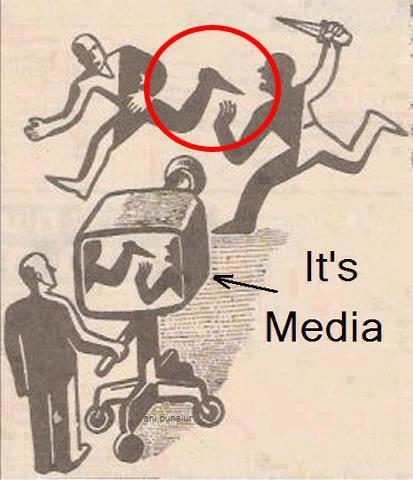
While surfing the web recently, I cam across this image.  Now, normally I don't find myself incredibly provoked by cartoons of this sort, but this was something entirely different; this picture actually said the thousand words to me that it's supposed to be worth.  In short, it asked me, "What are you doing about this?  Or are you doing anything at all?"

"It's Media"
I see this picture as representing what just about everyone within the media industry's been guilty of at some point: framing a shot just so, tweaking words in the proper way, only giving half the story.  As a means of communication between different areas of the world and society, this shouldn't be such a twisted message that we send; rather, we should be relaying an honest series of events and ideas, which has potential to make moves in turning the media into a perpetually reliable source.  Yes, the content is still truthful, more often than not, but it's displayed out of context.  For example, in the image here, the man seen running away in reality is caught in a shot that entirely switches his action, and does the same for his aggressor.  Because of the way the shot is framed, however, it can still be considered an honest representation of what's going on...just with a bit of the story missing.  It's like when a child is caught by his parents having done something wrong.  "Did you make this mess?" they ask him, and he replies "No, Johnny did."  What he neglects to mention is the fact that he aided Johnny in this action, and by doing so entirely changes the way that events proceed from that point.  Still, he hasn't told an outright lie; Johnny did do this, but not alone.

So, what am I doing about this kind of misinterpretation in the media, about this backhanded way of skewing ideas to make or break something else?  Sure, I'm in Park and learning all that I can to accurately work with the media, but how am I actually going to apply these skills to the real world to make a difference?  The fact of the matter is, I'm not going to do it alone, but that's what makes the media so wonderful opposite its negatives; everything connects, and there are infinite ways of getting this thought across.   It's a touchy situation, considering how quick people are to jump to arms over any slight infringement of rights, but with enough influence behind the movement, it has potential to make serious progress in the way of accurate media coverage.

Friday, September 7, 2012

capitilization And communication

there was a book i Read a Few years ago where the main character Hated the conformities of written language. she Said she felt Bad for the other letters In the sentence. now, aside From sounding mildly stupid as a principle on Her own, it make me Wonder about how capitilization Works in communication.

I'll stop that now, because it drives me insane. Call me a conformist or whatnot, but I like my capitilization. It did make me think though; what is the reason for it? How does it help our language to get our point across? And more importantly, how does that then transcend to other mediums in spoken word?

Aside from making it easy to see the start of a new sentence, capitilization can be used for emphasis. IF I WRITE IN ALL CAPITAL LETTERS YOU THINK I'M YELLING. if i type in all lowercase i have the perception of being meek. When this transcends to other spoken and visual forms, capitilization takes its form through the breaths and pauses and accents the actor places in the sentence. It takes form in the director's commentary whose goal is to tell a story in the best way possible.

In many ways I think that character is wrong. She doesn't quite no what the importance is of capitilization. As for the other letters in the sentence, I don't think they mind too much.

Friday, January 28, 2011

Finally figured out how to blog.

This is my first time using a blog as a resource so I'm still learning. My name is Ellis Williams as I'm sure some of you may very well know me and I'm excited to begin the course. I think what will set groups apart is the way we adhere to schedules and how much time we put into pre- production and then using that production and post production time accordingly. I think one thing we forget is how important pre- prod is because it is not highlighted in our courses till this semester but it is the structural foundation we should utilize before going into ANY assignment to achieve the desired shots/ angles/ expressions we want. I am settling for nothing short of great video and I think it will be fun to make great video. I would also like to voice small group communication and how we can be accountable as individuals and as a team. It is important that we use other venues other than facebook to communicate it is so detached and leaves the assignment to fall to deaf ears. A meeting time and a place to sit and generate ideas is crucial to our success as students and as team members for future endeavors. I bring this up because in the past group members do not contribute the same amount of work as others and I know that an even distribution of responsibility and accountability will have everyone rise to the occasion and not fall out of sync with the group because they are not feeling less involved in comparison to others. Let's not have our group members feel like their contributions are insignificant or that we as a group prioritize poorly leaving our assignments till the last minute to complete. Let's try to remedy all these past instances (because I know everyone has experienced it once before) and hold one another accountable for an assignment WE took on.

Just saying some of my grievances and optimism with my experiences with groups. I look forward to working with everyone.

Enjoy the Weekend,
Ellis

Tuesday, January 26, 2010

Collage


Sorry for the late post but here is my collage juxtaposing some of the ideas I am working with for the projects in the class. This is the same pic I showed in class of the work in progress, the collage is now finished but i haven't managed to get pics of it onto my computer yet. (when i get them on here I will swap out the pics).

Monday, January 18, 2010

The Art of Storytelling: “The truth never stands in the way of a good story.”

Storytelling itself is an ancient art. It’s a way we as humans communicate. It can help us understand/learn, see a different perspective, and give us pleasure amongst many other outcomes. Stories aren’t always truthful as was presented in this week’s reading on Explaining Magic from Tufte’s Visual Explanations. Tufte quotes Jan Harold Brunvand whom suggests “the truth never stands in the way of a good story.”

This idea in storytelling can also be exemplified in the stories young children tell. Children tend to have active imaginations where they invent stories, which they usually can’t wait to tell their parents and anyone else who would listen. At the same time as children are coming up with these fantastical stories they are often discouraged from telling lies and making up stories. Children learn quickly that lying and making up stories is highly frowned upon in our society. Imaginations are replaced by the reality of truths, which tends to not be as happy or exciting
The desire to embellish stories seems to make sense because reality tends to be unattractive while the prospect of an alternative reality can bring excitement. It should be obvious that storytelling does not require complete honesty. However, honesty is considered to be a virtue included in our daily lives. Some types of storytelling it is unethical to be untruthful. Although, some companies use misinformation in design to further their goals without regard to ethics (i.e. cigarette warnings). These fictions/lies/misinformation is driven by a desire to urge you to do or feel something.

According to McKee (2003), “Good storytelling displays the struggle between expectation and reality in all its nastiness. The great irony of existence is that what makes life worth living does not come from the rosy side. We would all rather be lotus eaters, but life does not allow it. The energy to live comes from the dark side. It comes from everything that makes us suffer. As we struggle against these negative powers, we’re forced to live more deeply.”

As a storyteller, you must flawlessly weave together a lot of information. The idea is to arouse the listener’s emotions and energy. The best kind of story is one that is compelling (McKee 2003). A little bit of truth is necessary to make a story believable while giving those experiencing the tale an opportunity to form meaningful connections. Thus, the best fictions will always have some sort of (underlying or universal) truth. This idea of some truth being in fiction is supported by American author, Stephen King, who said, “fiction is the truth inside the lie.”

Jung (1916, 1959) suggests that there are certain archetypal forces represented in the stories we tell influencing all humans. Woodside and Megehee (2010) created the below table of the different archetypes. (For a better )

In conclusion, the important take away is to remember we are all storytellers who have a choice and control in the way we tell our stories.

Wednesday, January 6, 2010

The broken window

Marcel Duchamp, Fresh Window, 1920 (MoMa, NY)

In Leon Batista Alberti 's treatise De Pictura (1435), where he discusses for the first time in western literature the concept of optical perspective, he mentions, in relation to art that, "it is impossible to take anything away from it or add anything to it, without impairing the beauty of the whole."

Illustration for Book 2, p.15

More recently, the American poet William Carlos Williams, talks about what he calls action “pruned to a perfect economy”, and goes on:

" To make two bald statements: there is nothing sentimental about a machine, and: A poem is a small (or large) machine made of words. When I say there’s nothing sentimental about a poem I mean that there can be no part, as in any other machine, that is redundant. Prose may carry a load of ill-defined matter like a ship. But poetry is the machine which drives it, pruned to a perfect economy. As in all machines its movement is intrinsic, undulant, a physical more than a literary character. In a poem this movement is distinguished in each case by the character of the speech from which it arises."

I believe the same applies to the concept of design, which is, like Williams says, a well tuned machine, made of all the necessary elements but nothing more, since, by logic, anything not essential would be taking the place of what is. A place where form and function are interchangeable and indiscernible from each other.

Alberti said, in his famous visualization of painting as a window that the observer, from a fixed point of view looks 'outside'. The role of the artist/designer, is to establish the continuity between those two seemingly separate worlds, breaking so to speak, the metaphorical glass that stands between them.

Now, Alberti was not refering to the surface of the painting as a whole as the "window", but rather to the square, quadrangolo de retti angoli, that you draw as a boundary, limit or predetermination of the shape, size, proportion etc where the outside will be seen, like a hole punched in the very fabric of reality.

I only wanted to share these thoughts to make you think about that window, about the possibility to break it, once you know it is there. Is it possible to maintain the coherence or continuity without it? What happens in our media world where the view is fragmented or distributed around millions of tiny windows that together are more than the sum of their parts?


All images, except Duchamp's Window are from The Painting of Leone Battista Alberti facsimile that you can find at the Science, Engineering and Technology Linda Hall Library

Saturday, September 12, 2009

Verbiage versus Wisdom

After reading Roy Ascott's article "Planetary Technoetics: Art, Technology and Consciousness," I found several points to agree with. I agree that, in order to survive as a species, we will need to move toward an expanded sense of connectedness with the other inhabitants of the earth. I also agree that artists can facilitate this process, as can technology. And, yes, the wisdom of indigenous cultures has largely been ignored, especially by Science.

However reasonable these points sound, Ascott conflates them with conjecture, such as when he seems to assume that the "Mixed Reality" of indigenous cultures are all based on plant-based drugs. He also sites Narby's hypothesis that the visions of shamans are from their ability to communicate with their own DNA, because we don't yet know what that annoying 97% is for. This is presented with reference to DNA's photon emission as a possible origin of shamanic imagery, which is so much easier to explain this way than something science has no real grasp of.

Perhaps the most dangerous idea presented here is the merging of biological organisms and technology. In my view, scientists should not be the ones deciding what they think they can control. I don't believe any of us are bright enough for that kind of power. If I have to choose, though, give me the shamans any day, preferably female.

Tuesday, April 1, 2008

Random Thoughts

Warning: This is more of a rambling of thoughts that I've had, and yes some things relate to SL, others not so much..

So, I sit here, on my computer with the understanding that we have about a month left this semester. And I thought about how when I first came into this class how excited I was. How I wanted to be in here, 1) Because people I knew just raved about SL and I had yet to be given an excuse to download it 2) I have had various expierences with virtual worlds, and was very interested in what made this one different. I came in to this class, not only wanting to widen my horizons, meet people from various degree backgrounds, but also have the ability to express myself.
And unfortunately I found myself in a very difficult place. Now understand, I still classify myself as being a young individual. And I think most would agree. I look around the room, and most of the people I sit with are not freshman in college. Even though people here are considered my peers, I do not feel like I am their peer intellectually. And many times this has stopped me from commenting in the class during discussion, and many times from posting or commenting on the blog as well.
And I regret that. I regret not taking the opportunity to step up and converse with those around me.

After such thoughts, I actually began to think about my interaction within SL. In terms of interacting with those that I might see in class, well, it seems as if I tried to avoid such things. As to other places in SL, I find it easy to start up a conversation with random people I meet, and I seem to have no problem with leading a conversation. And in real life, in any circumstance but our classroom, I seem to have no problems doing either of these things!
It just seems as for sharing, talking, and communicating within the class and on the blog, well I think feeling meek and shy may be an understatement.

And maybe all this has something to do with not really knowing as much as those around me. Or at least me feeling as if I don't know as much. Or maybe that sometimes I think that I really don't have much to say that would add value to the conversation.

I check the blog on a regular basis, and I think well, it would be nice just to post, post about thoughts, random as they be, some dealing with SL, others about news in technology and the world.

Hmmm. Well. I think that is enough rambling for now.
Hopefully later I'll get to post my machinama!!