Showing posts with label Seaworld. Show all posts

Thursday, April 2, 2015

Blackfish

Sticking with the theme from two posts ago, I returned this week to the documentary section of Netflix.
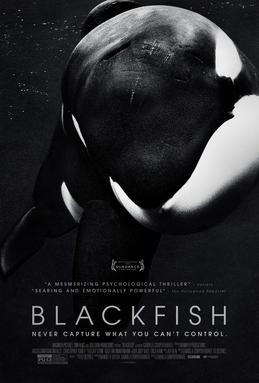
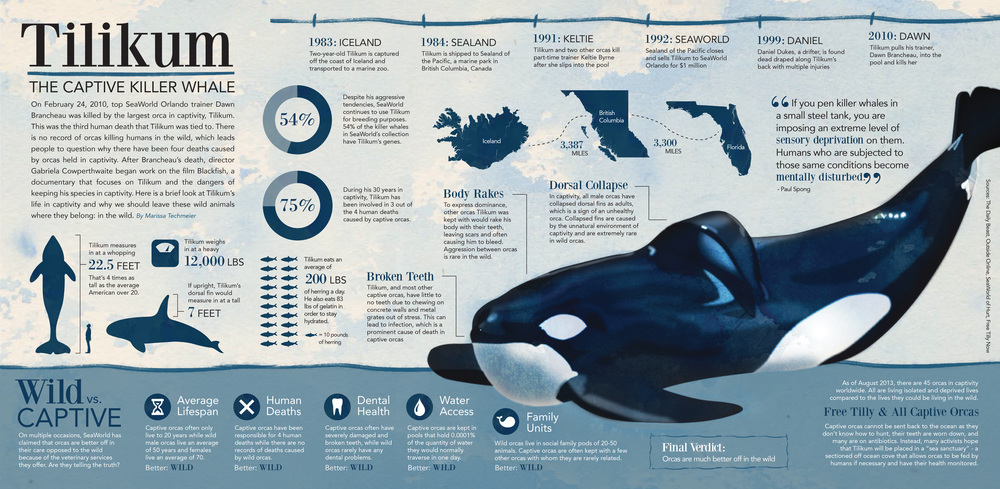
A friend of mine recommended I watch a 2013 documentary titled Blackfish. Blackfish tells the story of a killer whale named Tilikum, who is known for being the largest killer whale ever kept in captivity. This documentary follows Tilikum from when he was first captured in waters near Iceland in the early 1980’s through his days as a performance whale at SeaWorld. Tilikum’s story is unique because it showcases the need for SeaWorld and similar animal performance parks to stop keeping animals in captivity. Tilikum is known for being the orca that has caused the death of 3 different trainers through his time as a show whale. This aggression is a direct result of the way that he lives; killer whales are generally not very violent at all in open water. In captivity, however, orca violence increases dramatically. There has actually never been a documented death of a human by a killer whale in the wild, while Tilikum alone has been the cause of three deaths in captivity. 

Blackfish tells Tilikum’s story in a strong and passionate way. Viewers feel a connection to Tilikum and feel bad for him for everything he has to go through. This is especially true as viewers watch the physical changes in Tilikum; he goes from being a strong, active orca to having a floppy dorsal fin and being almost completely active. SeaWorld has reported that it is not uncommon for Tilikum to go three hours at a time without swimming around at all - he just sits in his much too small tank, motionless.
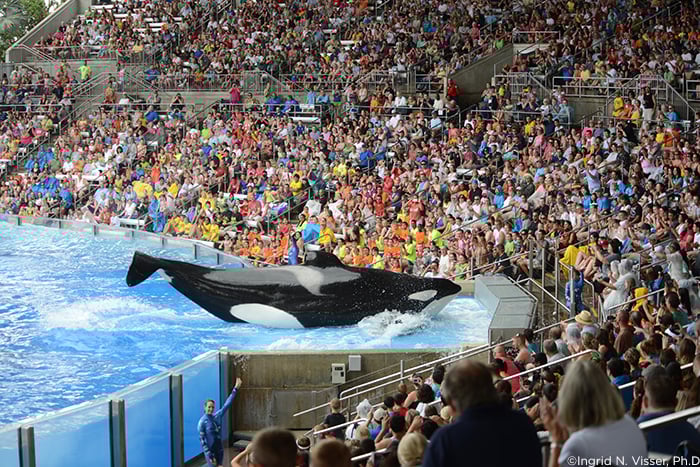

This documentary has received very positive reviews from all places, and rightly so. This is a very touching and inspiring film, and it completely changes the way that people view orcas in captivity. They go from being the “friendly Shamu” to the poor, tortured orca who will die, on average, 20 years too young. This powerful film has had a very positive impact, and I am very glad that I watched it and could learn more about the life of animals in captivity. 
Friday, October 3, 2014

"Blackfish" and the impact of Documentary Film

So I bet a lot of you guys already saw this film when it came out last year, but I'm a little late to the party so I'm gonna talk about it now!


For those of you who haven't seen Blackfish here is the trailer, so you can have an idea of what it is about and what kind of film it is:


To begin with this is an extremely interesting film in terms of subject matter. I am not a documentary film student, but I have always been impressed by the medium's ability to draw public attention to issues that many people don't know much about or didn't even know existed. When it came to this film, I was in the latter category. 

I had never really given SeaWorld much thought, which is surprising honestly because I'm not a big fan of circus for the same reasons this film argues we shouldn't be fans of SeaWorld. This film does an extraordinary yet haunting job of displaying why wild animals, Orca's in particular, are not meant to meant to perform for human entertainment.

This film is extremely disturbing, but also moving and eye opening. I have never been to SeaWorld but after watching this film I can guarantee you that I never will. But clearly, I am not the only person to feel this way after seeing this film. 

21 Million people watched the film when it premiered on CNN, and the consequences have not been kind to SeaWorld. Since it's release there as been extremely vocal backlash against SeaWorld. SeaWorld attendance and revenue has dropped significantly in the last year. Also since the films releases, the companies shares have also dropped 22%, and then after the companies announcement of low quarter earnings fell 33% on August 13, 2014 alone.

Critics say SeaWorld is going to have to respond to the demand for change soon, if they want to survive. However, the SeaWorld website still have an entire page devoted to tearing down the documentary and claiming it's all lies. (Which is extremely unsurprising)

In an article for CNN the director, Gabriela Cowperthwaite, stated that she never meant to turn people against SeaWorld, "I hope you like the film. I don't know if it will change the way you feel about animals in entertainment parks. I didn't intend for it to do so. I just wanted to tell the real story. And I trust that once audiences are armed with the truth, they will make the best decisions by themselves and their families."

If you ask me, I'm glad this issue is getting so much media attention. It has sparked an important ethical debate that may have otherwise gone unaddressed. It just goes to show the power of documentary filmmaking.

Wednesday, December 4, 2013

Morality's Place in Hollywood

If you had to ask me, at least a few hours ago, I would've said that there wasn't one. That morality and Hollywood were simply incompatible, that both could not exist at the same time. It seemed to me that Hollywood was run by a number of Gordon Gekko's and that "Greed is good". Sure, there are good, honest people trying to do good, honest things, but let's be honest, money is the name of the game.

That being said, the moral high ground IS in fact taken quite often, but less out of voluntary action and more the cause of the driving forces of impending blows to profit and "political correctness". Offend as few people as possible and reap as much profit as you can. I hate to sound cynical, because I certainly don't consider my self to be so, but I feel that this blasé effort to do some good within the medium, which undoubtedly has the ability to help an influence people exponentially, to be frustrating. A little proactivity with the old moral compass goes a long way. 


That's why I was so happy when I heard that Disney and Pixar had made alterations to the ending the upcoming animated film "Finding Dory" after some of the creators watched a documentary called "Blackfish". "Blackfish" is a documentary that addresses the dangers of keeping animals, specifically whales, in captivity in places such as the Sea World aquatic park. The folks at Disney were apparently so moved by what the saw, that they decided to rework the ending of the script, which in fact had the main characters of the film at a SeaWorld type place. Of the change, the people at Pixar stated that they didn't want to look back fifty years from now and see that this film had become something of a "Song of the South". 


If you haven't really heard of  "Song of the South", there's probably a good reason, as Disney doesn't exactly broadcast its existence. That's because today, the 1946 Disney musical is largely considered to be somewhat racist. But I digress. 

Now, that comment about Pixar not wanting it to be a "Song of the South" does suggest that Pixar has their best interests in mind. But here's what separates this instance from others: there was no public outcry, no online petitions, no focus groups. Heck, the script wasn't even released to the public. All this was was a few people who saw a documentary and felt so compelled to do some good. 


Now, I have no idea whether "Blackfish is wrong or right. There are arguments from both camps, with SeaWorld even releasing a public statement on the matter:


"Blackfish is billed as a documentary, but instead of a fair and balanced treatment of a complex subject, the film is inaccurate and misleading and, regrettably, exploits a tragedy that remains a source of deep pain for Dawn Brancheau's family, friends and colleagues. To promote its bias that killer whales should not be maintained in a zoological setting, the film paints a distorted picture that withholds from viewers key facts about SeaWorld – among them, that SeaWorld is one of the world's most respected zoological institutions, that SeaWorld rescues, rehabilitates and returns to the wild hundreds of wild animals every year, and that SeaWorld commits millions of dollars annually to conservation and scientific research. Perhaps most important, the film fails to mention SeaWorld's commitment to the safety of its team members and guests and to the care and welfare of its animals, as demonstrated by the company's continual refinement and improvement to its killer whale facilities, equipment and procedures both before and after the death of Dawn Brancheau."

But here's the kicker, I honestly don't care who's wrong or right. I feel that Pixar's heart was in the right place in this conscious, unforced decision to do what the people behind the film thought was right. That's enough for me.