Showing posts with label Paul Dano. Show all posts

Friday, January 31, 2014

Little Miss Sunshine: Beyond Words (SPOILERS)

I’d like to preface this writing by saying that Little Miss Sunshine is one of my favorite movies. All the way from the writing, to the filming, to the performances, there is an extreme level of care and of course, the inevitable family drama that I love to watch and write about. If you haven’t seen the movie, STOP READING. It is really great, and I recommend watching it before you read this post because I am going to be talking about one of my favorite scenes in the movie that gives a major plot point away.

At this point I’m assuming that those of you still reading have seen the movie so I won’t go into great detail explaining what it’s about. So the particular scene that I am referring to is when Dwayne freaks out because he finds out he is colorblind. I find this scene brilliant for multiple reasons.
The beginning of the scene sets the stage perfectly. Dwayne, who has taken a vow of silence until he is allowed to enlist as a Navy pilot, is in the back of the yellow van, as his sister Olive amuses herself by giving him an eye exam with a hospital pamphlet. Next to Olive is her Uncle Frank, and in the front are both parents. The scene starts out quiet normally, and there is no evidence of any topic of conversation being very important. After Olive tests Dwayne’s vision, she moves on to a colorblindness test that Dwayne takes to appease her. She asks him what color the letter is inside the bubble on the sheet, and Dwayne responds on his little notepad asking what she is talking about. This is where the greatness of this scene starts to explode.
            Frank, upon realizing what is happening decides to chime in. He tells Dwayne that because he can’t see the letter, this means he is colorblind and that people with colorblindness cannot fly jets. There is a beat and then Dwayne’s fuse is lit. He becomes like a Mentos trapped in a soda bottle and begins to throw himself against the side of the van violently. Frank starts yelling for Richard to pull over and both he and Olive begins to get upset because she has no idea what has just happened. When Richard finally pulls off the highway, Dwayne bursts out of the car and runs down the side of the grassy hill. At the bottom, he falls onto his knees and screams his first words in 9 months “F*******ck!”
            That one word may be one of my favorite lines in a movie just because of how honest it is. In that one line, the audience is able to hear and feel the anguish and heartbreak that Dwayne is feeling. Not to mention that way he performs this scene is so real.
            Within a few moments of screaming, Sheryl tells Dwayne that she knows he is upset, but they have to go if they are going to make it to the pageant. This causes Dwayne to go on a rampage about how much he hates his family and how screwed up they are. After his rant, there is silence. Olive then makes a gesture by walking down the hill and simply hugging him. The way she does this is so innocent and purely kind. After a moment, without a word, Dwayne gets up in resolve. He picks Olive up and carries her up the hill, and the family gets back in the car and on their way.

            This scene is a true testament of good cinematic writing and great acting. I would recommend it to anyone (especially if you are like me and enjoy hilarious movies about dysfunctional families).

Wednesday, December 4, 2013

12 Years a Slave and White Guilt in 2013

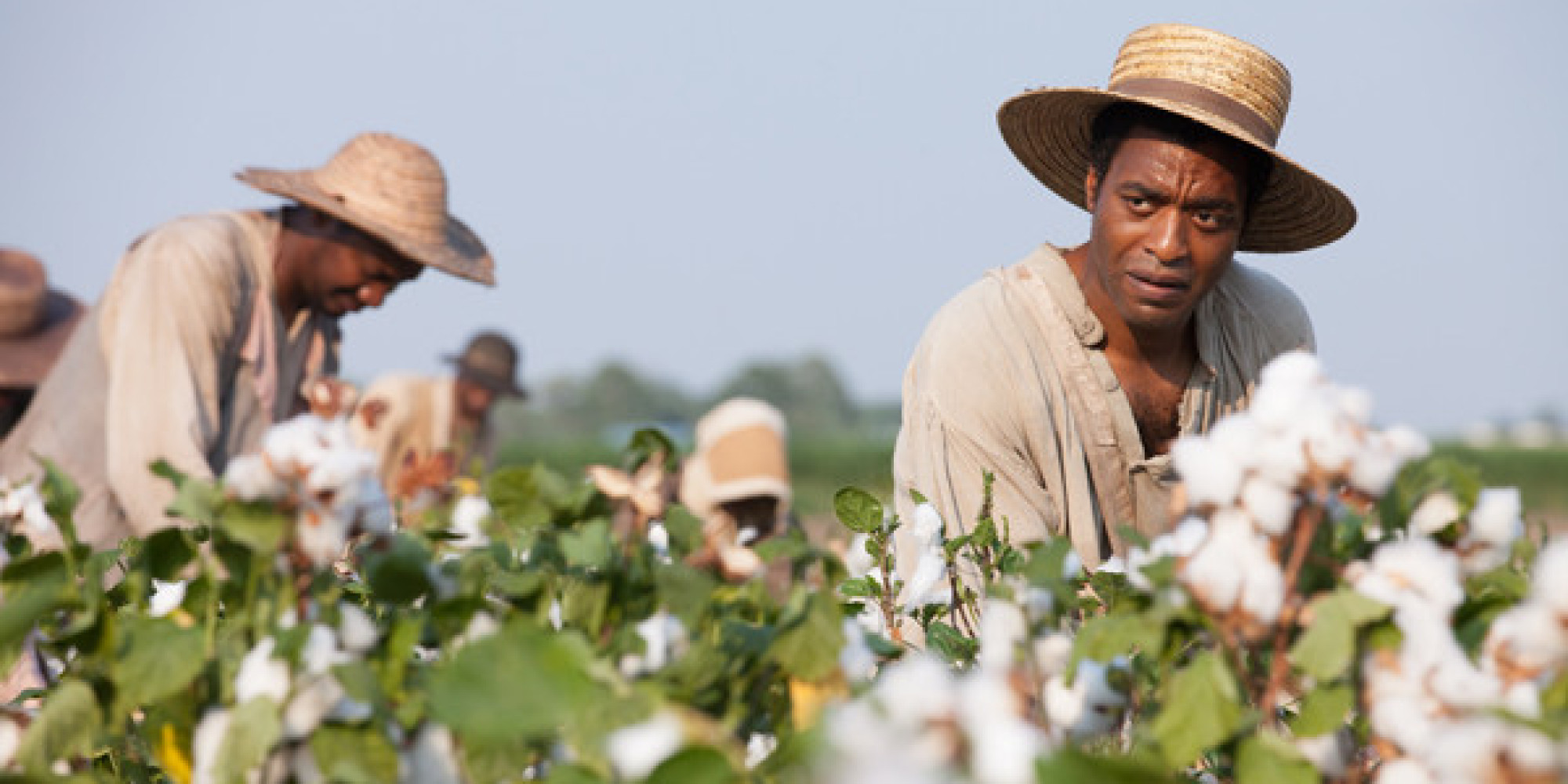
When the credits began to roll at the end of 12 Years a Slave, nobody in the theatre made any sort of move to leave. There was no popcorn crunching, no soda slurping, just dead silence. In part, this was because it was a fantastic movie - probably the best of the year - but it was also because, as an almost exclusively white audience, nobody was quite sure how they should feel. 

12 Years a Slave, which is only the third film by director Steve McQueen, is based on the true story of Solomon Northup, a free black man living in New York who was captured in 1841 and sold into slavery. The film follows Solomon (the incredible Chiwetel Ejiofor, who will almost certainly be nominated for best actor this year) as he gets moved around from slave owner to slave owner, trying to stay alive and somehow return home to his wife and children. As I mentioned, it’s a spectacular movie - the acting, the directing, and the cinematography are some of the best I’ve ever seen - and yet I can’t think of film in recent memory that has had so much Oscar buzz while simultaneously being something that people are almost afraid to talk about. 

So, to clear the air, I’d like to talk about 12 Years a Slave. 

Racism is an incredibly daunting thing for me to write about, and the more I look up at the title that I’ve given this piece, the more I have to wonder if it’s something I have any right talking about at all. As a middle class white guy from Vermont, I have almost no first hand experience with the topic apart from what I’ve obtained over the years through different kinds of media. My parents are not racist in the slightest, and I was raised to constantly be disgusted that people could judge others based solely on the color of their skin. Just because I’ve read Invisible Man and The Autobiography of Malcolm X doesn’t mean that I claim to have any real connection to or knowledge of black culture. Who am I to judge a brutally honest film about slavery?

I’ve done a little bit of research ever since I watched 12 Years a Slave, and I’ve found lots of articles that both praise and criticize the film; many, understandably, written by black critics. Some, like Orville Lloyd Douglas’s, make fine points about why Hollywood should make more “black” movies that focus on more than just the topic of race and that don’t try to make white people feel guilty. I understand where he’s coming from; with 12 Years and The Butler hitting theaters around the same time, it feels like someone’s really trying to make a point. However, other people, such as Wesley Morris, argue not only for the artistic merits of the piece as a film, but for how McQueen pulls no punches in the portrayal of white people; this is a film about slavery where the slaves stand alone; there are no white men pushed into the foreground, no Lincolns or Christoph Waltzes, to save the day for them. I agree with this aspect as well. 

But I still believe many people are missing the point. When I’m asked how the movie was, I typically respond “it was incredible, but there was an unbelievable amount of white guilt in that movie theatre.” Someone on YouTube even took the time to create a series of parody videos on that very topic. But this shouldn’t be anybody’s response. I’m fully aware that race is still a very prominent issue in our country in 2013, but there is no reason any person - white, black, hispanic, asian, or anywhere in between - should feel guilty when watching this film. By all means, we can be disgusted at how Solomon is treated by white people throughout the course of the movie; we should be. But taking that guilt - the guilt that slaveowners should have felt over 160 years ago - and applying that to ourselves today is wrong. 

I’m convinced that 12 Years a Slave defies all boundaries of a normal Hollywood film in a few different ways. There’s no real target audience: while the art house crowd might eat it up, no matter who you are, this film is for you. It’s a film that spends a painfully long time lingering on the botched hanging of Solomon, with the man, front and center, desperately trying to gain some traction with his toes in the mud pile beneath him. It’s a film that takes its time, utilizing really long takes and interspersing certain segments with shots of nature. It’s certainly not your standard Oscar-bait film. It is not a “black” film, and it’s not a “white” film. It’s not even a wholly American film (both McQueen and Ejiofor are British). More than anything, it’s a human film. 


Perhaps that’s what some people are missing, and what gives me the right to talk about racism and 12 Years. It is truly impossible for any white person to know what it’s like to be black and vice versa, but that doesn’t diminish the fact that this is a powerful film that affects each individual that sees it. Disagree with me if you want, tell me that the filmmakers are playing to my innate sense of white guilt and I’m not qualified to talk about this, but you’d be wrong. When you see Solomon come home after 12 years to find that his family is barely recognizable, and you see that no amount of happiness can fix the years of hell that he was forced to endure, you don’t have to have any necessary qualifications, apart from one. You just have to be human.