Showing posts with label optical illusion. Show all posts

Thursday, November 12, 2015

Red Bull's Latest Video & Forced Perspective

Red Bull just released a new BMX video, and it plays heavily with forced perspective to add an interesting element for all viewers, BMX fans or not.

Wikipedia defines forced perspective as: A technique that employs optical illusion to make an object appear farther away, closer, larger or smaller than it actually is. It is used primarily in photography, filmmaking, and architecture.

Here's a picture for example:


and here's a video Arturo showed me a few years ago really highlighting forced perspective.


So after seeing some other examples of forced perspective, here's the BMX video:


Friday, April 5, 2013

Color Correction and "Memory Colors"

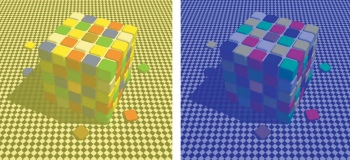
Your brain is lying to you.  On the left, the top blue tiles are the  exact same color as the top yellow tiles on the right.  Throw this into Photoshop if you don't believe me.  It's trippy.  Source

Since we discussed color correction in class on Wednesday, it brought to mind this article by Stu Maschwitz over at prolost.com.  It's been around for a few years now, but if you haven't read it before, I would encourage you to take a look.  It is a very good look at color correction and color grading, and how the two interact to create beautiful films.  It also dives into some of the details of why being a colorist is so hard.

The main point that Stu brings up is the idea of "memory colors".  What are memory colors?  I'm glad you asked.  To quote:
 Memory colors are colors that are, in the minds of your audience, inseparable from certain common objects or events. For example, the sky is so associated with blue that you might feel that you see those two words together as often as you see them individually. The same goes for green and grass.
The article goes on to explain how to use those memory colors.  Usually, they are so ingrained in our brains that  even if they are not accurate, our brain compensates.  But they look even better when they are actually accurate, which is where color correction comes in.  It is the colorist's job to make sure that any memory colors are faithfully reproduced, both in the color correction process, and in the color grading process.  Even if there needs to be a distinct color "look" in order to set a certain mood or tone, the memory colors need to remain accurate.  Check out the article for more detail, and lots of good examples from various films.  Actually, just check out his entire site.  He's got lots of other good posts on color correction, as well as camera reviews, filmmaking tips, and general all around interesting stuff.

Source: Prolost.com

Thursday, December 13, 2012

Video Mapping


While I was picking my classes for next semester, I stumbled upon a course called “Experimental video”. I talked to the professor more in depth about it and learned about all different types of filmmaking we’d learn in the course. This sparked my interest almost immediately when she mentioned one type of example, video mapping.

Video mapping is a projection technique that that display an image on any type of surface. For example this past summer while I was in Atlantic City, a building I was walking by looked like the bricks were falling off. There was a huge crowd watching and we quickly realized this image was being projected from somewhere.The images matched the building perfectly so it looked pretty legit. There were also random shapes of all colors on it dancing around to a beat. It was something I’ve never seen before. 

These projections can create fields of depth and optical illusions all matched with music. The possibilities are endless and it’s definitely a very cool and innovative entertainment technique. This is now starting to show in everyday places like Time square and other advertisements in big cities. Next time you’re out, try to see if you can find one.

Tuesday, February 9, 2010

Anamorphosis


István Orosz Anamorphic Column with Mirror

to see the anamorphic skull embedded in this painting click on it to enlarge it and then view the image from an extreme low angle from the left corner

This type of painting know as Anamorphosis (from the Greek "Formed Again") comes from a long tradition going back to the early Renaissance (15th Century) and even earlier, since the technique was actually invented in China before migrating to Italy. There are many famous examples, from Leonardo to Hans Holbein the Younger, from Andrea Pozzo to Marcel Duchamp and Salvador Dali, on to some of the street painters shown in the previous and this post.

This technique is also widely used in film to record a compressed image in a small frame (35mm for example) and expand

Here are some examples by Kurt Wenner and Julian Beever, contemporary masters of street art.