Showing posts with label community. Show all posts

Tuesday, September 30, 2014

Joseph Campbell and the Hero's Journey

When I started trying to write my first blog post for this class, the first topic that popped into my head was the way Dan Harmon, creator of Community and Rick and Morty and one of my favorite creative talents, structures the stories he writes. Harmon, whether he's writing a half-hour episode of a sitcom, a feature film, or a three-minute comedy sketch, utilizes "story circles," which he says allow him to tie narrative and character development directly together. Unfortunately, as I searched for visual aid to illustrate my blog post, I discovered that a past CP2 student had already covered the topic (Kyle Vorbach's excellent post can be found here: http://filmword.blogspot.com/2013/02/dan-harmons-story-circles.html). I decided to delve into the origin of Harmon's story circles, which can easily be traced back to the writings of Joseph Campbell and his theory of the monomyth.

Joseph Campbell was an American author and educator who specialized in examining mythology and religion for similarities across cultures. His life's work as an author came together in the form of his most lasting theory, that of a monomyth. In The Hero with a Thousand Faces (1949), Campbell argued that the structure of the hero's journey remained consistent throughout cultures, with only surface changes made to create the heroes that define a culture's mythology. Campbell was heavily influenced by Carl Jung, one of the most prominent psychologists of the 20th century, who developed a theory of collective unconsciousness. Jung's assertion that all of humankind shares certain archetypes heavily influenced Campbell's analysis of both mythological stories and more modern pieces of fiction. Harmon's story circles draw their cyclical structure and many of the narrative steps from Campbell's theory of the Hero's Journey:


Campbell's structure, however, goes into more detail than Harmon's. However, it should be noted that Harmon often cites steps such as the Crossing of the Threshold when talking about his writing. Campbell's basic steps on the Hero's Journey are as follows, broken roughly into three-act structure:

1. The Ordinary World
2. The Call to Adventure
3. Refusal of the Call
4. Meeting with the Mentor
5. Crossing of the Threshold 
End of Act 1

6. Tests, Allies, and Enemies
7. Approach
8. The Ordeal
9. The Reward
End of Act 2
10. The Road Back
11. The Resurrection
12. Return with the Reward
End of Act 3

The division by act structure can be debated, and different sources often re-name the specific steps, but the basic structure of the Hero's Journey stays constant over much of fiction, regardless of genre or artistic medium. Campbell's theory originally was formulated as a way to discuss mythological texts like The Odyssey and Gilgamesh, but has come to influence some of the most prominent novels and films of the 21st century. Want an example?

George Lucas and Mark Hamill on the set of Star Wars

George Lucas was one of the first filmmakers to take Campbell's theory and develop a feature film around it. It was Campbell's The Hero with a Thousand Faces that helped Lucas flesh out his basic ideas for his first big-budget film. Star Wars and the entire original trilogy owe their structure and storytelling beats to Joseph Campbell. Dan Harmon has since taken the same basic structure and applied it to over 90 episodes of Community, in addition to using the structure for projects such as Rick and Morty and Monster House. Studying Campbell's monomyth can help young storytellers master the basics of character development, pacing, and plot structure, regardless of medium.


My source for Campbell's steps was this website: http://www.thewritersjourney.com/hero's_journey.htm . If you're interested in Dan Harmon's story circles and would like to know more, I'd recommend checking out his tutorials on the Channel 101 wiki: http://channel101.wikia.com/wiki/Story_Structure_101:_Super_Basic_Shit.

Friday, August 29, 2014

The Great Gambino

Okay so maybe I'm not talking about THE Great Gambino but I do want to talk about a man some may know as Childish Gambino (a stage moniker) and others may know as Donald Glover. The man can do anything he wants.

He's a rapper:
(Bonfire music video, directed by Derrick Comedy alumn Dan Eckman)
With two certified gold singles (Heartbeat and 3005) Glover raps under the name Childish Gambino.


A writer:
(30 Rock)
After working on Derrick Comedy, he gained attention, and became a writer with occasional cameos on Tina Fey's hit show, 30 Rock. He later left the show to pursue his acting career.

An actor:
(Community)
“Usually, when writers tell you they want to pursue performing, you want to tell them to keep their day jobs. But with Donald, I had to agree that his talent, youth and handsomeness were not to be wasted sitting on my living room floor.”  - Tina Fey

And a comedian:
(From his standup, Weirdo)
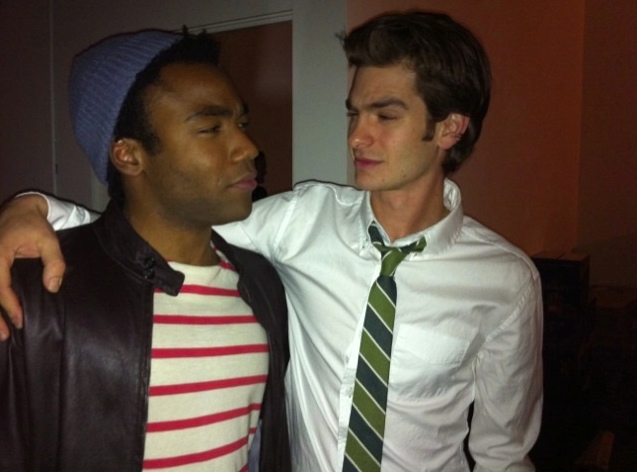
This clip explains the internet campaign that began with one fan suggesting on an online message board that Donald would make a good spiderman. This seemingly harmless opinion led to an internet sensation revolving around arguments of the race of spiderman and ended with Andrew Garfield getting the role. Don't worry though, they worked it out.

(Picture tweeted by Glover with the message, "Talked it out")

This story does have a happy ending. Writer, Brian Bendis, released a comic about a year later with a black spiderman, saying he had the idea before the whole "Donald for Spiderman" debacle, but that it did influence his choices for the character.

Now that character, known as Miles Morales, is appearing on Ultimate Spiderman, a Disney Channel cartoon adaptation of the Marvel comics. Miles Morales is a half black, half latino prepubescent who takes over for Peter Parker, and IS TO BE VOICED BY DONALD GLOVER.


And as a bonus heres a Derrick Comedy sketch about film school and a crazy ex-boyfriend played by Donald Glover:

As a second bonus here is Tina Fey rapping on Childish Gambino's album Royalty:


Thursday, April 4, 2013

Picking up a fan-favorite

This week I've started to watch a fan-cultivated show Community.  The NBC sitcom centers around an eccentric Spanish study group at a community college.  The show was created by writer Dan Harmon and premiered in 2009. The show focuses on comedian Joel McHale and his fellow group of actors getting into crazy situations, and often referencing and parodying pop culture.  I'm now on the 6th episode and enjoying it quite thoroughly.  Despite it's critical acclaims and cult following, the show is not very popular among viewership.  Ratings have been above 4 million viewers but did not reach much more than that.  This has caused much controversy over the show, since NBC would not proclaim the show a success, however it has a very big core fan-base that really enjoy the show. Season 4 which was scheduled to premiere in October was delayed to premiere in February and Dan Harmon stepped down as show-runner.  


I am enjoying the supporting characters more than I enjoy the main 2 characters.  Joel McHale (Jeff) who host's The Soup on E! is a hilarious comedian and I really enjoy him, but his character is not very likable, and he's sneaky and kind of mean.  His leading lady Gillian Jacobs (Britta) I do not find very likable either.  I find her snarky and annoying, and find it hard to connect with her.  Hopefully as the show goes on, these characters will grow on me.  The supporting characters are all wonderfully developed.  Of course Chevy Chase is a comic classic and can't do wrong, Danny Pudi and Donal Glover are remarkable, and Yvette Nicole Brown is hysterical.  My personal favorite is Alison Brie of Mad Men.  I find her character refreshing and love seeing her span of talents from a show such as Mad Men to a comedy like this one.


Their show is filmed in a single-camera format, and was even picked up into syndication in 2013 by Comedy Central.  It's been noted that some of the actors like to improvise lines while on set.  Chevy Chase has been particularly noted to improvise and Joel McHale and Donald Glover are known to like to come up with their lines as well.

What I really enjoy about this show is that it is based off of creator Dan Harmons actual life.  This is just like my ICTV show I created that is based off of my own life.  I was always told to "write what you know" so I was very pleased to see that other people follow that rule as well.  I'm sure it was a lot of fun to produce a national television show based off of your life.  I will continue to watch the show and maybe they will convert me to becoming a cult follower.


Tuesday, February 26, 2013

Dan Harmon's Story Circles

As a scriptwriting minor and hopefully, a future television writer, I have spent a lot of time trying to find the best (and easiest) way to structure a story. The typical three-act structure was not cutting it for me, as it left too much to interpret; dividing an episode of television up into three identifiable parts was difficult and messy, especially with the commercial breaks.

As a scriptwriting minor with a serious affection for NBC's Community, though, I have found the structure that I was seeking through the work of the show's creator, Dan Harmon. Since the 90's, he has perpetuated the idea of the "Story Circle", as seen below.


These story structure circles dictate not only the ebb and flow of the episode, but the state and development of the characters within it. It is a quick, surefire formula for creating compelling and fun stories. This isn't just the ramblings of some comedian; it is based directly off of Joseph Campbells monomyth, or the Hero's Journey. The protagonist ventures out into the unknown, and then returns, having changed. Here are the steps elaborated further:

1. A character is in a zone of comfort,
2. But they want something.
3. They enter an unfamiliar situation,
4. Adapt to it,
5. Get what they wanted,
6. Pay a heavy price for it,
7. Then return to their familiar situation,
8. Having changed.
As you can see, the Story Circle does not vary from the three act structure, but instead expands and develops it. Watch an episode of Community. I would wager that in 75% of the episodes (or maybe more), all seven of the main characters go through this circle, whether in an elaborate way or not.

I just recently used this very same circle to write the script for my film for this class, called $perm Bank. I loved how the formula emphasized character change and tied the plot directly into character growth (shouldn't that always be the case?)

Dan Harmon released a series of six well-written tutorials to teach his formula, the first of which can be found here. He also graciously includes a sixth tutorial which explains the use of this character-changing formula within the realm of television, a venue which is notoriously stagnant in that regard.

Friday, February 8, 2013

Season 4, more like Season SNORE! AYOO!


When I am asked what my favorite TV show is, I, with a stroke of pride, reply "Community". Well, until tonight that is. Now, I am preemptively appending that response to "Community Seasons 1-3".

I do not envy the position that the Community writers faced entering this season. With cult-worshipped and studio-hated showrunner Dan Harmon gone, those in charge of the show were left with the predicament of satisfying the studio's demands while also emulating the unique voice of the show's creator.

The first episode without Harmon was funny, don't get me wrong. But it was missing something.

To be honest, it felt like the show was tied up to a chair, and the writers kept beating it to death with rulers while yelling "CHARACTER DEVELOPMENT! MAKE IT META! THESE ARE THINGS PEOPLE LIKE!". In short, characters became caricatures, as did the show.

Community worked for three amazing seasons building up these complex, funny, multi-faceted characters, the shining example being Abed, a fan favorite. This first episode turned his entire personality and made it a meta gimmick (a decision that old Abed would have look down upon as well).

The first three seasons of Community taught me something as a writer. Character development doesn't equal change; sometimes it is about how characters don't change. In Season 3's "Virtual System Analysis", Annie spends an entire episode exploring Abed's mind in a very literal way. At the end of the episode, we are left with a better understanding of Abed, and the knowledge that he understands himself better as well (he never uses empathy). This helps explain his actions throughout the rest of the series.

In this first episode of Season 4, we also journey into Abed's mind. He is upset about everybody leaving Greendale (a conflict introduced this episode) and learns that everybody will grow up eventually (a resolution reached in the same episode).

It is hard to pinpoint exactly what the problem I had with the episode was, but I imagine it resonates with "change". Abed's drastic change in character over the episode more or less represented the drastic change the show has undergone.

Before I found myself wishing for "Six Seasons and a Movie!". Now I found myself begging for "Three Seasons and Nothing Else".

Wednesday, October 10, 2012

NBC and Chuck

I know a lot of you probably enjoy NBC comedies. The Office, Parks and Recreation, and Community always seem to be mentioned when you ask a college kid what their favorite shows are. And while NBC as a network may have some issues (just ask Jack Powers about NBC if you ever get the chance) their comedies are almost always seriously underrated.

One of my favorite NBC comedies though, is Chuck.

Chuck is about a computer geek named Chuck, who accidentally downloads a bunch of CIA secrets into his brain. In order to protect him from various bad guys and criminals who don't want their identities compromised, the NSA and CIA send two of their own agents, Sara and John, to protect Chuck.

While it sounds like just another Get Smart spy-comedy, it really is a great show. Zachary Levi has excellent comedic timing, and all the characters, true to the NBC comedy way are diverse and amusing, especially Chuck's best friend, Morgan, and his sister and brother-in-law (nicknamed Captain Awesome) are equally amusing.

Despite being such a great and well-made comedy, Chuck was almost cancelled after its fourth season in 2009. However, the shows famously dedicated fan base put together a petition that got over 100,000 members. The petition, combined with a sponsorship from Subway restaurants, led to NBC renewing the show for a final, thirteen episodes.


Personally, I really love Chuck. It is such a funny, well-put-together show, and it is the type of show where you can sit down and watch one episode and then somehow mysteriously watch eight more and not realize how it happened. If you like NBC comedies, and you like good shows, I highly recommend Chuck.

Monday, November 14, 2011

Bye bye Community?

NBC recently announced plans to change up their Monday and Thursday nights due to lack-luster ratings:

http://mediadecoder.blogs.nytimes.com/2011/11/14/nbc-overhauls-prime-time-benching-community-and-prime-suspect/

The most upsetting part about this is their change to Thursday nights, as the Thursday night comedy block on NBC is my favorite time to watch TV. In the article it mentions that Community is being benched. Which is a huge disappointment, as this one of the best shows on TV right now as it never fails to try new things and still be funny. The only upside of this is that it's being replaced with 30 Rock-which I miss desperately. The show isn't cancelled but it makes me nervous that this is getting benched while Whitney simply gets a new time slot. And fortunately Up All Night will be moving to Thursdays where it definitely belongs, as this is one of my favorite new shows.

Just not ready to say goodbye to this yet:

Thursday, February 10, 2011

Community

One of my favorite shows on television right now is definitely Community, which airs on NBC on Thursday nights, at 8pm. Having gone to community college for two years before transferring to IC, I can definitely say you meet some characters, but nothing compares to the professors and students who attend Greendale Community College. When lawyer Jeff Winger, played by the amazing Joel McHale, finds out his law degree is invalid he has no choice but to go back to school. During his first day at Greendale Jeff poses as a tutor and starts a study group with members from his Spanish class. From this point forward hilarity ensues as Jeff, Abed, Britta, Annie, Shirley and Pierce work toward their degrees while growing closer along the way. Although this show follows a storyline and most of the episodes build on from the last, many of the filler episodes borrow themes from iconic films. For example, the Halloween episode this season was filled with zombies, while the most recent episode revolved around an intense game of Dungeons and Dragons featuring music very similar to Lord of the Rings. I find this show intriguing because it demonstrates how film and television are not completely different. The storylines that made great films such as Goodfellas so unique, can be re-interpreted and used on TV. It just takes creativity and clever scriptwriting.

Wednesday, January 26, 2011

HEYY EVERYONE!!!

Hola everyone!

I didn't really know what to put in this blog post but everyone else is introducing themselves so that works! My name is Jenna Boswell and I'm a junior TV-R major with a video concentration! I transferred to IC in the fall after going to community college on Long Island for two years. I'm not really sure exactly what I want to do in the television field but I'm hoping either something with production or casting! I'm planning on studying in Los Angeles next Spring semester to get a better idea or what I truly want to do when I grow up. My favorite television shows are Community, Vampire Diaries, Parenthood, and The Office. I recently discovered the show Chuck and can't stop watching it! Theres something about a show with a Nerd Herd that is very appealing! Besides television I also love Broadway plays and musicals! Living a train ride away from NYC I've been spoiled by live theatre since I saw Phantom of the Opera in the eighth grade. Thats about it... See ya in the AM!

Monday, October 26, 2009

Shamar's IRS Research and Design Paper to be created on Blurb

IRS Research and Design Paper to be created on Blurb

-Pursue own interests within your academic area in the context of virtual environments
-Utilize qualitative and/or quantitative research methods and identify, discover, or determine the answers to critical research questions within your field of study
-Publish on Blurb or Lula


BAM!

I will explore how to create an online network in a virtual environment that serves as a teaching tool and a place for a global community to converge around a topic of interest even if they are physically located thousands of miles away.

In this paper, I will specifically explore how to create a globally connected network around BAM!


To do this, I will flesh out how to build a virtual world that does the following:

Hosts an online educational space that teaches about the history of trance dance through videos/ photos/ text

Hosts an online performance space that enables djs to stream music live from any location in the world to multiple locations that can be experience BAM at the same time

Hosts an online convergence space where speakers and participants can share their experiences in real time and have their experiences cataloged. A mythical character will be the host.

Hosts an art museum that will hold the generative artwork of all involved in BAM across the world

Hosts a store that sells the generative artwork for download to be put on computers as screensavers, displayed on screens during parties and fundraisers, and to be used by artists in music festivals across the world.

Monday, March 17, 2008

Welcome back - and thoughts on civic engagement

Hope everyone had a wonderful break... and welcome back. To get back into the rhythm of things, I wanted to share some thoughts on a discussion I attended last night at Thotica (in SL - every Sunday night, on evolutionary psychology). This group is very engaged and many are very much of the post-humanist school of thought. Last night's discussion included many opinions shared about the evolution of human as "cyborg" via advances in technologies and programs such as SL. As they posed the question regarding the pro's and con's of transitioning to "life" in virtual realities, the discussion moved to the idea of community. Certainly there are many communities forming in SL, as they have via social networking sites, blogs, and interest communities on the Internet. Yet, civic engagement in local communities continues to wane in our culture. Will people choose a virtual community over their neighborhoods, towns, civic organizations, etc? (it appears some already have) And if so, why? And at what consequence? (we still need to raise our children and provide food, clothing -in theory, and shelter in the rl) I have many thoughts on how to answer these questions both from positive and negative perspectives, but thought I'd throw it out to you...